GEORGE LUKE
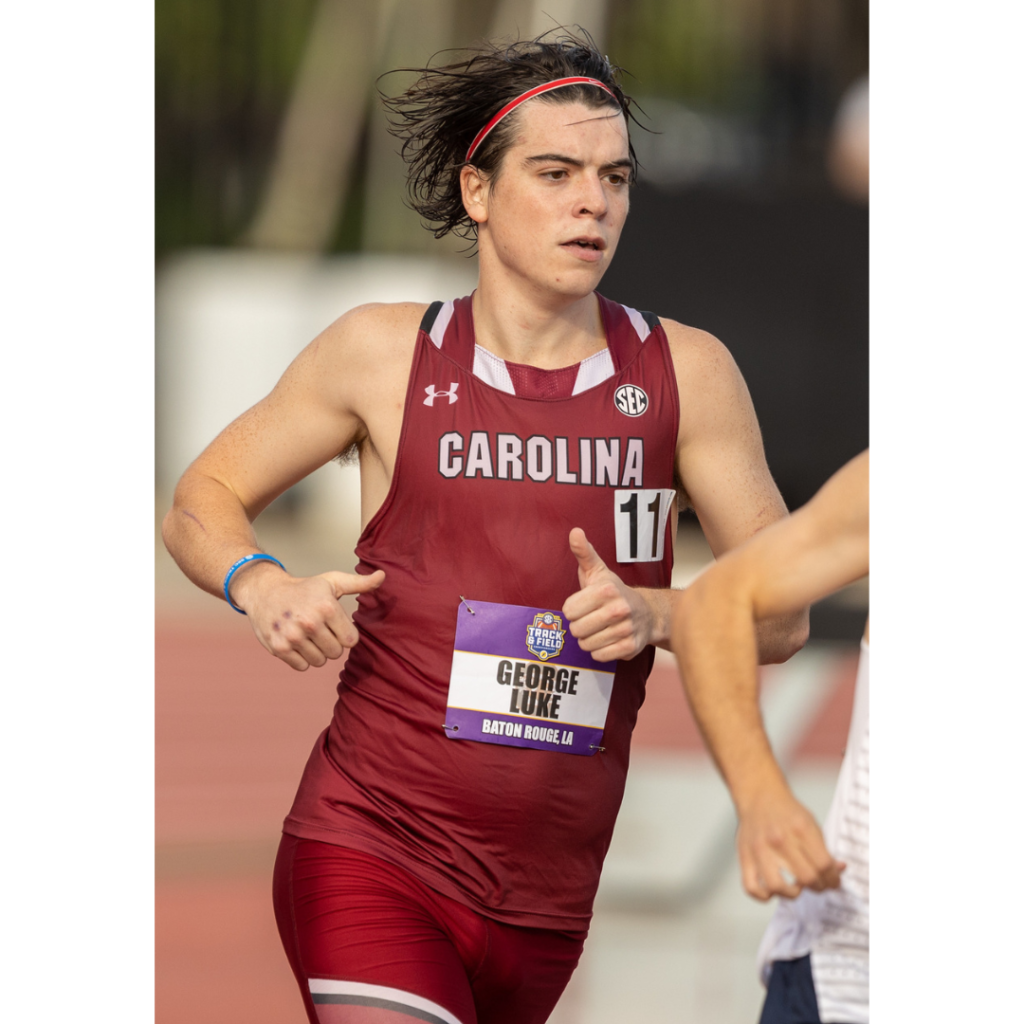
George Luke, a senior on the University of South Carolina Men’s Track and Field Team hailing from Clinton, Connecticut, recalls beginning his running journey at the onset of high school with the inspiration kick-starting from his parents, both collegiate track athletes. Upon completion of a successful high school cross country and track journey at Xavier High School, the start of Covid-19 impacted his college trajectory. Luke chose the University of South Carolina for the likely ability of walking onto the men’s team, where now as the only senior within the group, he’s focusing on the 1500 meter event. Luke discusses training with the team as well as training during summers spent in Connecticut and the Denver and Boulder areas of Colorado. He also touches on his future within the sport and how injuries have impacted his running journey.
“So I really couldn’t say where I’d be without running, ’cause it’s basically shaped my entire path at this point.“
Date: January 29th, 2024
Keywords: Running | Columbia | Connecticut | Colorado | University of South Carolina | Cross Country | Injury | Training
Hannah Clark: This is an oral history interview for the South Carolina Honors College thesis project, More than the Mileage: Finding Community and a Sense of Place through Recreational Distance Running, documenting the perspectives and experiences of recreational distance runners. This is Hannah Clark, the date is January 29th, 2024, and today I’m interviewing George Luke virtually via Zoom. We are both in Columbia, South Carolina. George, would you start by giving me your full name and spelling it for me?
George Luke: Yeah, my name’s… middle name too?
HC: No, just first and last is fine.
GL: Okay. Yeah. George Luke, G-E-O-R-G-E L-U-K-E.
HC: Perfect. Thank you. All right. We’re going to start with some background. Where were you born, and if different, where do you currently reside?
GL: Yeah. I’m from Clinton, Connecticut, and now I currently live right here in Columbia.
HC: Perfect. Thanks. Do you mind telling me a little bit about your family?
GL: Yeah, I’m the oldest of four. I have two younger brothers and a younger sister. And then, yeah, my parents, my mom’s from Maine and my dad’s from upstate New York originally, and they were both, both athletes, track athletes when they were in college too.
HC: Nice. So I guess building off of that, how long have you been a runner and what, or who, inspired your start into running?
GL: Yeah, I guess technically speaking, I’ve been running since freshman year of high school, so that’s four, eight years at this point.
HC: Okay.
GL: Eight years. And yeah, my dad, as I said, he ran for University of Miami, the U, and then after that, he was semi-pro in the marathon for a while, and so he started the kickstart. Yeah, he did really well in the marathon, qualified for the Olympic trials a couple times. And then my grandpa, he lives in Greenville, South Carolina. He has every state age group record from 65 up to 85 now in the 5K, 8K, and 10K.
HC: Wow.
GL: Yeah, and then we’re all George Luke, so I’m the sixth. My dad’s the fifth, my grandpa’s the fourth. So it’s kind of like just following in the pathway.
HC: Yeah. Wow.
GL: Yeah.
HC: That’s pretty cool though. Is your mom a runner or did this more come from your dad’s side?
GL: Yeah, well, she threw the javelin mainly in college. She had a brief little stint with some running, but no, it’s mainly from my dad.
HC: Okay, nice. Do you have a particular memory from your early experiences with running?
GL: Oh, geez. I’m trying to think here. I remember when I was before high school, when I was a bit younger, trying to go out with my dad on his morning runs and just get absolutely torched, but I’m sure what was for him, the easiest pace in the world. But I don’t know, once I started running more seriously, I remember this one race, I had just joined the cross country team at my high school and it was this local 5K, and I did what I thought was okay for myself. I think I ran 20:30 maybe, I can’t remember exactly, but I remember my mom was looking at the results and we were looking at some of the other teammates on my team, and this one kid absolutely torched me. He ran 16:30 or something and she was like, yeah, he’s another freshman. And I couldn’t believe that he was another freshman, because I was like, ‘there’s no way. That’s impossible. How can he be that faster than me?’ And now we’re best friends. So he runs for Notre Dame now. But yeah, I guess that’s a big one, I remember.
HC: That’s funny. You’re like, who’s this kid? And then it turns out, yeah…
GL: Exactly.
HC: …and someone exactly your age.
GL: Yeah.
HC: So obviously it’s pretty cool that you have this family history with running. With your dad in particular, if you don’t mind me asking, how has that relationship progressed? Has he been a coach figure in your life as well? How has that really developed, I guess?
GL: Yeah, it’s interesting. He’s been pretty hands off with it all. I was lucky enough- my coach in high school was amazing, so he’s been pretty hands off. I guess the biggest thing is, especially more in high school, I don’t need it as much now, but trying to motivate me to get out the door on days where we didn’t have practice. But I think the biggest thing, yeah, he was more of a long distance guy, like 5K, 10K, and then marathons and stuff after post-collegiate at least, so we have a bit of a difference in event types, but I think the biggest thing is, just is injury advice. I don’t get injured too often, which I’m thankful for, but whenever I do, he’s someone I usually try to go to because he just for some reason knows everything on every type of injury. So he always has a good stretch. It was funny, I think three winters ago, I was dealing with this knee problem, and it didn’t bother me for about a month, and I was asking him about it because I couldn’t figure out anything, and he gave me three stretches and within a week it had cleared up and I was like, [I] should have done this a lot sooner, but, but no, I guess, yeah, it’s just always nice to have someone that has similar experiences because I don’t want to sound, I guess cocky here, but there’s a very big difference between training at a high level compared to just going out for a three mile jog every other day. So it’s good to have someone with that sort of experience to, I guess, compare stuff to.
HC: For sure. That makes sense. Someone who’s gone through it before and…
GL: Right, yeah.
HC: …same wavelength with it. So can you tell me about the group that you run with?
GL: Yeah, it’s interesting. It’s funny you ask this now. This year it’s changed so much because it was funny, I saw something the other day and was like, ‘oh, if I could go back to when the track team was like this.’ And it’s weird being a senior, all the people that I grew up with, or well not grew up with, but used to run with are basically gone. I’m the only senior guy on the track team right now.
HC: Oh, wow.
GL: Yeah, which is weird. I came in as a walk-on, and there were four other, three other guys that were also, I guess it would’ve been our sophomore year, and so they’ve all since gotten cut for one reason or another. So it’s weird being the last one remaining. And the whole team culture has also changed with the new head coach and everything, and some of the freshmen we brought in. But yeah, right now the main training group is myself and then two freshmen and a sophomore. Well, I guess the sophomore kind of just got injured, and then a couple foreigners depending on the day. It’s really mixed up with how it works right now. The training groups, it’s basically who has time between classes, but right now I guess, yeah, the mile group is myself and then two other freshmen. So it’s been interesting, I guess mentoring them, kind of. And yeah, lately we just got a guy from Kenya, Joshua, and so it’s been fun to, I guess see how he’s liking things, making sure he is moving in well, adapting well and stuff. And he’s a great guy too, so.
HC: Definitely. So seeing yourself kind of go through the years on the team and then now it’s the final year. Yeah. And just for the record, what is the official name of the team that you run on?
GL: Yeah, the University of South Carolina Men’s Track and Field team.
HC: Perfect, thank you. Thank you. What events are you running? I know you said the mile. Is that the one you’re focusing on?
GL: Yeah, I’d say my main focus is the mile, 1500. I think I opened up this past week. So yeah, now that the indoor season started, we opened up with 1K just to try things out, and I think this weekend I’m running an 800 for a little speed, but my ideal event range is, yeah, 1500, mile.
HC: Got it. Got it. I guess moving, shifting a little bit more individually, can you describe to me how you feel when you run?
GL: That depends on what I’m running. [If] it’s just a nice, easy jog, it’s not too bad, but [if] it’s a workout, it can be interesting. I never really thought about that too much. I guess relaxed is a good way to put it because when you’re running, you’re only focusing on the running sort of, so you can just ignore everything else and just have a nice little hour session to yourself or something like that, I guess. Or relaxed is probably the best way to put it, which sounds weird, ‘cause you’re like, running hard and everything.
HC: That makes sense. I get it for sure. And how, if at all, does this emotion change when you run in a different place? Say like your hometown versus where you’re currently living or someplace new?
GL: Oh yeah. Well, Columbia does not have the best places to run, so it’s always good to get out. I think at least when I go back home, or go back to- because my high school was 25, 30 minutes away from where I grew up, so I would drive up back up to high school for a lot of my runs, it’s a lot more sort of nostalgic, kind of just remembering those old routes and going on them. And now we all have GPS watches, so we’re looking at some of them and it’s like, yeah, we used to call this eight miles, it’s six and a half. But, then I’d say I’m pretty fortunate to be able to travel a lot and whenever I get out to travel, it’s always awesome to explore. This past winter I was in Europe, and I think one of the things I like best about running in another country as you can actually see some of the, I guess behind the scenes stuff, not stuff where a normal tourist would see, which is super cool. I was like, one example, we were in Lichtenstein of all countries and I went on this just casual six mile run, ended up being three miles up a mountain, but you get up top and there’s this little village up there with a nice brewery and all these- and just this great view of the Swiss Alps and everything. It was beautiful and it’s like one of those things you’d never see if you were just experiencing the place as a tourist. So yeah, I’d say when traveling it’s more of a, either, if I’m going back home, sense of nostalgia, but if I’m going somewhere new, excitement, I guess to just explore. Because I think that’s one of my favorite things about running is exploring new- being able to explore new areas.
HC: Definitely. And like you said, in a way that you might not be able to have had access to.
GL: Yeah, exactly.
HC: No, thank you for that. Kind of in a similar vein, how do you feel connected to your surroundings when running?
GL: I don’t know. I mean, I guess it’s nice when the scenery’s a bit better than around the city of Columbia. It’s nice to just sort of look out and take stuff in. It’s funny, we were on a run, [this was] probably a few weeks ago at the river, the Riverwalk [park in the city of Columbia] there on the Columbia side, not the Cayce side, and we were talking because we hadn’t run there in months. Our coach just had to stop going there for whatever reason. And we’re like, when you’re not running here every other day for practice, it’s actually kind of nice. So it’s interesting when you’re running the same route, it can get a little boring, but when you experience something for the first time or again for [a newer] time, I guess [it] just makes you appreciate it all for sure. Yeah, I don’t know.
HC: No, no, that totally makes sense. You’ve kind of touched on this talking about your training group, but can you walk me through your feelings when you run alone compared to running within a group or a larger team, I guess?
GL: Yeah, it is different. I think I know all of my teammates absolutely hate running alone because when you’re with people, it’s so much easier. You have people to talk to, you have just other people there with you to keep you going and stuff and give you some sort of motivation. But I think I am, I guess, lucky in the sense that it would’ve been from basically the start of Covid until I joined the club team, where I was just running alone. So that was probably at least a six, seven month period, and so I kind of got used to being able to get out there by myself and get after it. I mean, I’ll listen to music here or there, usually more here than there, but it is nicer to sometimes just be, I guess alone with your thoughts. I know I don’t usually do this, but one thing when I’ve talked to my dad about it, is he likes, especially on a Monday morning, say, when he goes out, he gets up wicked early, like 5:30 in the morning to go for his runs, but he hates running with music. He likes to just be there, think about his week, plan stuff out, plan out his day, and it’s just sort of a time for him to, I guess reflect on everything. And I appreciate that myself sometimes where, say there’s something I need to get off my mind, I’ll just say, ‘hey, I’ll just go for a run.’ And that’s usually a good way to just either A, think about stuff logically or B, just forget about stuff and enjoy the moment temporarily.
HC: For sure, depending on which one you need, you know.
GL: Yeah, exactly.
HC: No, definitely. This one’s a little more abstract, but how would you describe what running means to you to a non runner?
GL: I mean, the first thing I usually go is when people say, I can’t remember that- ‘if I like running’ or whatever, I always say I hate it, which is weird to someone initially thinking, but I’d say, I guess the best way is it gives me a sort of purpose, I don’t know, which is weird. Yeah. (pauses at 17:02) How do I phrase this? I don’t know. But I like- my favorite part about running is the training aspect. I don’t really like the running aspect, but I like having something to train for, and so I guess it gives me a constant goal to always be reaching at, and that’s what I like. I mean, yeah, it gives you some sort of purpose where you’re not just sitting around all day going to class then, but yeah, there’s always something out there for you kind of chase after, which I like.
HC: Yeah, for sure. And then you mentioned this, just with Covid, and how that impacted your personal running journey. So I guess in total, how did the pandemic affect how you approached running or I guess your running career, so to speak?
GL: Yeah, that was really interesting. I was coming off of a really good senior indoor season. I was like, state runner up in the 1K and stuff, and if I continued on the trajectory I was going, I wouldn’t have had a problem running at any colleges, well, specifically here I guess, but then Covid hit, so I didn’t have that senior outdoor season. I think there was only one team that was of the schools I was still considering that I would’ve been able to join, so I really had nothing. So for that first month, it was like, well, for the first couple of weeks when we weren’t sure how long it was going to take, I was still training. I would meet up with a couple of my teammates sort of on the down low and we’d get in some good tempo sessions or something. Then after that, I remember texting my coach, telling him, ‘It’s weird, I feel like I don’t have a purpose right now.’ I didn’t know where I was going to be going with running. I didn’t have a goal. So at first it was just weird trying to find a reason to keep going. But then I guess, more towards the turn of the summer, I guess May, I was kind of like, well still- once I knew I was coming to South Carolina, I was like, ‘well, I have to walk on at this point.’ So then that shifted to me to be like, alright, time to start training for that. And then I finally get to campus, and I emailed the coach at the time, Coach Alden, and he is like, yeah, we’re not having tryouts because of the pandemic or because of Covid and all that. I was like, ‘well, now I have to wait a whole ‘nother year.’ So at first that really sucked. I was like, ‘can I really do this for a whole ‘nother year, training by myself and everything?’ But then it worked out. I joined the club team and then it was all good.
HC: Yeah, so hit with some delays there, but…
GL: Exactly. But it all worked out in the end.
HC: Yes, exactly. And I guess this kind of goes along with that timeline or I guess what you were describing, but how has your relationship with distance running changed throughout your time participating?
GL: Yeah, I think definitely- I’d say right now, I’m probably, I guess loving it the most I’ve ever loved it. And part of that comes with just being better, I guess. If you’re better at it, you’re going to like it more, seeing these better results, and it’s more enjoyable, because in high school it was impossible- if we didn’t have practice that day, it was about a 5% chance I was actually going to go for a run.
HC: Oh yeah.
GL: But now I almost planned my day around like, ‘all right, when am I going to run?’ Yeah, no, definitely right now I’m loving it the most I ever have. I think the time I struggled with it the most was either right at the beginning of Covid, well, I guess a month into Covid, or it would’ve been summer of sophomore year, between sophomore and junior year, I had this internship and it was just far enough away from my house where a commute would’ve been annoying. It was like an hour and a half away, hour 15 [minutes]. So I rented this small one room apartment of this place, and I was living out there for the summer, and then I just come back home on the weekends, and some of the routes out there were okay, but overall it just sucked being alone, training out there, I was just miserable and I was ready for it to be done. I got the work in and stuff, and I honestly think those might’ve been the highest mileage weeks I was ever doing in the past eight years. But yeah, it sucked. And then complete juxtaposition to last summer when I was out in Colorado, ’cause that’s like, the running hub, Boulder out there. So I was loving life out there. Even though I was in a similar situation, I was living alone, I guess. Well, I was renting the third floor of some woman’s house, so she was kind of a roommate. But yeah, I was training alone and stuff, but it’s the location, and I liked my job a lot better than the one I had, so that helps. But the location made a complete difference in my, I guess, mentality towards it.
HC: Would you say that, just knowing that that was a supportive running environment kind of helped you get going? Were you able to make connections there, or just you liked the job, everything was better or something like that?
GL: Yeah, I think it was sort of the mindset I had going into it, because with the first summer, it was like I was going out there for my job, and then the running was just something I had to do afterwards. And so I’d have to, after work, lug myself. Also, that first job, I was at a desk on a computer eight hours a day, and as much as that- it just wears on you. And then, oh- (Zoom glitches at 23:44).
HC: Oh, sorry.
GL: There we go. No, you’re good. You’re good. And it just wears on you. And so it was tiring and hard to get out for a run later that day. But the second summer, I was going out there with the purpose of running, and then I just got an internship on top of things just so I could have an income and stuff. So I think, yeah, I didn’t run too much with other people. There were a couple, one-off times where if someone was starting at the same time as me at the same place, we’d jog together. But the community there, yeah, it’s great. And you’ll always see people when you’re running, which also kind of is nice, because it’s like you might not be running with them, but someone else that’s out there doing the same stuff as you. My very last long run, when I was out there, I was up on Magnolia Road, this really famous long run spot up there, and there were a bunch of guys out there from other schools, Princeton, Brown, Miami [of] Ohio, Drake. And I got asked- because I started an hour [later], I’m assuming they all started at 9, I got there at 10:15. So I started, I was seeing all of ’em as I was starting and they were ending. They were all like, ‘oh, join us.’ I was like, ‘I would, but I still have another six miles to go out that way.’ But yeah, no, I mean the community out there is great, and it definitely does make a difference.
HC: For sure. If you feel comfortable answering this, how has distance running impacted your mental health, if at all?
GL: Yeah, I think this is actually, this is part of the reason why I wanted to do this, because I feel like one of the things you always hear about- one of the biggest things to improve your mental health is go out and work out or do some sort of exercise or something. And it’s been weird for me, because there’s always, I guess the dopamine hit afterwards or whatever it is, I don’t know the exact science. But it’s been interesting, ’cause it’s almost like I do it every day, so at this point, it’s normal. And I definitely feel worse if I don’t run, because then it’s sort of like, ‘oh, you just wasted your day, what did you do?’ So it is nice to do something to feel like you’ve accomplished something. But I’ve also noticed- I’ve started lifting a lot more, at least than I had been, and outside of the normal team lifts and stuff, and I feel, way, I guess, better, after a good lift than I do a good run. I don’t know if that’s just because I’m running every day, so at this point it’s normal for me, or if maybe there’s, I don’t know, some other thing to it. I don’t know the exact answer, but I guess at the same time, after a really good workout, you feel amazing. So I don’t know, but I guess I had said earlier how it’s sometimes nice to just go for a run when you need to get something off your head. And yeah, I do that so much if there’s something bothering me or, yeah, I don’t know, it is always nice to just be able to go out there and either think things over or just sort of rationalize stuff with yourself, or even just forget about it for 45 minutes, an hour. But then also, what was it, last November, November 2022, I was injured for a month and a half, and that absolutely killed me that I couldn’t be out there running. There was some other stuff into it, but yeah, it was actually kind of interesting how much it actually did affect things I noticed. So I don’t know.
HC: No, yeah. Thank you for walking me through that, and that kind of leads me into another time. If you don’t mind digging into that, how was working through that injury for you, from the moment you knew that you might be out for a little bit to working towards recovering?
GL: Yeah. Let’s see. Let’s see if I can remember exactly. So I remember for a week or so, I had been having foot problems. It was a problem with my foot, and I think the trainers officially diagnosed it as just tendonitis, but it didn’t really have the same exact symptoms as tendonitis or anything, so they couldn’t quite figure it out. So initially for a week or so, I had been having foot pain, and then we were doing a workout, I get through half of it, and I’m just like, ‘I can’t, can’t anymore.’ So I go see them. And then basically for the next month or so, I was just in the trainers every other day doing foot exercises to try to rehab it. And nothing was working, which was really annoying. Nothing really worked until they started- they gave me some anti-inflammatory drugs or whatever, and that helped things a little, but all in the meantime, it was weird. It felt like when I wasn’t running or anything, it felt like I didn’t really have a purpose or anything. So I was just held up in my room a lot. And that’s another great thing with running, is it forces me to get out the door, start my day, especially because we have practices in the morning. And then it wasn’t until I remembered my sophomore year of high school also having another foot problem, and my trainer back then made this small little custom insert out of some foam to put under my foot, I can’t remember exactly what the purpose of it was. And I found that in one of my old track bags. I’m like, ‘Screw it. Nothing else is working. Let’s just try this.’ Cleared it up almost instantly. And I was like, that could have just saved me a whole month and a half of work. So yeah, then it was a couple weeks getting back into shape, and then we were ready to go again. So that was very annoying. And sometimes it’s like those funny things where it’s like, ‘wow, it was that simple of a fix,’ but…
HC: Yeah, and just the sheer luck that you found it randomly.
GL: Yeah, exactly. That too. That too.
HC: Wow. Well, I’m glad that you were able to get back into it after that and get things going again. I guess this can be, again, something big or small, but could you tell me about a time that you felt proud to participate in a running group or organization, this team or one from the past?
GL: I’m trying to think. I mean, probably my- I know my, oh, I think my favorite moment, no, maybe not my- I don’t know. One memorable moment from high school was we had just won- well, so it was my sophomore year, and we had our best team in however many years, and we had won states. And then the way it works in Connecticut, because you have states, it’s like, I guess, wait, remind me- are you [from] South Carolina? You’re from South Carolina?
HC: I’m from Ohio…
GL: North Carolina? Oh, that’s right. Yeah, yeah, yeah. Sorry, sorry. I can’t remember how Ohio does it, but you know how South Carolina has 5A, 4A, 3A [high school athletic divisions]?
HC: Yeah, yeah, definitely.
GL: So we have sort of like that S, SS, ML, LL, whatever. So we won Ls, we won states, and then after that, they combined the top X amount of people from the different sections into the state open. I’m trying to remember how it went. Oh, okay. So no, actually we lost Ls, because there was this big fall, like 400 meters into the race, three of our guys got caught up into it…
HC: Shoot.
GL: …the entire race was a bust after that. We lost Ls to our in-state rival Staples. Come back, it’s the state open, we beat them on a sixth man tiebreaker. It was like the sixth, our sixth guy was 66, the others’ was 67. It was that close. And then, so we’re going into New Englands, the New England Championship. We hadn’t won this race since ’90, ’96, ’97. It had been over 20 years. And I was injured at the time. I was supposed to be an alternate, but I had gotten injured. I sprained my back or something, the stupidest [thing], but I still went up with the team to Belfast, Maine. It was like 10, 15 degrees out. It was freezing. And I remember after they- because it was a tight race, we weren’t sure exactly where things had shaken out, and they post the results on this big board. There’s this whole group of people around, and I look and I see Xavier, CT right at the top, and I immediately started jumping up and screaming, but I was in a crowd, and some people were like, ‘whoa, whoa, whoa,’ trying to get me to calm down. So I sprint out the crowd and sprinted up to my coach, and I was like, ‘we did it.’ And yeah, that was awesome. That was an awesome feeling. I think that might be- thinking back on everything, because we won, I think two, three state championships, two state opens, New England’s NXR, I think that might be my favorite memory from winning a state championship in high school.
HC: No, that’s awesome. That feeling of, you know, waiting for the results to come in, and from a sixth man tiebreaker? That’s crazy. That’s so cool.
GL: Yeah, no. That was awesome. I think actually, yeah, the shirt I’m wearing is from a commemorative shirt from that year.
HC: Look at that, just for the occasion.
GL: I know.
HC: This is one of my last ones, but, this might be hard to think about, but how do you foresee your running career or journey changing or adapting as you move into the future?
GL: Yeah, I have no idea. I know at the start of this school year, I have one more year of eligibility for NCAAs. And so my plan was, I was going to see where I run or what times I run this season and then go from there, see if I want to use that fifth year or not. Now I’m kind of ready to be done with school, so I don’t quite know if I’m going to be going to grad school or not, but I definitely want to keep training. How far I’ll go, I’m not really sure. I mean, I guess my ultimate goal, I want to be able to try to break four [minutes in the mile] someday. I think that’d be pretty cool. Will I get there? I don’t know. We’ll see. But I definitely want to try to keep training pretty, at a pretty competitive level, at least these next couple years out of college. And as I said, I’m moving back out to Denver, so, I’m going to be in a good spot to be doing it. And I know there’s loads of people that [are] out there post-collegiately that are still training and enjoying it. So I think, yeah, because as I said, I really like having something to train for. I don’t care so much about the running, but the training aspect is what I like doing. Doing some good track workouts or getting in some good speed sessions and stuff like that, and then seeing how it translates all into a race is always awesome. So I think that’s the immediate plan right now, no marathons or nothing, but, I don’t think I’ll ever do a marathon, maybe one just to say I’ve done it, but that’s about it, not my thing. But I definitely [would] like to keep training. I mean, as I said, my grandpa’s 80, let’s see, 84 right now, and we both just ran the Greenville Turkey Trot together a few months ago. So, I don’t know if my body will last that long. But yeah, I definitely, I want to keep competitively running for as long as possible.
HC: For sure. No, that’s awesome. I guess overall, how would you say running has impacted your life?
GL: I don’t know where I’d be right now without running. Between (pauses at 38:06), I mean, the high school I went to, so it was a private school, it wasn’t my town’s public school. And part of the main reason was just because their academics were infinitely better, our public school wasn’t the greatest with stuff. But also because my parents, I guess whether I liked it or not, they forced me to sort of run in high school. And my high school’s team was way better than my town’s team too. So that sort of kickstarted things, that made me, I guess, go to the high school I went to. And then from there, I mean, I pretty much chose South- when it came down to choosing my final few schools, one of the reasons South Carolina stood out was because I knew I had a chance to walk onto the team here. So then, yeah, I chose my college because of running, and now it’s like, it’s such a big part of my life, and I guess [my] personality, is sort of like, ‘yeah, I run’, so it’ll be interesting to- and then from there, I went to Denver, to Boulder, because I wanted to run over the summer, I wanted to altitude train, and now the internship that I had, that [was] over the summer, they gave me a return offer, and I’m going to be working at an amazing company out there. So yeah, it’s kind of crazy how that’s all worked out. So I really couldn’t say where I’d be without running, ’cause it’s basically shaped my entire path at this point.
HC: Yeah, no, that’s awesome. That’s all I really have, unless you have any closing thoughts, but I appreciate you, you know, giving me these stories and your time today through all of this. It’ll be very helpful, so I appreciate it.
GL: Of course. Yeah, for sure.