Keywords: Running | New Jersey | Culture | University of South Carolina | Running Club | Marathon | Community | Cardiovascular Health
Hannah Clark: This is an oral history interview for the South Carolina Honors College thesis project, More than the Mileage: Finding Community and a Sense of Place through Recreational Distance Running, documenting the perspectives and experiences of recreational distance runners. This is Hannah Clark, the date is February 13th, 2024, and today I’m interviewing Javier Rodriguez, virtually via Zoom. I’m in Columbia, South Carolina, and Javier is in Salamanca, Spain. Would you start by giving me your full name and spelling it for me?
Javier Rodriguez: Yeah. My name is Javier, J-A-V-I-E-R Rodriguez, R-O-D-R-I-G-U-E-Z.
HC: Awesome. We’re going to start with some background first, how old are you?
JR: I’m 21.
HC: Where were you born, and if different, where do you currently reside?
JR: I was born in northern New Jersey, and I still live in northern New Jersey, but just a little bit more south, around Newark area.
HC: Got it. Tell me a little bit about your family.
JR: Let me see. Well, my dad grew up in New Jersey as well, and he went to West Point, so he has always been pretty athletic, I would say always big on teaching us how to hike, and do other outdoor activities, surfing, hiking, anything like that. My mom was also- grew up in Syracuse, New York with 11 siblings, so a big community there, especially a lot of soccer playing, so she was definitely involved in our childhoods, helping to encourage us to play soccer, although she didn’t really participate as much. And then among my family, I have four siblings, and I would say that all of us are pretty athletic. My little brother tried out for a soccer team in Europe once, and my older two siblings are- one of them did a marathon before me, and the other one is more of a weightlifter.
HC: Cool. What is your current role or occupation?
JR: Well, currently I’m just in a transitional period I guess, but I’m set to begin medical school in this fall, and yeah, I’ve just graduated a few months ago, so right now I’m kind of chilling.
HC: Well, congrats. All right. Now into the running portion. How long have you been a runner?
JR: I would say I first started running back in middle school, let’s say for just a couple times every month maybe, but when I really started would have to be, I think 2017, I believe it was, when I started running cross country for my high school.
HC: If you remember, what or who inspired this start into running?
JR: Well, to be fully honest, I feel like I was always decent. I hadn’t really tried it very often before, but it ultimately came from a suggestion from my parents. I think it’s important to have athletics in your life, both as a way to stay healthy, as well as to- I’m going to be honest, it was also a résumé builder for college, and I was not really- I had played soccer a lot, but I was not athletic or really skilled, talented enough to get onto our local soccer team, so I joined the cross country team.
HC: Makes sense. Can you describe a particular memory from your early experiences with running?
JR: Wow. To be fully honest, I think that just cross country in general is a very- it’s certainly a unique culture. I feel like a lot of the students were like me, almost, I don’t know, that makes it sound worse, but not necessarily that it was their own idea to join. And so for that reason- I mean obviously I kept with it, but there’s this kind of culture of suffering a little bit. There’s also different groups. There’s the kids at the very top, they’re the ones on varsity every time, always dropping new PRs [personal records], very impressive I will say. Then there’s a couple other groups, there’s a middle one with the decently fast kids, but don’t really care as much, and then the really slow ones. I was generally in the slower area, to maybe near the end I got into the middle area, but I would say, there’s a lot of complaining and a lot of shared suffering almost. So you have a hard workout and that’s what you’re talking about a lot.
HC: Definitely. Do you remember the shift for you where it moved from, maybe that culture of suffering, to something you enjoyed?
JR: Yeah. Honestly, for me, it was starting up back again. Well, although I do talk about this culture of suffering, it’s not as bad as I’m making it sound. It’s almost like- how to describe it? It’s almost like type two fun, I would argue where maybe in the moment you’re having a tough time, but you look back on it and you think about how fun it is, or it’s just a shared bond, really, just like army training or something. It’s very tough, but then at the same time it’s like, ‘wow, I really got very close with friends.’ But when it started to become more of my own volition, I think that’s when it definitely changed, and that would have to be, I think, 2021, starting running again, just kind of shifted more from something that I’m required to do, to something that I wanted to do just for myself.
HC: If you have one, tell me about the group that you run with or the most recent group that you’ve run with.
JR: Yeah, so I would have to say, I think that would be the Gamecock Cross Country Club. It’s a pretty good group, and I think it’s, well, I must say much less of a culture of suffering, almost as I was calling it before. I would like to say that everyone there is there because they really want to be there, and there’s a lot less complaining overall as well. So I would say it was a pretty good group to run with, because one big problem about running sometimes is that it could get a little boring, a little lonely, if you’re running every time alone, and so having a community there just helps you to cope better, to keep going and to stay consistent with your runs.
HC: No, definitely. Can you- well, let’s go with this first. How do you feel connected to others when you run in a group?
JR: Well, first of all, I feel like, as I was describing before, that type two fun, that’s automatically there. Obviously, it’s not exactly miserable, but it’s like you’re doing this difficult thing together, so you really feel connected through that bond of, not suffering, but just of effort really. That’s definitely a big thing just by running, you could be running in silence, and you still kind of feel that connection, because running next to other people who are in a similar place to you, that they both want to do this and they are doing it, despite how it could be a little bit difficult. And in other ways, I mean, you just get to have full conversations with the people around you. I can remember doing that, especially in cross country, we’d be just trading stories, talking about whatever is happening in our lives, or whatever random little fact we had about ourselves. I think that especially- a lot of that is just to get away from the monotony, but it really helps you to connect yourself with the rest of the running community.
HC: Definitely. Can you describe to me how you personally feel when you run?
JR: Okay. Well, recently I’ve been suffering with a muscle injury or something, but for the most part, I would say once you’re in the groove, it’s really perfect. You kind of get that runner’s high a little bit. I don’t know. I think that one of the biggest things nowadays is that we’re often inside for a large portion of our day, especially in university, ’cause I mean, you go into classes, you go home, you do homework. That’s really it. I think for me, one of the things I like the most about running is getting out into the fresh air, and so you’re almost guaranteed that for 30 minutes, an hour every day. So I would say it gives you a little bit of a runner’s high. Yeah, I mean, it depends on your pace, of course, if you’re doing a workout, you’re not going to be thinking about much else except that one lap, but for the average run through the neighborhood, say you’re just kind of experiencing your own little solitude, thinking about whatever, through- with other people, just kind of blissfully in the moment, but also communicating. I don’t know. It feels very freeing, I would say.
HC: Going along that- getting outside and that fresh air point that you spoke to, how do you feel connected to your surroundings when you run?
JR: (Pauses at 11:20). I would say, well, first off, running could be just such an amazing way to discover an area. When I first moved to my new house for last semester, it was a great way to find out what’s nearby, what parks, how far I really am from different things. So that could be a great way to feel connected, but you just- I don’t know, maybe it’s part of the fresh air thing, but you’re just, you’re in there, it almost feels a little surreal, just experiencing everything in that first-person view, running along, there’s cars driving by you, you see the people, you run past the park, you see the kids playing or the, I don’t know, the disc golf course. I think sometimes, especially you find a new site and you can’t help yourself, you have to go back there every time, and you could just kind of look out and you’re like, ‘damn,’ like yesterday, I went out on a run here and I found this, I would’ve never found it otherwise, but I found this giant just field, of not entirely sure, some kind of little crop, but it’s just, I don’t know. It feels very freeing. You’re kind of out there and I don’t know, you’re connected to the ground.
HC: No, yeah, I get it. Well, I guess in that sense, if this applies, how do you feel when you run in your hometown compared to a new place? I guess that kind of ties into the last one.
JR: I would say you definitely- of course, everything’s a lot more familiar, so I think in that way, sometimes you could get a nostalgia from running around your hometown. I know when I usually run around my hometown, I’m thinking about things I’ve done on this street, or when I was driving down here a couple of years ago, so it could sort of help your mind to wander, just to think about different people in places that you know. Whereas- and I would say that a familiar place allows your mind to wander a whole lot more, ’cause you’re not really thinking about where you’re going, you’re almost on autopilot. When you’re in a new place, you got to focus a little bit more, think about where you’re going so that you don’t get lost or caught out way too far. Although- so your mind won’t be wandering quite as much in a new place, but it’s still, since you haven’t been to wherever running and wherever before, it’s much more of a stimulus, just a bigger stimulus in general. Almost sensory overload, because seeing everything for the first time, and it’s like there’s so much sensory information coming in, that that’s what you’re focusing on, more than any other thoughts.
HC: Definitely. How would you describe what running means to you to a non runner?
JR: I mean, I want to say something, like, really cheesy, that it’s a way of life, which I would say that’s pretty accurate. But yeah, I try to do this all the time, I’m always trying to proselytize and convert people to the ways of running, but it can be a little bit difficult. But I would say it’s almost like, it’s very often, I would say a ‘healthy introspection’ type of activity. It’s good to get away, kind of- if you’re going alone, be alone with your own thoughts, just experience the outdoor world, without all this- although I was talking about sensory overload from new environments, it’s a lot healthier to have that than to have the sensory overload coming in from Instagram, TikTok, all the different apps on your phone. Yeah, I guess you could- I don’t know, in some ways you could call it sort of an addiction, I wouldn’t really go that far, but I would say that on days when I’m not running or exercising, I kind of feel that, almost guilt, like I got to be getting out there, like I haven’t done anything all day. So for that, I would describe it as a way, way of life. Yeah.
HC: You mentioned kind of that guilt if you couldn’t get out there, if you feel comfortable answering, can you walk me through a time where that affected your running journey or your relationship with running, I guess?
JR: I feel like it definitely keeps you coming back a lot more. I think the number one thing that causes you to feel that kind of guilt is just making it a habit. So, I can’t remember how many hours you have to do something before it becomes a habit, or how many times, but once it does, I feel like it really keeps you on track, and I think that’s pretty common for other runners. It’s just you run, and that’s what you do every day, or every other day, and if you get off that schedule, you feel guilty, like, ‘ah, I feel like my training is going downhill.’ I don’t know. I would say even just the past month, I’ve definitely felt that a good amount, still been recovering from the Kiawah Island Marathon back in December, and then I started running around New Year’s again, but then immediately got hit with some knee pain, and so obviously, I know that’s another thing, I know- I know that I have to, you know, lay it off a little bit, avoid that super strenuous running and then recover and come back even stronger, but sometimes it can feel very difficult. It’s just like, I want to get out there, I want to, I don’t know, feel the heart pumping, be out in the fresh air and just, yeah, take in everything.
HC: Speaking of a marathon, or your races in the past, can you walk me through the experience of training for an event like that, whether it was the marathon or something else you want to speak to?
JR: Yeah, I mean, honestly, I do feel like my training is a lot more, maybe informal, than a lot of other people’s. I know- well, seeing on Strava [running tracking app], people have their workout plans, and it’ll be three months in the future, or three months in the past, and they start there and they just go through with that. But for me, I feel like, I don’t know, just sometimes days can be inflexible. You can’t always do one workout on one day. Maybe you’re going out of town or have some kind of other engagement. I think it is a good way to plan, and to give yourself- or have that as a rough guideline, but I really didn’t do that, which is maybe why I got injured like a month before. But, my main thing was just trying to accomplish maybe a certain mileage each week. Slowly try to up that long run every week, and just kind of estimate what I needed and what I didn’t need. So I would take those hard days and then easy days, which I think is what most marathon plans do, but for me, following such a rigid plan was pretty much- well, I mean, I didn’t really try, but it felt too restrictive for me. I might consider doing it for the next race I have, which is a half marathon in May, but we’ll see.
HC: When you’re training, how do you prefer to, I don’t know, get those runs done? Solo, with a group, or a combination? What’s your go-to?
JR: Well, it definitely depends on my schedule. I think no matter what solo runs are going to be the- what is it? Not necessarily the easiest, but just the least restrictive. If you have a gap in your day at this time, then you could go then, you’re not reliant on any other people. And they can also be better in other ways, just so that you can make sure that you’re doing whatever pace you need to hit. If you have to be going fast, then if you go with other people, then [it] can be difficult. They might be going too fast, too slow. I mean, especially another thing for the Gamecock Club was that sometimes, I mean, I guess you could always do longer mileage, you could do shorter mileage too realistically, but at that point it doesn’t really make the most sense to wait until that time [for practice]. But the group runs will definitely keep you motivated a lot more. So for me, I tried to fit them in on those more easy days, or just on days where I knew I’d be able to show up. For me, it ends up being usually solo runs.
HC: That makes sense.
JR: And group runs, yeah, are just a nice luxury.
HC: This is more for historical context, but it might not apply ’cause I know you said that you started back up running in 2021, but if it does, how did the pandemic affect your running journey?
JR: Well, so I had just started halfway through my senior year of high school, so I was planning to finish off strong with spring track. I never did winter track, but I always did cross country and spring track throughout high school. So with Covid coming, I remember my first idea of being almost kind of happy, a little relieved, ’cause I always did prefer cross country to spring track, so I guess I was a little bit relieved there too. But when the pandemic first hit, I would say I was still running occasionally, maybe once a week. I would say after a month or two though, I probably, probably stopped running completely, which I guess is kind of the opposite of what you might want to hear about running (laughs). But yeah, it would’ve been good to keep going, I think, but instead I kind of just forgot almost, and then I forgot about it for a whole year after that.
HC: Oh, got it. And all answers are acceptable (laughs). Well, let me think. If you feel comfortable answering, how has distance running impacted your mental health, if at all? Or the other way around.
JR: I want to say, I think it’s definitely helped a lot. I feel like it is a very good time- I was talking about earlier with kind of a time for introspection. You get out there and it’s just a time to be disconnected from all those electronic things, everything. It’s just you, yourself and the environment around you. And I don’t know, I feel like it just gives you a lot of time to think by yourself, and think about whatever pops in your head. Sometimes, I don’t know, sometimes I have no clue what’s popping into my head. When I finished the marathon, I was like, ‘what did I just think about for the past four hours?’ But I think I can definitely remember specific times in my life where I’ve thought about different personal relationships with girlfriends or friends, like, ‘Oh, I don’t know. How did this date go? How could I try to resolve this thing with my family or my friend?’ So I think it is a great way to just give proper thought to all those things that are always on your mind, but you might be very distracted with homework, or with your phone. And then of course, I think the fresh air is just great to reinvigorate you. I know this, I guess this isn’t exactly as much my lived experience, but I know there’s also, of course, studies about how much mental health is improved by regular exercise, and especially cardio. And I’ve heard one thing that one of the biggest ways to prevent dementia, Alzheimer’s is to have been running, and have very good cardiovascular fitness, so I think that running really is a miracle drug for way more things than just cardiovascular health, including mental health.
HC: I agree. Thank you for that. Kind of back to the running group side of this, at any point during your running journey, can you tell me about a time you felt proud to participate in a running group or organization?
JR: Yeah, I feel like, yeah, unfortunately I didn’t get to go to the most amount of meets with the Gamecock Running Club, and I really do wish I had joined a couple years ago, honestly. But, when I think of that, mostly what I think of the most is back in high school going to cross country meets. It’s just such a common experience, the entire event, you all get pulled out of school super early, then you have to, I mean, for us at least, it was driving at least an hour, usually. And then although you’re there, you’ve just driven an hour, it’s like you still have five hours or something until your event comes on. Meanwhile, maybe you’re seeing other people’s events, or running around getting videos, shouting out times, and just trying to encourage your fellow runners. I think that those have definitely got to be the most community-building experiences. You’re all in it together, you’re all there freezing, or baking, trying to do homework on a tarp with no seats, and just finding anything to pass the time and supporting each other throughout it. And then also, of course, the marathon. I feel like that was another great experience. [I] definitely felt very bonded with the people around me, and I can’t lie, there was some, I can’t remember what song it was. I think it was, I don’t know if you know it, ‘That’s Just the Way It Is.’ You probably know that. I just remember that, that came on near the very end of the marathon, and I was like, ‘damn, this is really just…’ I don’t know. I feel like you’re part of something way bigger than yourself.
HC: For sure. Well, let me just think of how to phrase this. How do you foresee your running journey progressing as you move into the future?
JR: (Pauses at 28:33). Well, with medical school, I could see it becoming a lot more difficult to get runs in. But that being said, I still want to make it a very regular part of my routine, if not once every day, once every couple of days. I mean, it’s the only difficult thing about running sometimes, that it can be very difficult to find the time to fit in a run, especially if you’re training for something like a marathon where you have to get in a lot of mileage, and often slow mileage as well. But I could definitely see it- and I definitely want to continue using running as a healthy coping mechanism to increase my cardiovascular fitness, improve my times, especially. I mean, I’d love to one day Boston [Marathon] qualify, but I think I have a pretty long time before that. But yeah, I just want to keep practicing, keep improving my time, and I know that at a certain point, you can’t really improve your times, which is kind of a sad thing, but I’m hoping I have a few more years before that, and I want to continue that all throughout, to stay [healthy]. Running has also been a really big thing for me- just, well, honestly, one of the reasons I got back into running was I had a blood test, and then they said I had high cholesterol at the age of only like 19, 20, which is pretty surprising to me, but that was kind of like the kick I needed to get me out there and start running again to regain some of that fitness. ‘Cause yeah, I mean, cardiovascular disease is I think the leading killer in the U.S. now, so we all got to do our part to not succumb to that.
HC: Exactly. You’ve definitely touched on some of these points, but overall, how has running impacted your life?
JR: I would say it’s been very helpful to me both for, yeah, like I was saying, for combating stress, for giving me a healthy outlet to think on issues, explore my environment, and gain a sense of community from running groups, yeah, and overall just a healthier way to live to help out with the heart.
HC: Yeah. Well, that’s all I have for you. Thank you so much for taking the time to meet with me and answer these questions. Yeah, thank you for helping me out with this.
JR: Of course. No problem.
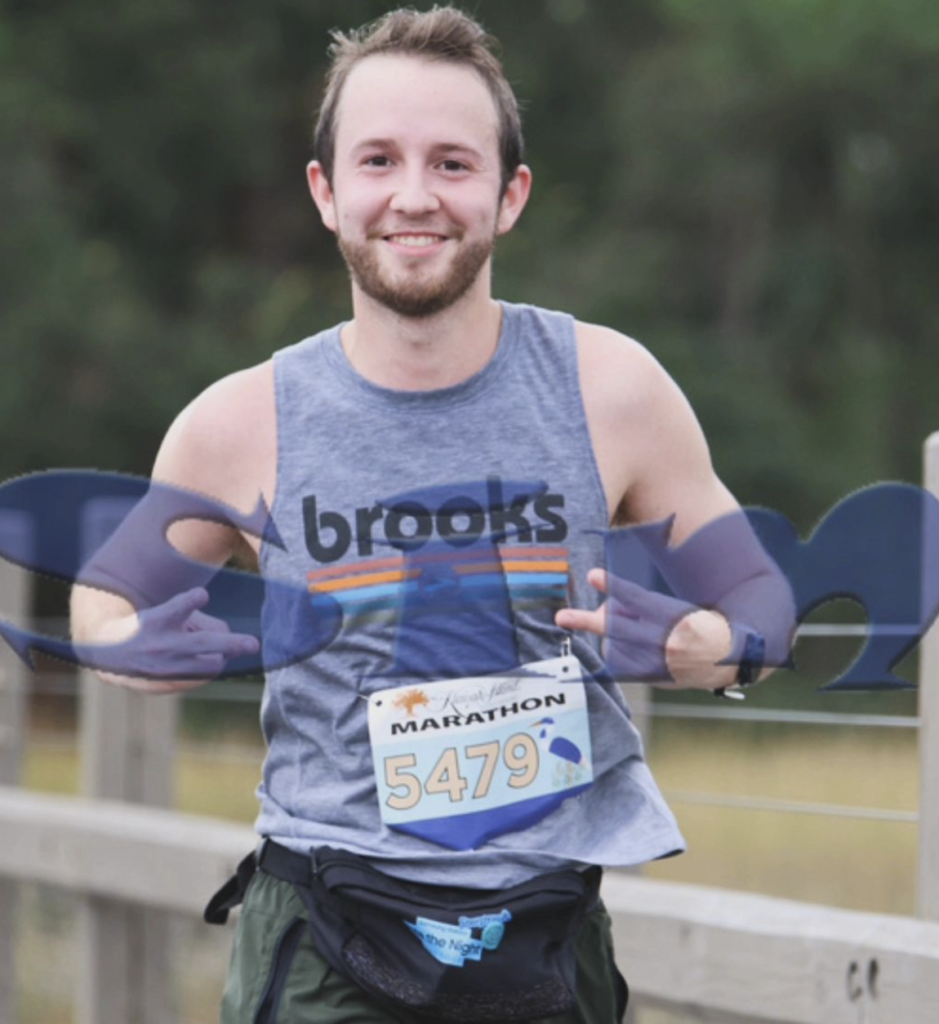
Javier Rodriguez, age 21, is a December 2023 graduate of the University of South Carolina starting medical school in the fall, and originally hails from northern New Jersey. In 2017, Rodriguez officially started running through high school cross country as a way to stay healthy and have a résumé builder for college, but more thought of it as a culture of suffering, or ‘type two fun.’ He found enjoyment for the sport again through Carolina Cross Country Club and running on his own terms, and discusses the stimulus that comes with taking in one’s surroundings while running. Rodriguez defines running as a ‘way of life,’ and talks about the unique connections made through running with others. He emphasizes how running serves as a time for personal introspection and has a great impact on someone even beyond cardiovascular health. He ends by reflecting on memories of being part of a community through high school cross country and his marathon experience, and highlighting a dream of being a Boston Marathon qualifier in the future.
“So I think that running really is a miracle drug for way more things than just cardiovascular health, including mental health.“
Date: February 13th, 2024
Keywords: Running | New Jersey | Culture | University of South Carolina | Running Club | Marathon | Community | Cardiovascular Health
Hannah Clark: This is an oral history interview for the South Carolina Honors College thesis project, More than the Mileage: Finding Community and a Sense of Place through Recreational Distance Running, documenting the perspectives and experiences of recreational distance runners. This is Hannah Clark, the date is February 13th, 2024, and today I’m interviewing Javier Rodriguez, virtually via Zoom. I’m in Columbia, South Carolina, and Javier is in Salamanca, Spain. Would you start by giving me your full name and spelling it for me?
Javier Rodriguez: Yeah. My name is Javier, J-A-V-I-E-R Rodriguez, R-O-D-R-I-G-U-E-Z.
HC: Awesome. We’re going to start with some background first, how old are you?
JR: I’m 21.
HC: Where were you born, and if different, where do you currently reside?
JR: I was born in northern New Jersey, and I still live in northern New Jersey, but just a little bit more south, around Newark area.
HC: Got it. Tell me a little bit about your family.
JR: Let me see. Well, my dad grew up in New Jersey as well, and he went to West Point, so he has always been pretty athletic, I would say always big on teaching us how to hike, and do other outdoor activities, surfing, hiking, anything like that. My mom was also- grew up in Syracuse, New York with 11 siblings, so a big community there, especially a lot of soccer playing, so she was definitely involved in our childhoods, helping to encourage us to play soccer, although she didn’t really participate as much. And then among my family, I have four siblings, and I would say that all of us are pretty athletic. My little brother tried out for a soccer team in Europe once, and my older two siblings are- one of them did a marathon before me, and the other one is more of a weightlifter.
HC: Cool. What is your current role or occupation?
JR: Well, currently I’m just in a transitional period I guess, but I’m set to begin medical school in this fall, and yeah, I’ve just graduated a few months ago, so right now I’m kind of chilling.
HC: Well, congrats. All right. Now into the running portion. How long have you been a runner?
JR: I would say I first started running back in middle school, let’s say for just a couple times every month maybe, but when I really started would have to be, I think 2017, I believe it was, when I started running cross country for my high school.
HC: If you remember, what or who inspired this start into running?
JR: Well, to be fully honest, I feel like I was always decent. I hadn’t really tried it very often before, but it ultimately came from a suggestion from my parents. I think it’s important to have athletics in your life, both as a way to stay healthy, as well as to- I’m going to be honest, it was also a résumé builder for college, and I was not really- I had played soccer a lot, but I was not athletic or really skilled, talented enough to get onto our local soccer team, so I joined the cross country team.
HC: Makes sense. Can you describe a particular memory from your early experiences with running?
JR: Wow. To be fully honest, I think that just cross country in general is a very- it’s certainly a unique culture. I feel like a lot of the students were like me, almost, I don’t know, that makes it sound worse, but not necessarily that it was their own idea to join. And so for that reason- I mean obviously I kept with it, but there’s this kind of culture of suffering a little bit. There’s also different groups. There’s the kids at the very top, they’re the ones on varsity every time, always dropping new PRs [personal records], very impressive I will say. Then there’s a couple other groups, there’s a middle one with the decently fast kids, but don’t really care as much, and then the really slow ones. I was generally in the slower area, to maybe near the end I got into the middle area, but I would say, there’s a lot of complaining and a lot of shared suffering almost. So you have a hard workout and that’s what you’re talking about a lot.
HC: Definitely. Do you remember the shift for you where it moved from, maybe that culture of suffering, to something you enjoyed?
JR: Yeah. Honestly, for me, it was starting up back again. Well, although I do talk about this culture of suffering, it’s not as bad as I’m making it sound. It’s almost like- how to describe it? It’s almost like type two fun, I would argue where maybe in the moment you’re having a tough time, but you look back on it and you think about how fun it is, or it’s just a shared bond, really, just like army training or something. It’s very tough, but then at the same time it’s like, ‘wow, I really got very close with friends.’ But when it started to become more of my own volition, I think that’s when it definitely changed, and that would have to be, I think, 2021, starting running again, just kind of shifted more from something that I’m required to do, to something that I wanted to do just for myself.
HC: If you have one, tell me about the group that you run with or the most recent group that you’ve run with.
JR: Yeah, so I would have to say, I think that would be the Gamecock Cross Country Club. It’s a pretty good group, and I think it’s, well, I must say much less of a culture of suffering, almost as I was calling it before. I would like to say that everyone there is there because they really want to be there, and there’s a lot less complaining overall as well. So I would say it was a pretty good group to run with, because one big problem about running sometimes is that it could get a little boring, a little lonely, if you’re running every time alone, and so having a community there just helps you to cope better, to keep going and to stay consistent with your runs.
HC: No, definitely. Can you- well, let’s go with this first. How do you feel connected to others when you run in a group?
JR: Well, first of all, I feel like, as I was describing before, that type two fun, that’s automatically there. Obviously, it’s not exactly miserable, but it’s like you’re doing this difficult thing together, so you really feel connected through that bond of, not suffering, but just of effort really. That’s definitely a big thing just by running, you could be running in silence, and you still kind of feel that connection, because running next to other people who are in a similar place to you, that they both want to do this and they are doing it, despite how it could be a little bit difficult. And in other ways, I mean, you just get to have full conversations with the people around you. I can remember doing that, especially in cross country, we’d be just trading stories, talking about whatever is happening in our lives, or whatever random little fact we had about ourselves. I think that especially- a lot of that is just to get away from the monotony, but it really helps you to connect yourself with the rest of the running community.
HC: Definitely. Can you describe to me how you personally feel when you run?
JR: Okay. Well, recently I’ve been suffering with a muscle injury or something, but for the most part, I would say once you’re in the groove, it’s really perfect. You kind of get that runner’s high a little bit. I don’t know. I think that one of the biggest things nowadays is that we’re often inside for a large portion of our day, especially in university, ’cause I mean, you go into classes, you go home, you do homework. That’s really it. I think for me, one of the things I like the most about running is getting out into the fresh air, and so you’re almost guaranteed that for 30 minutes, an hour every day. So I would say it gives you a little bit of a runner’s high. Yeah, I mean, it depends on your pace, of course, if you’re doing a workout, you’re not going to be thinking about much else except that one lap, but for the average run through the neighborhood, say you’re just kind of experiencing your own little solitude, thinking about whatever, through- with other people, just kind of blissfully in the moment, but also communicating. I don’t know. It feels very freeing, I would say.
HC: Going along that- getting outside and that fresh air point that you spoke to, how do you feel connected to your surroundings when you run?
JR: (Pauses at 11:20). I would say, well, first off, running could be just such an amazing way to discover an area. When I first moved to my new house for last semester, it was a great way to find out what’s nearby, what parks, how far I really am from different things. So that could be a great way to feel connected, but you just- I don’t know, maybe it’s part of the fresh air thing, but you’re just, you’re in there, it almost feels a little surreal, just experiencing everything in that first-person view, running along, there’s cars driving by you, you see the people, you run past the park, you see the kids playing or the, I don’t know, the disc golf course. I think sometimes, especially you find a new site and you can’t help yourself, you have to go back there every time, and you could just kind of look out and you’re like, ‘damn,’ like yesterday, I went out on a run here and I found this, I would’ve never found it otherwise, but I found this giant just field, of not entirely sure, some kind of little crop, but it’s just, I don’t know. It feels very freeing. You’re kind of out there and I don’t know, you’re connected to the ground.
HC: No, yeah, I get it. Well, I guess in that sense, if this applies, how do you feel when you run in your hometown compared to a new place? I guess that kind of ties into the last one.
JR: I would say you definitely- of course, everything’s a lot more familiar, so I think in that way, sometimes you could get a nostalgia from running around your hometown. I know when I usually run around my hometown, I’m thinking about things I’ve done on this street, or when I was driving down here a couple of years ago, so it could sort of help your mind to wander, just to think about different people in places that you know. Whereas- and I would say that a familiar place allows your mind to wander a whole lot more, ’cause you’re not really thinking about where you’re going, you’re almost on autopilot. When you’re in a new place, you got to focus a little bit more, think about where you’re going so that you don’t get lost or caught out way too far. Although- so your mind won’t be wandering quite as much in a new place, but it’s still, since you haven’t been to wherever running and wherever before, it’s much more of a stimulus, just a bigger stimulus in general. Almost sensory overload, because seeing everything for the first time, and it’s like there’s so much sensory information coming in, that that’s what you’re focusing on, more than any other thoughts.
HC: Definitely. How would you describe what running means to you to a non runner?
JR: I mean, I want to say something, like, really cheesy, that it’s a way of life, which I would say that’s pretty accurate. But yeah, I try to do this all the time, I’m always trying to proselytize and convert people to the ways of running, but it can be a little bit difficult. But I would say it’s almost like, it’s very often, I would say a ‘healthy introspection’ type of activity. It’s good to get away, kind of- if you’re going alone, be alone with your own thoughts, just experience the outdoor world, without all this- although I was talking about sensory overload from new environments, it’s a lot healthier to have that than to have the sensory overload coming in from Instagram, TikTok, all the different apps on your phone. Yeah, I guess you could- I don’t know, in some ways you could call it sort of an addiction, I wouldn’t really go that far, but I would say that on days when I’m not running or exercising, I kind of feel that, almost guilt, like I got to be getting out there, like I haven’t done anything all day. So for that, I would describe it as a way, way of life. Yeah.
HC: You mentioned kind of that guilt if you couldn’t get out there, if you feel comfortable answering, can you walk me through a time where that affected your running journey or your relationship with running, I guess?
JR: I feel like it definitely keeps you coming back a lot more. I think the number one thing that causes you to feel that kind of guilt is just making it a habit. So, I can’t remember how many hours you have to do something before it becomes a habit, or how many times, but once it does, I feel like it really keeps you on track, and I think that’s pretty common for other runners. It’s just you run, and that’s what you do every day, or every other day, and if you get off that schedule, you feel guilty, like, ‘ah, I feel like my training is going downhill.’ I don’t know. I would say even just the past month, I’ve definitely felt that a good amount, still been recovering from the Kiawah Island Marathon back in December, and then I started running around New Year’s again, but then immediately got hit with some knee pain, and so obviously, I know that’s another thing, I know- I know that I have to, you know, lay it off a little bit, avoid that super strenuous running and then recover and come back even stronger, but sometimes it can feel very difficult. It’s just like, I want to get out there, I want to, I don’t know, feel the heart pumping, be out in the fresh air and just, yeah, take in everything.
HC: Speaking of a marathon, or your races in the past, can you walk me through the experience of training for an event like that, whether it was the marathon or something else you want to speak to?
JR: Yeah, I mean, honestly, I do feel like my training is a lot more, maybe informal, than a lot of other people’s. I know- well, seeing on Strava [running tracking app], people have their workout plans, and it’ll be three months in the future, or three months in the past, and they start there and they just go through with that. But for me, I feel like, I don’t know, just sometimes days can be inflexible. You can’t always do one workout on one day. Maybe you’re going out of town or have some kind of other engagement. I think it is a good way to plan, and to give yourself- or have that as a rough guideline, but I really didn’t do that, which is maybe why I got injured like a month before. But, my main thing was just trying to accomplish maybe a certain mileage each week. Slowly try to up that long run every week, and just kind of estimate what I needed and what I didn’t need. So I would take those hard days and then easy days, which I think is what most marathon plans do, but for me, following such a rigid plan was pretty much- well, I mean, I didn’t really try, but it felt too restrictive for me. I might consider doing it for the next race I have, which is a half marathon in May, but we’ll see.
HC: When you’re training, how do you prefer to, I don’t know, get those runs done? Solo, with a group, or a combination? What’s your go-to?
JR: Well, it definitely depends on my schedule. I think no matter what solo runs are going to be the- what is it? Not necessarily the easiest, but just the least restrictive. If you have a gap in your day at this time, then you could go then, you’re not reliant on any other people. And they can also be better in other ways, just so that you can make sure that you’re doing whatever pace you need to hit. If you have to be going fast, then if you go with other people, then [it] can be difficult. They might be going too fast, too slow. I mean, especially another thing for the Gamecock Club was that sometimes, I mean, I guess you could always do longer mileage, you could do shorter mileage too realistically, but at that point it doesn’t really make the most sense to wait until that time [for practice]. But the group runs will definitely keep you motivated a lot more. So for me, I tried to fit them in on those more easy days, or just on days where I knew I’d be able to show up. For me, it ends up being usually solo runs.
HC: That makes sense.
JR: And group runs, yeah, are just a nice luxury.
HC: This is more for historical context, but it might not apply ’cause I know you said that you started back up running in 2021, but if it does, how did the pandemic affect your running journey?
JR: Well, so I had just started halfway through my senior year of high school, so I was planning to finish off strong with spring track. I never did winter track, but I always did cross country and spring track throughout high school. So with Covid coming, I remember my first idea of being almost kind of happy, a little relieved, ’cause I always did prefer cross country to spring track, so I guess I was a little bit relieved there too. But when the pandemic first hit, I would say I was still running occasionally, maybe once a week. I would say after a month or two though, I probably, probably stopped running completely, which I guess is kind of the opposite of what you might want to hear about running (laughs). But yeah, it would’ve been good to keep going, I think, but instead I kind of just forgot almost, and then I forgot about it for a whole year after that.
HC: Oh, got it. And all answers are acceptable (laughs). Well, let me think. If you feel comfortable answering, how has distance running impacted your mental health, if at all? Or the other way around.
JR: I want to say, I think it’s definitely helped a lot. I feel like it is a very good time- I was talking about earlier with kind of a time for introspection. You get out there and it’s just a time to be disconnected from all those electronic things, everything. It’s just you, yourself and the environment around you. And I don’t know, I feel like it just gives you a lot of time to think by yourself, and think about whatever pops in your head. Sometimes, I don’t know, sometimes I have no clue what’s popping into my head. When I finished the marathon, I was like, ‘what did I just think about for the past four hours?’ But I think I can definitely remember specific times in my life where I’ve thought about different personal relationships with girlfriends or friends, like, ‘Oh, I don’t know. How did this date go? How could I try to resolve this thing with my family or my friend?’ So I think it is a great way to just give proper thought to all those things that are always on your mind, but you might be very distracted with homework, or with your phone. And then of course, I think the fresh air is just great to reinvigorate you. I know this, I guess this isn’t exactly as much my lived experience, but I know there’s also, of course, studies about how much mental health is improved by regular exercise, and especially cardio. And I’ve heard one thing that one of the biggest ways to prevent dementia, Alzheimer’s is to have been running, and have very good cardiovascular fitness, so I think that running really is a miracle drug for way more things than just cardiovascular health, including mental health.
HC: I agree. Thank you for that. Kind of back to the running group side of this, at any point during your running journey, can you tell me about a time you felt proud to participate in a running group or organization?
JR: Yeah, I feel like, yeah, unfortunately I didn’t get to go to the most amount of meets with the Gamecock Running Club, and I really do wish I had joined a couple years ago, honestly. But, when I think of that, mostly what I think of the most is back in high school going to cross country meets. It’s just such a common experience, the entire event, you all get pulled out of school super early, then you have to, I mean, for us at least, it was driving at least an hour, usually. And then although you’re there, you’ve just driven an hour, it’s like you still have five hours or something until your event comes on. Meanwhile, maybe you’re seeing other people’s events, or running around getting videos, shouting out times, and just trying to encourage your fellow runners. I think that those have definitely got to be the most community-building experiences. You’re all in it together, you’re all there freezing, or baking, trying to do homework on a tarp with no seats, and just finding anything to pass the time and supporting each other throughout it. And then also, of course, the marathon. I feel like that was another great experience. [I] definitely felt very bonded with the people around me, and I can’t lie, there was some, I can’t remember what song it was. I think it was, I don’t know if you know it, ‘That’s Just the Way It Is.’ You probably know that. I just remember that, that came on near the very end of the marathon, and I was like, ‘damn, this is really just…’ I don’t know. I feel like you’re part of something way bigger than yourself.
HC: For sure. Well, let me just think of how to phrase this. How do you foresee your running journey progressing as you move into the future?
JR: (Pauses at 28:33). Well, with medical school, I could see it becoming a lot more difficult to get runs in. But that being said, I still want to make it a very regular part of my routine, if not once every day, once every couple of days. I mean, it’s the only difficult thing about running sometimes, that it can be very difficult to find the time to fit in a run, especially if you’re training for something like a marathon where you have to get in a lot of mileage, and often slow mileage as well. But I could definitely see it- and I definitely want to continue using running as a healthy coping mechanism to increase my cardiovascular fitness, improve my times, especially. I mean, I’d love to one day Boston [Marathon] qualify, but I think I have a pretty long time before that. But yeah, I just want to keep practicing, keep improving my time, and I know that at a certain point, you can’t really improve your times, which is kind of a sad thing, but I’m hoping I have a few more years before that, and I want to continue that all throughout, to stay [healthy]. Running has also been a really big thing for me- just, well, honestly, one of the reasons I got back into running was I had a blood test, and then they said I had high cholesterol at the age of only like 19, 20, which is pretty surprising to me, but that was kind of like the kick I needed to get me out there and start running again to regain some of that fitness. ‘Cause yeah, I mean, cardiovascular disease is I think the leading killer in the U.S. now, so we all got to do our part to not succumb to that.
HC: Exactly. You’ve definitely touched on some of these points, but overall, how has running impacted your life?
JR: I would say it’s been very helpful to me both for, yeah, like I was saying, for combating stress, for giving me a healthy outlet to think on issues, explore my environment, and gain a sense of community from running groups, yeah, and overall just a healthier way to live to help out with the heart.
HC: Yeah. Well, that’s all I have for you. Thank you so much for taking the time to meet with me and answer these questions. Yeah, thank you for helping me out with this.
JR: Of course. No problem.