KATY HALL
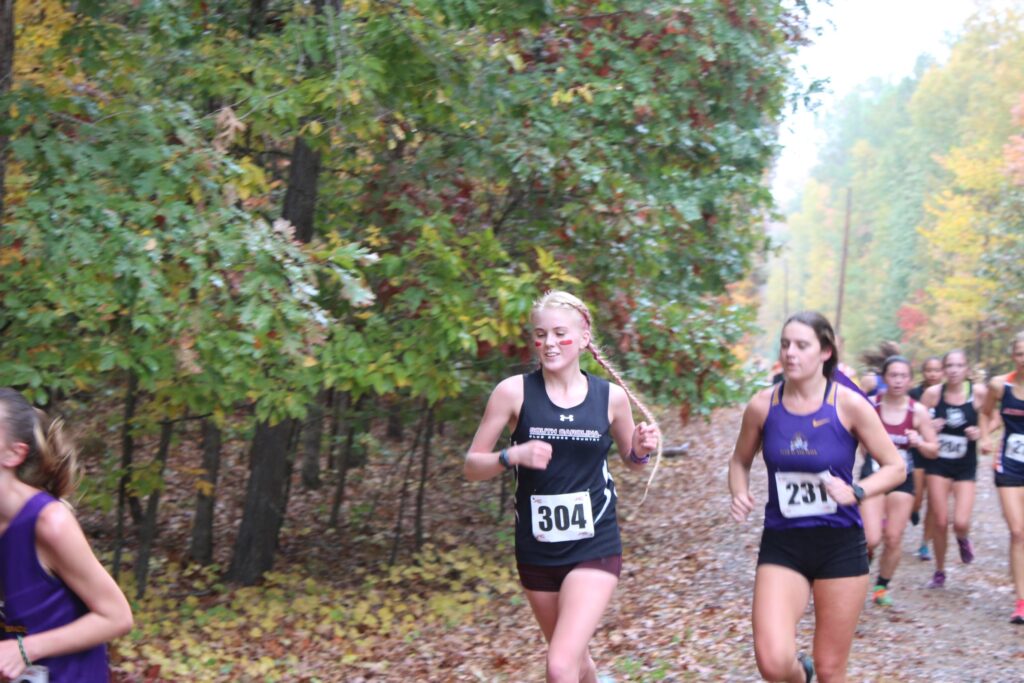
Katy Hall is a senior at the University of South Carolina and the Vice President of Carolina Cross Country Club hailing from the nearby Irmo, South Carolina area. By starting cross country in sixth grade with a push by her mother, the Irmo coach, Hall began her running career that spurred her first experience with team camaraderie. Moving into college, a self-imposed break from the sport allowed her to take control of her journey, reintroducing her love for running and allowing her to be a leader for others within the Cross Country Club. Hall touches on how the act of running allows for comfortability within new settings as well as seeking a healthy identity as a runner, leaning into how the degree of participation within the sport can fluctuate through different seasons of life.
“I feel like I’m doing something good with the energy that I have been given, and I am very aware of the fact that running itself is a blessing. So it feels really fulfilling to get to use that and to get to be good at it.”
Date: January 26th, 2024
Keywords: Running | Columbia | Irmo | Club Running | Leadership | Mental Health | Lifestyle | Surroundings
Transcript
Hannah Clark: Alright, there we go. We’ll set that there. Okay. This is an oral history interview for the South Carolina Honors College thesis project, More than the Mileage: Finding Community and a Sense of Place through Recreational Distance Running, documenting the perspectives and experiences of recreational distance runners. This is Hannah Clark, the date is January 26th, 2024, and today I’m interviewing Katy Hall in Columbia, South Carolina. Would you start by giving me your full name and spelling it out for me?
Katy Hall: Okay. My name is- middle name?
HC: No, just first and last is fine (laughs).
KH: So my full name is Cathrine Hall. It’s C-A-T-H-R-I-N-E H-A-L-L.
HC: Perfect. We’re going to start off with some background. Where were you born, and if different, where do you currently reside?
KH: I was born in Oklahoma City, Oklahoma, and I currently reside in Irmo, Columbia, South Carolina.
HC: Perfect. Tell me a little bit about your family.
KH: So my dad is a family medicine doctor as a physician, and my mom was a stay-at-home mom for me growing up, and now she teaches at the American Learning Academy, I think it’s called, and coaches cross country for Lexington High School. I’m the oldest of five, so we’ve got four younger siblings. We’re all kind of spaced out every few years. So biggest- our range is kind of five kids in 10 years. And then we’ve got two dogs, we’ve got a black lab and we’ve got an English mastiff who is a year old and 160 pounds.
HC: Wow. (Laughs). Perfect. Thank you.
KH: Of course.
HC: What is your current occupation or role right now?
KH: I’m a full-time student. I am studying for a Bachelor’s in art studio, and at the same time I’m working on a Master’s in art education. I work part-time at a local running store. Yeah, I guess that’s pretty much it.
HC: Perfect. I guess we’ll get into the running portion. So to start off, how long have you been a runner?
KH: How old was I? I guess since maybe around 10 years-ish. Okay. Yeah.
HC: Sounds good.
KH: I mean, not by choice.
HC: Going off of that, what or who inspired your start into running? I know you said it wasn’t by choice.
KH: Yeah, so you could say I was inspired. I was more of, forcefully shoved, but my mom’s a big runner and she’s been a big runner since she was in high school, college. I mean by the time she was making me run, she was about to run her first Boston Marathon, so she’s a very avid runner, and I wasn’t really interested in any sports, so she put me into running and then she started coaching, so at that point I really didn’t have a choice.
HC: That makes sense. So she started coaching while you were-
KH: So I had already joined the team, so I had already been running cross country. You can start conditioning in sixth grade or the summer after your fifth grade year, and then in seventh grade you can officially be on the high school team. So I ran through the seventh grade and she started coaching when I was in eighth grade.
HC: Okay, got it. How fun, or not, depending on the perspective.
KH: Not so much.
HC: I guess, yeah, building off of that, do you have a particular memory from your earlier experiences with running and could you describe that for me?
KH: Yeah, so I guess probably my big turning point was eighth grade, we had a very good coach. His name was Mike Moore, and he definitely knew what he was doing. He was very passionate and he was very good at what he did, and he had a stroke and passed away my eighth grade year. So that’s kind of when- our team was relatively small, but we bonded really closely, and that was kind when I understood the team, family aspect of cross country, and that’s what got me really into the sport itself. So I didn’t really enjoy the running part of it, but I really valued the team aspect and that was what carried me through the rest of high school doing cross country, would be that eighth grade experience.
HC: Wow. Would you guys say you kind of rallied together in that moment, and well, obviously it’s such a big event like that.
KH: Yeah, absolutely. So yeah, so that was- in the week between [when] he had a stroke and when he passed away, we had a meet and I ran, I worked a lot harder than I had previously, and I was gifted with some, just, natural talent and also I was still kind of a kid, so I had some of that just, childhood speed. And so I worked hard in this one particular race, and I was third on the team, and that was when I realized I could be good if I worked for it. And then having the team support me and in realizing that was very just encouraging and inspiring.
HC: For sure. For sure. Well, thank you for telling me about that story.
KH: Yeah, I’m happy to.
HC: I guess currently now, if you have one, tell me about the group that you run with.
KH: So I am an involved member on the Carolina Cross Country Club that- What was the prompt?
HC: Oh, no, no worries.
KH: Just about it?
HC: Just about, yeah. Tell me about the group.
KH: Yeah, it’s a very low maintenance running club affiliated with the University of South Carolina. Everyone who’s there runs because they want to be there. It’s totally optional. And so choosing to run with a group of people who’s also choosing to be there and no one’s- it’s not mandatory for everyone, has been such a game changer in college, just having that freedom to make the decision to run has made it a lot more enjoyable to stick with.
HC: Right, and I’m following your line of reasoning there. That totally makes sense. Would you say- how does that differ from your high school cross country?
KH: So in high school we couldn’t really miss practice. I mean, I would look forward to the days that it would get canceled due to weather. And also we had summer mileage and that felt like homework. Everything I do with running now, right now, is optional. I’m choosing to do it and that has been so much- I’m sorry I keep- (kicks foot underneath table at 5:43).
HC: No, no, you’re fine. You’re fine.
KH: I’ve been so much more enjoying it that way.
HC: Got it. That definitely makes sense. Well, this kind of answers itself, but you said it’s optional, but how often do you guys meet?
KH: So the team itself meets five days a week, or the cross country aspect of the club meets five days a week at 5:00 PM Monday through Thursday and 4:30 on Fridays. It changes to 6:00 PM after daylight savings, and then sometimes we do optional stuff over the weekend. The track aspect of our club, which we just added last year, meets Monday through Thursday at 5:30.
HC: Nice, thank you for that. So now just getting into your personal feelings and emotions while you’re running, could you describe to me how you feel when you run?
KH: Yeah, so definitely, I mean, I feel like I’m doing something good with the energy that I have been given, and I am very aware of the fact that running itself is a blessing. So it feels really fulfilling to get to use that and to get to be good at it. Obviously tiring, especially right now, this heat has been, my running performance has- is on the decline because it’s gotten so much warmer, but you know, I’m socializing, I’m getting all these endorphins, I’m hanging out with people. So it’s a really good experience. And then afterwards you feel really good. You’re in a very upbeat mood and you are looking forward to dinner and just laying around for the rest of the evening. I mean, it feels good to be active.
HC: Yes, definitely. And kind of going off of that, could you walk me through your feelings when you run alone compared to running in a group?
KH: Yeah, those have changed a lot. I don’t think I started enjoying running until about two years ago for as long as I’ve been doing it. And I couldn’t really run more than three miles by myself and I had to have music, and everything had to be- it was very conditional. And then once I started running for myself, and choosing and being more motivated, now I can use that kind of- I am recognizing the value of running on your own. It’s a very good quiet time. So I spend that time often in prayer or in thought, and that carries me through a lot of, I can run eight miles with no music, which is unbelievable to think that that’s what I can do now versus three years ago. So running alone, I mean, I’ve lost that social aspect, but I’m getting a lot more time to reflect, essentially.
HC: For sure. That makes sense, and that’s definitely something you’ve grown into and part of your…
KH: Oh, absolutely. Yeah.
HC: ….growing with.
KH: And it’s also very rewarding to feel like I can do that.
HC: For sure, for sure. Kind of shifting a little bit, but in the same realm, do you feel as if your emotions about running change when you run in a different place compared to where you typically would run, I would say?
KH: I guess it would depend on the context. The running itself, probably not, but if I’m on vacation and I’m running, it feels kind of like extra credit. It’s like, okay, this is what I’m choosing to do. But it also feels very defining of my character. So if I’m on a family reunion, it feels good to be like, ‘of course I’m going to go run’ because that’s how I’m known as and that’s how I know myself. So it feels very connected with what I’m going to do with my time.
HC: Yeah, definitely. Would you say that there’s been an impact of different locations of where you have lived or where have you spent time with your relationship with running? I know you’re from nearby to where we are right now.
KH: So I really haven’t done a lot of running outside of Columbia. I’ve gone on a few trips to the mountains and that’s very different. That’s different in the sense that I’m there with people, and we’re having fun, and it’s socializing, and it’s cooler usually when I go than where we start, and the altitude itself is [different], so the feeling itself is very physically different. I wouldn’t say my emotional perception of it is very different. Same- I’ve also run up in Connecticut, and that’s been the same thing. It was a lot colder, it was exciting because there was snow, and I was just on vacation, so I was just there to have a good time just to [run], it didn’t feel like I wasn’t checking something off.
HC: Yes, exactly. It was more just of an extension of your time spent there.
KH: It was kind of more of an itinerary thing than something I had to do.
HC: Okay, that makes sense. So this gets a little nuanced, but how would you describe what running means to you to a non runner or running in general?
KH: Oh, that’s tricky because [it’s] changed in the past few years…
HC: You can give me both or whatever you like.
KH: …well, so I mean three years ago I would’ve been like, ‘well, I don’t like the actual running and I don’t think anyone does.’ I would assume that for everybody, I’d be like, no runner likes running. They just like each other, and because that’s how I felt. But now it’s like, gosh, I don’t even know (pauses at 10:29). I am doing it because I want to. I would go back to the fact that running is a blessing. So if I had to explain it to someone, it’d be like, ‘okay, well I have the bodily capability and the mental strength to do this, and I have the ability to be good at it, and it’s not something that I want to waste at this point in my life.’ They say your twenties are when you’re the most fit. I mean, that’s why these collegiate athletes are so good and I want to value that while I can. I don’t want to be 40 and wish I realized I could have been a lot faster. So that’s been pretty motivating. Then just having something to do with your free time that connects you with people and is good for you. It seems like killing all these birds in one stone essentially.
HC: For sure. So, you’ve kind of touched on this and I just wanted to know how has your relationship with distance running changed throughout your time participating? And I know you’ve touched on in the high school to college, but could you dig into that a little more and maybe do you foresee any changes looking into the future as well?
KH: Yeah, so with distance running, again, I liked that I was good at it, and I liked- it’s fun to be the best, and that’s what I was, I was the best in high school, not even- just from a literal standpoint. But I hated the competitive aspect of it and that was burning me out of it so fast. So coming to college, getting to choose, it was so much more fun, but I still wasn’t enjoying the actual running part of it. So sophomore year was kind of a plateau for me here at college. I think part of it was I was running the same distance, the same pace every run, and that was really messing with my brain, but I was just really not enjoying any running and I wasn’t having any good days. So, at the end of the year, I took a three week break just for my brain, which I’d never done before, any breaks I’d taken were injury related. So I took a three week break for just my mental perception of running and came back, and wrote my own mileage plan, which I didn’t even expect to stick with, but I was like, ‘I’ll write my own mileage plan to try to get 300 miles over the summer and if I don’t hit it, that’s okay.’ Which was completely different than I’d done before. And I did stick with it, and I really enjoyed hitting the mileage that I’d set for myself, so I felt a lot more successful. And that was kind of when I started enjoying running, was getting good at it, because based on what I had given myself to do. So that was the first year I got back under 22 in a 5K, and I felt like one of the best again. Was there more in the question?
HC: No, no, that’s perfect.
KH: I feel like there was more I was going to say…
HC: No, you’re good. It was just about your changing relationship with running.
KH: …and then being able to set that example for people. I am used to being a lead by example kind of leader, because I mean the four young siblings, and then my team in high school, so it feels good to be able to set that example for new people in college too who have had a similar experience in being burned out but still want to run.
HC: If it did, did that shift impact your perspective on running with the club team or running in a group, kind of having that change in your own mental state? Or was it more just to…
KH: No, I did feel a little bit more confident coming to [practice], but also part of that came with age, because being a freshman is like, you are not going to assume authority as a freshman. By the time I was a sophomore and junior, I was already one of the more regular people and more experienced people. And so at that point I was kind of starting to feel more comfortable the way I had in high school, being kind of a leader. And now I feel like I am the oldest, which is kind of wild. But I do feel, I feel confident in what I’m doing. I feel like I can offer good advice and good insight to, mainly girls, but also guys who have, again, just picture themselves and understand that they’re runners but want to enjoy it and don’t want to just give up on running because they don’t like it at the time.
HC: Growing in that leadership role, so to speak, how has that (pauses at 14:51) Oh, sorry. Excuse me. I hit a blank there. Okay, we’re going to scratch that, but I was interested in how you were talking about kind of setting that self-fulfilling goal for yourself, but if you didn’t hit it no problem, and how that shifted some thought processes about running for you. So this kind of leads me into how has distance running impacted your mental health, if at all?
KH: Okay. Yeah, I was not aware of the impact and value around mental health until probably later in high school. And I knew running made you happy, everyone talks about the endorphins and everything. But then once I started going to therapy, and then realizing how valuable mental health is, I became very thankful that I had running as an outlet for that. And then even in the time since then, I’ve just continued to recognize how it’s generally a really positive [thing]. In itself, running is a very mentally strengthening form of exercise. I think you can easily get too caught up in it, and you know, everything’s okay in moderation, and outside of that it can get a little too much. So if you’re constantly down on yourself about your performance, then obviously it’s going to kind of impact you negatively, but the act of running itself is generally a very positive mental form of recreation.
HC: Definitely. Is there a time where you didn’t feel very purposeful in your running or you didn’t feel like you found a benefit from it? If you don’t mind me telling?
KH: So that probably would’ve been sophomore year where I was just like, I was coming to practice because why wouldn’t I? I’ve always- pretty early on I got to the point where it was like, why wouldn’t I? I’m a runner like that. It was something I identified with and it was something that I knew was, sorry- (kicks foot underneath table at 16:35).
HC: No, you’re good.
KH: I knew it was part of who I was, but I didn’t love that, because it felt like I was stuck with it, and so sophomore- that’s why I was coming to practice, ’cause I was like, well, ‘this is where my friends are, and this is what I do, and this is what my schedule’s built around and I’m not going to not be a runner.’ I don’t want to be known as someone who stops coming to practice. So that was kind of where I was just doing it because I felt like I needed to, and not because I really wanted to be there.
HC: For sure. And then going back a little bit, just to add some historical context, how did the pandemic affect your running journey?
KH: Oh, okay. Yeah, that’s interesting, and I haven’t really thought about that a whole lot, so I might tangent a little bit.
HC: All good.
KH: When the pandemic hit [it] was right in the middle of track season, so we had a Saturday track meet and we did really well, and I was really fit, and I made a difference in winning the DMR, the distance medley relay, and then everything got shut down, so we didn’t go back to school after that. But we stayed holding captain’s practices because, in the chance that we came back to school, we didn’t want to lose all our fitness based on the pandemic and we thought that we’d have an advantage. So we stayed fit pretty much through the rest of the school year up until maybe May or so. And then it obviously didn’t work out, we didn’t end up racing anymore, and I was done running for high school level. And so I did want to keep up with running, but there wasn’t really anything I was working to at that point, and that was different, I mean, that’s completely different. And I also didn’t know there was a club team at USC, so I wasn’t prepared to have a running community in college, so I was just trying to stay fit and keep up with running. But honestly, I think I was so distracted by so much, like I was graduating, I had prom, I had to think about college and moving out, so I wasn’t really thinking about running a whole lot at that point.
HC: That makes sense.
KH: I hadn’t thought about that.
HC: I know, kind of interesting to see how- I mean, we think about the pandemic and how it affected the obvious parts of our life, but then the recreational like, oh, how did that shift? But thank you for that.
KH: Yeah, thanks for asking.
HC: So I know we talked about place and running a little bit, but how, if at all, do you feel connected to your surroundings when running?
KH: I think running gives you a very good idea of where you are. I think it’s probably one of the most effective ways to learn your way around somewhere new. And so coming to downtown Columbia, living, excuse me, in Irmo, I felt like a local, but then it was really kind of humbling at practice to not know where we were going. It turns out I’m not actually a local, I only visit here sometimes for dinners. So it was a really good way to get to know my way around, get familiar with my surroundings and start to feel really comfortable, feel like I knew I could navigate where I was if I was walking by myself or driving by myself. So I felt very- a lot more connected. And so even now if I’m driving somewhere with my family, I’ll be like, ‘that’s where we run,’ and it is kind of something I get to be proud of, like this is something that I’m connected to because I run there.
HC: Definitely, and going off of feeling- that feeling of being proud, can you tell me about a time that you felt proud to participate in a running group or organization? Doesn’t have to be anything groundbreaking, just if there was a moment, or you know, an instance where you [dealt with that]?
KH: Yeah, I mean I’ve got a lot of those. I’ve really had a very blessed and fortunate experience running, but I’ll go with a more recent one would be- this is what, something we’re proud of for running?
HC: Yeah.
KH: At the McAlpine meet in Charlotte this past fall semester, our girls got third and we weren’t expecting it, but then when I was kind of hearing the scores of the teams that were leading up and we hadn’t heard our names yet, and I mean a lot of our top five girls had done really well, I was kind of like, ‘we could place, we could get third.’ And then they called their name and that was very exciting, ’cause it’s a big meet, a lot of teams go to that. So, and then we won a pickaxe, and we got to all go up there. So, it was really exciting to be like, okay, ‘we don’t love competing, but we are kind of good at it,’ and so if we really wanted to be even better at it, we totally could.
HC: Almost like it was a natural extension (laughs) of, you know, enjoying what we’re doing…
KH: …and being good at it at the same time.
HC: Yeah, for sure. I love that story.
KH: Thank you.
HC: And then this is kind of overarching, and I don’t mean to circle all the way back to the family question, but, do you feel like you had your mom within your running journey when you started off? How have you guys still connected through running if you still do, or does that kind of dual relationship still exist?
KH: Yeah, well, so in high school, it’s a little tricky because it’s definitely- there’s a duality to it because she’s very supportive and she understands what’s good in terms of performance, and she has a lot of experience with the mental difficulties of running because it’s very much a mental sport. So she’s very good at strategy, like, ‘this is how you beat someone.’ So I definitely had an advantage. However, it wasn’t ever my own thing, and so yeah, she has the claim that I run because she made me run, and I mean that’s tough. Coming to- we haven’t always had the strongest relationship, regardless, coming to college, it is something that we can still connect about if we get lunch or something. I mean, so where I work, the running store I work [at] has its own racing team that’s pretty good, and she’s part of it. So sometimes we know a lot of the same people in the running community, she’s very involved with the races that this business puts on and that I’ve been involved with. So there is still that connection, even if I don’t see her all the time, there is a lot of connection through running. I think she’s gotten to know her way around Columbia in the same way by running through it. And yeah, that’s probably as far as I would go with that.
HC: Yeah, no, thank you for that. I definitely see what you were saying there, just the duality and then finding a way to connect even though lives are changing and you’re progressing on. I guess one final thing I have is just overall, and you can go as far as little as you want into this, how would you say running has impacted your life?
KH: I would say very positively. It’s interesting. So because going through elementary and middle school P.E. was where I was okay with not being very sports-oriented, wasn’t very good with throwing balls, wasn’t very good with kicking balls, wasn’t very good with being strong or- because I was not a very athletic or sporty kid. So when I realized I could be good at running, and be again, one of the best, it was wild. I was like, I didn’t realize that I could be an athletic kid. And so once I kind of grew in that, and became attached to that idea, and worked for it, and realized that could be even better if you work for it, I think that’s when it subconsciously just attached itself to it as being something that’s part of my lifestyle. So then when I came to college and took a break, that was kind when I took a moment to be like, ‘I don’t think I’m ever not going to be a runner’, so it’s okay to take a three week break, if in the grand scheme of things, if my whole life is spent being a runner, a three week break- a break is nothing. And also, all fitness is temporary. So I can be slow and I can be fast, and it’s going to end up changing and it’s going to fluctuate. And that has been- I mean, yeah, that’s been really helpful for me, just to keep in mind. Being attached to running as a lifestyle is definitely part of my personality, it’s something I’m proud of, it’s something I like to tell people, like, ‘yes, I’m a runner.’ And people are generally impressed by running, which feels good, but ultimately you kind of remind ’em, like anyone, for the most part, can be a runner. I mean, you don’t really have to have experience with it. It’s good for you, and it is one of those sports that you kind [of] have the rest of your life if you want to. You don’t meet a lot of 60-year-old soccer players. I mean a lot of people- all runners are really all ages, all shapes, all sizes. The distance gets longer, you don’t meet a lot of really of, 5K runners who are older, they tend to start to shift towards half and full marathons, but the act of running itself is something that really sticks with you, and I like that I have that already.
HC: For sure. And kind of on that same theme of running sticking with you, how would you foresee your personal running journey moving into the future? Would you foresee yourself still within some sort of group or maybe taking more of an individual route? Any thought on that? Obviously hypothetical.
KH: Sure, sure. No, no, that’s a good thought. I mean, I would think- I mean, running is where I’ve met the best friends and people, that in my life that I’ve met, I mean [I’m] dating a runner and all my friends in college have been runners. So I would imagine if I had to move somewhere, which I probably will, I think the running community would be my quickest way to find friends. I am understanding and aware of the fact that I will probably not always be in the same shape I am now, or have been before, because I intend to start a family and have kids, and I want to be fully devoted to them and not let running come in between me and those who I love. So when it comes to sacrifices, I understand that running is going to have to come eventually, but it’s not to say running as a whole, I don’t have to stop running. I mean, I can still run for peace of mind and for fitness, but I think everything’s temporary. I think everything changes a little bit, and I think running, I mean [my] relationship with running is going to have to eventually alter a little bit to make room for other things that may come.
HC: Yeah, definitely. That makes total sense. That’s all I have unless you have any final closing thoughts you’d like to share?
KH: Not particularly. I am- I’m not super good at telling stories and short answers, so sorry if it’s all over the place when you listen to it again.
HC: This is all about just telling your side, in the way that you feel is best, so this has all been greatly appreciated. I appreciate it a lot, and thank you for your time, for coming out today and helping me. So yeah, thank you.
KH: Thank you for answering and for letting me reflect on all of my own experiences.