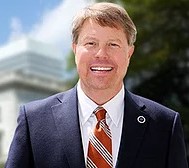
Interviewee: Chip Huggins
Interviewer: Carlos Sanchez
Location: Remote interview (Columbia, SC and Columbia, SC)
Date: September 18, 2020
Accession #: ELEC 007
Length of Recording: 59:31
Summary
Colonel “Chip” Cecil Huggins Jr. was born in Columbia, South Carolina and currently serves in the South Carolina state legislature as a Republican representing District 85 (since 1998). He is a 1987 graduate of Winthrop University. In the interview he discusses his parents and grandparents and how they came to call the Columbia area home. He describes his wife’s role in his political interest, how he became a state representative, the non-political jobs that have led him to where he is now, and some of the elections and bills most memorable to him. He discusses how his Christian faith impacts his role as a public servant, the effects of the COVID-19 pandemic, his opinion on the Black Lives Matter movement and the meaning of civic–or civil—engagement, what being a member of the Republican party means in 2020, and the advice that he would give to those aspiring to run for elected office.
Keywords
South Carolina House of Representatives | Columbia, South Carolina | Irmo | Black Lives Matter | COVID-19 | Religion | Republican Party | Civil Engagement | South Carolina State Legislature
Recording
Transcript
Carlos Sanchez: This is an oral history interview for the 2020 Election: Sharing Stories of Civic Engagement Oral History Project, part of coursework for honors college class SCHC 326 documenting the perspectives and experiences of those who are engaged in some way in the 2020 election. This is Carlos Sanchez. The date is September 18th, 2020. And today I’m interviewing Chip Huggins remotely. I’m in Columbia, SC and Chip Huggins is also in South Carolina and Columbia, SC. So, thank you for being with us today Representative Huggins. Would you start by giving me your full name and spelling it?
Chip Huggins: Sure, I go by Chip. Obviously, my full name is Colonel C-O-L-O-N-E-L Cecil C-E-C-I-L Huggins H-U-G-G-I-N-S Junior J-U-N-I-O-R and of course Chip is my nickname and we’ve been by that name since I was about 3 days old (laughs) so C-H-I-P is the name I go by.
CS: So where and when were you born?
CH: I was born in Columbia, SC on November the 30th, 1961.
CS: Cool and is that where you grew up? What was the community like around then?
CH: I grew up, actually, that was right in downtown Columbia for about, I guess 60 days of my life, and then we moved out to Saint Andrews, which is really the suburbs of Irmo and the area that you grew up in as well so. Lived there for pretty much the entire time of my life.
CS: Cool and what was that community like back then?
CH: You know it was very much like if you go to the outskirts of really Newberry now where you about have to go to get a little bit more of the less traffic, the non-development. Not a lot of commercial. It was very sparse, very quiet. Then things changed. Obviously, things move out, and that’s kind of what happened. The city tends to keep moving out and will continue to do that for the rest of our lives.
CS: Wow yeah, so can you tell me and talk to me a little bit about your parents and grandparents?
(unintelligible at 2:33)
CH: Absolutely, you know my mom and dad were here. My dad was from South Carolina. He was born and bred in Mullins which is down in the lower part of the state. In fact, most of my Huggins family is in that part of the state where they’re from. My mother grew up in the lower part of Georgia, which is Wrightsville, Georgia. A lot of people know it from Herschel Walker. Herschel Walker kind of put Wrightsville on the map. But they met when dad was at the University of South Carolina. He had come on the GI Bill. He had been in the military he was in World War Two and the Korean War. And then mom, she was in nursing school here at the Columbia Nursing School is what it was called. And so they met. Dad was making glucose because he was a chemistry major and he made it in the basement of the hospital. And so they met and then got married and certainly grew up and made their home here in Columbia. Dad was a chemist. Went to work for DuPont right [after] his graduation. But he ended up going to the city of Columbia and became the Superintendent of the water plant and was pretty instrumental in purifying water there with the city. Mom was a nurse. She was a scrub nurse for almost 30 years. David Tribble, it was the South Carolina surgical associates, I think, was the group and she did a lot of that.
My grandparents, obviously one set were from Wrightsville, GA. They both were farmers and that’s what they did. Mostly cotton. My grandparents on my dad’s side, they were farmers too. They were tobacco farmers, but my Granddaddy had a real tragic thing happened to them. My dad had three sisters to die in one year and my granddaddy saw that as an omen, and he sold the little farm that they had and went into the Methodist Ministry and was real instrumental in forming the Southern Methodist Ministry. So he ended up moving to Columbia. I think Washington Street was his last step that he did here in Columbia, so he was a minister. But we’ve still got a lot of relatives in the Georgia area from my mother side, we’ve got a lot here in South Carolina, from my dad side and my sister and I are the two children. Kathy is her name, she’s 11 years older than me. Both of my parents have passed and so my sister has literally been like my mom, which has been great to have.
I’m married, my wife is Ginger. She grew up in Greenville. She came down to work for governor Campbell, Governor Carol Campbell, who served two terms as our governor and she had worked for him as a congressman. But she ran the governor’s mansion was her job when she came down. We have two children. Laney, she’s married to Nathan and her last name is now Jones. And they live here in Columbia. She’s a clinical psychologist, and he’s an accountant. And then my son Hiller. He is 27 and of course he lives in Greenville and he works with a trucking company there and they’ve all done very well in the COVID which we have been blessed by, so we’re thankful for that but that’s pretty much it. We have one dog, Gigi, (laughs) a little Australian mini that has been a real refresher for us. She bought some energy that we probably needed in our house, when we were lonely nesters. So we’re right there, we’re pretty simple. We just tend to stay in Irmo and Chapin and try to watch out for our district.
CS: Awesome, thank you. So looking back, who had the biggest influence on you and who did you really look up to?
CH: You know that’s great that you said that. So that my brother-in-law, who–my sister and him were married–was Jim Konduros. He was an unbelievable figure in my life. After my dad, you know my dad was obviously great. My mom. I had great parents, you know, and that’s a blessing because that’s the thing we found these days, it really is tough when you don’t have them and so they were obviously my role models. Then they weren’t, but Jim was really a strong male influence on me. And we had a lady that I grew up with that was like my second mom and her name was Henrietta Bell, and I can only tell you… oh, she was unbelievable. And then I had a minister, mine was Dr. Bill Barton, and he was unbelievable. I have so many, I’m so blessed. I encourage folks to try to utilize that as much without trying to ever overdo your welcome, but I’ve been blessed to have some really good people that have helped me and certainly tried to role model me after them.
CS: Awesome. So you were obviously talking about how you’ve kind of seen the community change over the years. Can you go a little more into depth about that?
CH: Sure, well you know in I say this literally as I’m sitting here just thinking about age differences, and you know I’m getting old, and your age also starts to show you the population growth that we’ve had, population has obviously exploded. South Carolina in general. I mean, my goodness, I can’t even think about what it was in 61 compared to 20, and so you know, population is obviously a lot more. A lot more cars and vehicles on the roads. South Carolina is in a tough spot because we can only widen our roads so much. I mean, we’re not a big state and you only have so much room that you can expand so you know your infrastructure changes have been huge and so along with that is growth of development. Your areas that used to be nothing but hunting and farmland are now houses and companies and you know all those things, so you still have to grow crops, you still have to provide the food on our tables, so trying to make sure that we have very exciting announcement made in the lower part of the state with a new concept and growing lots of vegetables and we’re going to have to look toward those sort of things to get through our growth in all the areas that we’re seeing. So population, infrastructure changes, and then development. I think have been the biggest ones we’ve seen.
CS: Awesome, so how long have you been a representative?
CH: This is my 20th year that we’re in right now. And, if you all will send me back again, we will go for two more years and that would be 22 total at the end of that. We are up for election this November.
CS: So, what really got you interested in politics?
CH: (laughs) You know, I blame my wife, Carlos. I’ll say that candidly because I’m very thankful she’s my much, much, much better half by far. But, she was in it in the sense of being around it with Governor Campbell. And I’m going to tell you that he was amazing. The guy was just absolutely… you could ever clone yourself in the sense of this just amazing guy. I mean he was. He was the real deal, and you know we were fortunate to see that I was in a business that is a lot like what this is in the sense of helping people is what I like about the business and the politics of it. Sometimes you could just take that and you know that gets to be really hard sometimes, but you know when you help people and seeing that that’s really why I got into this and trying to make a difference. I did a lot when I was in the real estate business in the sense of you have so many issues come up when you’re closing a property and you have to work through those, and that’s very similar to what this business is like in serving in the in the Legislature. So we got into it to try to help people.
CS: So can you talk a little bit more about those previous jobs and the impact that they’ve had on your political career?
CH: Sure, right out of college. Now I worked three jobs while I was in school, I was not… we didn’t come from much, so I had to try to do everything I could. For every dollar I could get to make sure I got through school so, so we were able to work and it taught me a lot. I worked at a bank. I worked a clothing store and I worked at odd jobs, let’s say that. I actually picked up trash a lot. We do things along those natures, people that could use a college guy to clean their office or clean up their parking lots or whatever, and so we did all those things to get through school and you know, doing that taught me a lot. It was very good to see that. I think it helps you to deal with people and work through just things that come up with a job.
I went right into the real estate business right out of school, and I went into Chapin, which was very interesting because Chapin at the time, there was hardly anything there. I mean, Lake Murray was still very popular even though it was not so, the lake was very active. We sold a lot of properties on the lake and then I decided to go into pretty much all the Midlands and so I came into Columbia, went to work with the company, and then I formed my own company and I had Huggins and Company Realtors for a number of years and then we had as a partner at the Settler Company and then I folded in with what is now Coldwell Banker. And so I did that up until about 13 years ago and had an opportunity to go into the restoration business and I’m still learning. It’s been a long learning experience, I’m not an owner in that company yet, I’m just a learner, and we’re still watching to see where that’s going to take us, but it’s been an interesting experience. I’ve learned so much. We’ve taken a twist into more of the insurance arena, and so it’s taught me a lot of other areas of business which has been good for me. So, as you go through your paths of everything, I encourage you to get as much of that as you can because you meet a lot of folks that you help and they help you and that that’s really good. So that’s what we’re doing now, I’m currently the director of business development for Duraclean, which is a restoration company. We do fire, smoke, water things that we hope never happened to anybody, but they do every day and we go in and clean it up and hopefully get them back as good as they were before.
CS: Awesome. As a state representative, how would you describe that job?
CH: I mean in the sense of this, it is a very time-consuming job, and everybody does their job different and I take mine very serious. When someone has a problem, I want to help them. It’s very frustrating to me when I can’t help them. When we have needs, I obviously want to try to help now. I have an opinion that we have enough laws on the books. However, sometimes you find that those laws aren’t there and we go in and try to correct those issues where legislation is needed. You know, prime example of that is probably our opioid issues that we’ve had so much of. I got really involved in that early on and that was one that has just grown enormously. We’re still working through it and going on, so that’s the interesting part about serving, there’s never any dull moments. I mean, by the time we get off of this interview, I will have had at least 10 to 15 more issues or needs that are out there. We’re in the middle of session right now because we’ve been so… our year has just been interrupted through the COVID so much. So we’re in session this week and next week. So there’s a lot of issues, a lot of things on lots of people’s minds that they are contacting us, contacting us, and so you get contacted. You get either through your emails, through your text messaging, through phone calls. People are always wanting to ask you questions, get answers to questions, find out about funding, find out about things, whether it’s a state agency that might be able to help them with an issue they have.
So, you’re always working on something and it never really goes away, so that kind of, if you’re looking ever, if you ever start thinking about it, you’re looking for something that you’re going to sew it up and it’s just going to wait for the stitches to come out, that isn’t going to happen in this business. It’s going to keep with some issue out there that’s going to keep cropping up that you’re going to have to deal with. And you’ve got to be able to deal with those things. So we try to do the very best we can. We’re in a committee that we serve on that we’re the chairman. And literally Megan is our chairman. She’s the person with that does all the legal work here and we have Kami Thordahl that does pretty much all the staff work, but we pretty much have all the regs that go on in our state. They come through this committee, and of course, the administrator procedures that they would have. So we have a lot of things we have to work on, especially if you give all the COVID requirements. Now they’ve got an emergency state right now, so they’re really going forward with a lot of things, but we’ll end up having a lot of that to come back and have to look at when we come back in session so we have a lot of that going on as well. (Unintelligible) I serve on Ways and Means, and Ways and Means also is the money committee, so we’re actually dealing with that. Out of the house, we’re probably not going to pass a budget this year, so we’re going to leave that on a continuing resolution, so we’re getting a lot of feedback on that right now too.
CS: Awesome. You mentioned the COVID-19 pandemic, could you kind of go into a little more depth about the real effects that has had on you and your job?
CH: Sure, I’ll just say this Carlos, be careful what you sign up for in all this and even in 20 years I’ve never been through anything like this. With the recession, the recession was extremely tough right after I came in. That was a tough time too, because we were in a budget shortfall and that was real hard to deal with too. But this is nothing [like that], no comparison. The unemployment issues that we’ve had across the state you probably saw where I think we’re upwards to 4 billion dollars right now that we’ve spent just in South Carolina on unemployment claims, and don’t quote me on that number, but I’m getting that off the memory of what I’ve seen here recently. I mean, that’s enormous for a state of our size. It was enormous for me from a district like ours. I mean, you probably don’t think about those issues until all of a sudden, the restaurants are closed. The hairdressers can’t do their job. The you know the gyms are closed. The bowling alleys, everything. So all those people are out of work and they don’t have a paycheck, and so we had to work through all of that, there were so many. We’ve got a guy in our district. Every time I can plug him, his name is Mark Hendrick, and Mark Hendrick we could not have done without. His wife Allie, you may have had her as a teacher and let me tell you, oh Mark Hendrick, I couldn’t have made it through this without Mark Hendrick. So we’re thankful for that. But having people there is resources has been a big help.
PPP loans which are for the businesses out there. Those are the payroll protection loans. Enormous, enormous needs, and again people that live in our area. Greg White happens to be the head of the Small Business Administration for South Carolina, and I cannot tell you how helpful he was through all of this and helping our businesses in our community. So, we weathered that part of it. We’ve got a lot of repercussions right now that we’re looking at. That are the tourism dollars that are missing, the entities that have not been able to pay the revenues to the state, and so we’re in a worrisome time about unknowns that we can’t really make concrete decisions with, so that’s put a big burden on us, trying to help and make good decisions for our state as a whole without a lot of concrete answers right now, so it’s really throwing us for a loop. Testing has been huge. The PPE, which has been a big thing around that right now, I think we’re at a more stable level, I’m just using this as an example, but there was a time where if you had to find a roll of toilet paper, good luck. I mean, you know toilet paper, paper towels, paper goods in general, masks, gloves. All those things we’ve at least got back to some normality and being able to go and shop without a lot of problem with that, so a lot of those things we’re getting better with.
Now we’re in the vaccine mode. When that is really going to be. Our governor has done an outstanding job of going ahead and getting us ready. They’re ready to implement that, assuming that it does come, they had to get that ready by November 1, which they’re well ahead of the curve there. We’ll see, I’ve got a couple of friends that are in the trials. They’re very impressed. By the way, they’re District 5 graduates too. One’s an engineer and one’s an attorney and they both have been very impressed with it. They tell me they’re further along than they’re putting out in the media. I hope that’s right. I mean, I believe it, just the way the media is. But in general, those are those are the real things that we’ve been dealing with. Hospitals, first line responders. We’re sitting here, “golly bomb”, your firemen, your police, your first responders, your teachers, your doctors, your nurses. All of them need raises and we can’t really do anything with that right now. Senate passed something, and I don’t fault anybody trying to do because we’re all trying to help trying to do the best we can, but you go out here and make false promises that we can’t produce down the road and then it puts people out of work and furloughs and everything else under the sun. You’ve done nobody any justice, so those are the things that have really hit us with a brick wall, and it’s the biggest brick wall I’ve ever been through, and I’m not real good at going through them (laughs). So anyway, it’s been tough, but we’ll get through it. I don’t want to give you…. You got a good future ahead of you, by the way, once we can get through this thing, you’re going to have a… It’s going to be hopefully getting us back in action in a big way.
CS: Thank you, yeah, I appreciate that. So, what are kind of some of the highlights of your time in office? Or some of the bills or moments that you’ve been most proud of?
CH: You know I had one right out of the shoot that was very interesting to me. In fact, I got in trouble with the Department of Justice. And let me tell you something, if you don’t think that’s a fun experience, they will make you feel like they’re coming to your house to get you, by the way, that was not a fun thing. This was called the Seller Property Disclosure Bill, and this was a bill to really help the buyers, which are the consumers. But the Department of Justice read the bill the other way when they originally read it, and so the first year that I introduced the bill, I had to work through them, literally through Washington and all that to try to get them to be convinced this was a consumer friendly bill. Once we did, it was smooth sailing, but it took a lot and I had a guy and we were good friends, but he can be a real nemesis, Senator Gerald Malloy, over in in the Senate. He’s a good friend of mine but let me tell you what, he blocked that bill and I didn’t know any better, I was a first year and was just as green as I could be in the in the process. And so I finally realized the importance of going and talking to people and just telling him and keep telling him what this was about. And finally, along with him and everyone else, we got that bill to pass. I think it passed unanimously. I don’t think it had a negative vote, but it put the seller property disclosure which is now required, I think since 2002 or 2003, I forget whatever year that was close to that, but that’s been a great thing. It has saved a lot of people. Basically, it makes you disclose anything that you know that is defective in your property. If you have knowledge on it. And it’s been a real blessing because a lot of people used to sell things and wouldn’t tell you anything and next thing you know you’ve got a foundation that cracks in half and you didn’t know anything about it and so it’s a lot better because of that. Don’t get me wrong, I’m not going to sit here and I had a lot of help. A lot of people that brought that bill to me that said it was a need and we went with it and certainly educated a lot of people with it. So that’s really it. Taught me a lot about the process. It was a great experience, and we did get it over the threshold, which some of them don’t.
You know some, we’ve still got bills sitting that don’t get across it, but the other one that’s probably most is the opioid bill, which I called the South Carolina Overdose Prevention Act. It is a bill that, my goodness, I’m going to tell you, folks you probably even know are really a cause of that bill. Unfortunately, I mean it’s terrible that you have to have things like that to cause things to come about. Maryland had passed that bill the year that we introduced that bill and it happened to be in the front page of the paper when someone was there at a hotel and they texted it to me and I got it, read through it, took it to Legislative Council and I said I want to introduce that bill and we did, and again, I had no idea what we were going to get into, because if you think about all the folks that get into the medical arena, your pharmacist, your doctors, your nurses, the pharmacies, all the CVS is in the world, the Walgreens of the world, well, they came out of the woodwork and then there came SLED and certainly the sheriff’s associations, the solicitors, and so all those people had to collectively be comfortable with this because it was allowing Narcan, which is naloxone which is the formal name of it, but Narcan is the generic, to be put on the streets, so that Heaven forbid you or I to have an overdose that they can come, and they can administer this to you, and it will save your life. But, there’s some repercussions of thoughts that you might be getting someone even to be more of an addict, but I’d much rather save that life and hopefully we can save their life, get them out of their addiction rather than passing away and there not being a chance to do that. So we’ve come a long way with that. We’re still working on it. I spent a good portion of my time before I had this call with you on the phone of something very exciting that I hope will be another step in the right direction. It has to do with some protocol of treatment, and that’s where we’re at really with it right now. We had really, really hoped this bill would go from the embryo, which was really putting Narcan on the streets to so many facets of way with that. Then to get to the point where we can actually cure the addiction and get people treatment, and we’re getting really close to that. So it’s very exciting, that’s something I’d like to see to an end before I go away from this place. So I hope we can. Anyway, we’re excited about that. But that’s two that are very meaningful to me. I’ve got a lot of others, but that those two especially.
CS: Awesome
(unintelligible)
CH: It’s not every day you get the Department of Justice. I don’t recommend that, by the way, because it don’t usually end good at it. It ended well for me. Thank goodness because I didn’t have anything to hide. But well, I think so many people got in trouble with them and it’s no fun (laughs)
(unintelligible)
CH: We’re an open book so come at me. (unintelligible) you ain’t going to find much, we’ll take our chances.
CS: Wow, well, kind of on the converse of that, are there any low points that you’ve had?
CH: You know, I can say that some of these votes we have to take can be very, very challenging. We have some races that go on and these races that we have outside of the body of this legislature; what I mean by that is we have we choose the judicial candidates, we choose the Board of Trustees, which is certainly like the Public Service Commission and some of your commissions, and more, those things can be so frustrating because you will have–I’m just using you as an example–where you’ve got some of your best constituents for one person and you’ve got some of your best constituents for the other person. So making those decisions, and especially when you got 2 great people you’ve got a treat so man, you know, and I’m a choose kind of guy. I will make a decision and sometimes it’s just not always the right one. I try to pray before I do, I try very hard to, because I mean it is very important. These are very important decisions and I’ll say this: God does render a decision, like I said, and sometimes that may not be the one, maybe there was another reason He made me think that way, and I do tend to feel good about it because I do that. We make those decisions and try to do the very best we can, but those can be very low points because even though you pray and you do, I sometimes walk away and still will be just okay. But you’ve got to move on, you just have to move on and know you did the very best you can. I certainly hope I would never do anything in any wrong regard that would ever be an intentional something. If I did that, I would really carry a load, but we hopefully just have the normality of about like I did Friday a week ago when I ran into the back of folks on the Interstate. Where you just know you made a mistake, and you know you apologize and tell him, I don’t try to run away from it. I just own up to my mistakes and do the best thing I can the next time, so that’s what I try to do with the low points that we get to. But you’re going to have low points no matter what you do. You’ve just got to get through and we’ve got to look at the positive and accentuate all the positive.
CS: Yeah. You mentioned prayer there and how your grandfather was a minister, correct?
CH: Right.
CS: So, would you say that your faith is a had a big impact on you and your formation as a…?
CH: Sure. I have to say this, because I’ll tell you, I never want to be a hypocrite (laughs). I don’t mean that wrong, I go up and down just like anyone and you try to do the very best you can to live every day, and man I try very hard to live by that devotional, I do every morning, but sometimes I slip. You try to just get through those things. But I absolutely do. I think about it and I don’t know what in the world people without faith…. Hey, like I said, I’ve not been through anything like this COVID thing in my lifetime. I mean, it’s been the toughest one and if I didn’t have that faith, it would just… I couldn’t get through it. So yeah, it’s a big impact and I try to do everything I can to live by it in every way.
CS: Yeah, so can you kind of describe your first election?
CH: (laughs) Hello my goodness, yeah that was a very interesting time, and I’m going to say I would never do anything to lose. That’s not anything I would ever go at. I’m a very competitive person but at the same token, I didn’t really see my chances being great. I was going up against two very politically prone–they were already out there, they had been very well named, recognized—guys, and then we had another unknown like me. But he was a fairly well [known] family name in the Chapin area especially. And so, the one thing that I had was an open, so it was not where you were running against someone, we were running together, the four of us. So I was very fortunate and blessed that the two political guys, they kind of went at each other, and I just stayed out of the fray and we ran a very positive, upbeat campaign on issues and just own our platform and what we were going to do, focused on what we were going to do, and we didn’t go into the fray of these political antics. And so I ended up in a runoff. And I got in the runoff with the gentleman and they send a postcard out the Saturday before the runoff election on Tuesday, stating that I’m for video poker. And of course, I’ve never been in politics, I had never made any and I was absolutely not for video poker, and it was a big lie which they had intended to go out because they never intended for me to be… they didn’t think I was going to be the one in the runoff, so it was going to go against the other guy. Well, we had to get on the phones the day before the primary and I can’t tell you how much it helped me to hear a lot of people at least realize that that was not me. Even though the postcard worried me to death, and it was one of those things you just can’t believe, you realize that people really do pay attention to what you’re all about and who you are and what you are. And it was refreshing for that.
I ended up winning the election and so that was my first time in office and so we started serving. I came in a special election. Even though I was elected in 1999 when the election was held, I served my first term the year 2000, and so it was interesting. I get in, the first thing, video poker ended up going away because Jim Harrison figured out some language that took it and basically made it illegal. And so, it took care of itself. But that was interesting. We had that that going on right there after that postcard had gone out in my election, but I was fortunate how young guy, he had not really ran a campaign, because a lot of times when you get into these things, some of them, they’ll get 15-20 people, they don’t have really a lot of time to devote specifically to you. My guy did, and he came up with some doozies. I’ll just share this with you, whatever it’s worth, one of my turning points in my campaign: I didn’t have a lot of name recognition other than I was in the real estate business and a lot of people maybe had seen my real estate signs and I was just a poor guy from Irmo, and so it wasn’t like I was from anything, and so Terry kept trying to come up with ideas of how we could get my name recognition out. You probably are way too young to remember The Burma Shave, which is the old Gillette, the razors they had the commercials, and they were like 4 tiered usually where they would have like 4 shingles that said different things. Terry decided we were going to go out on Interstate 26 starting at the Piney Grove exit to the Saint Andrews Rd exit and do it at rush hour traffic with a Burma Shave—a commercial–so we had these huge posters, I don’t know where he got them from, and it was something to the effect where it said something… it ended with “Vote for Chip. He’ll cut that tax” and he was on the top of his Jeep–he had a Jeep renegade–with his big sunglasses on and everybody was looking and gawking. The Interstate was packed and apparently my opponents called the radio station, called Highway Patrol. Next thing I know there’s about 8 highway patrolmen coming out on the Interstate telling us we couldn’t be out there and all this. Every radio network, almost every TV covered it and it was crazy. It was a brilliant idea, innocent as it could be, but it was one of those things that worked, very simple. And so, I attribute a lot to Terry Sullivan, he was instrumental. And Luke Buyers, who was a guy that helped me a lot on that and Walter Wetzel. I had those three guys at the end that were just incredible to work with and they had the time at the time. They probably wouldn’t have time today because they’re so busy, but that was hopefully a good win for them. We were thankful to win. So that’s it.
(laughter)
CS: That’s a good story, that sounds cool! So, what does the term civic engagement mean to you?
CH: You know (laughs) well, you’re going to make me Google. I’ve gotten so used to Googling things when I can’t come off the top of my head, but civic engagement I think is where it’s so important to know what is going on around you. I’m going to give you a prime example. I had a call on Wednesday. We’ve got a lot going on out here with these protests and civil protests. And then we’ve got uncivil protest. I’m going to give you two things in my mind that come right off the top of my mind. Civil engagement is as simple as coming to a hearing and getting up, and from the bottom of your heart, telling an open testimony on something that’s very meaningful, that’s this passionate. Now, coming there with a gun in your hand or coming there to cause nothing but absolute pandemic on everybody… that’s it. I mean that to me… civil is doing it in a way that gets your point across, but not doing it in a way that causes destruction, and so I hope we can.
I’m seeing a better day with that right now. I hope it’ll stay that way. We’ve been so blessed so far in South Carolina. We’ve had some instances, and I’m hoping on the right page with you. I hope I’m going in the right direction, but I’ll give you right out of the shoot. We had a church that we ended up having to do the work on. That when that protest came that weekend, it was in Columbia, SC, this church was in Gilbert that church in Gilbert got vandalized as a result of those protests. So, what tends to happen these days, right now, with this is that the civil engagement is what gets something done. It really gets the attention. This other now has gotten to the point where it just gets people angry, and they’re not going to put up…. When you see a mayor like Steve Benjamin do like he’s done—and that guy has done a yeoman’s job in this stuff that we’ve gone through here in Columbia—he stood up, and that’s hard for him, that’s hard for him and his makeup of the city, and he did a great job. It just shows you that it doesn’t matter what you are, what party you’re from, what… right is right, wrong is wrong, and civil engagement is right when it is civil, when it’s wrong is when they go out here and do all these things and cause so much damage and destruction. And that wrecks our country. It really is gets to the bowels of eroding what our country is all about. So I hope we can have the civil engagement and not the non-civil, and I hope we can see good exhibitions where things truthfully get listened to. That don’t mean that it’s always going to change immediately or anything, but I guarantee you, do that more civilly in the right way, you’re going to get a lot more response then you’re going to get doing it the other way.
CS: Yeah. So, I know the Black Lives Matter movement is definitely going to be a big topic in in this election, and I know that you are… you really care about law enforcement, so could you kind of touch on the relationship between these two?
CH: Sure. I’m going to say this: we’re hearing this “defunding the police.” Well, in South Carolina we are not defunding the police, I mean if anything we’re refunding the police and we should refund the police. I just hate where we’re at with these COVID tough budgeting situations that we’re in. You’ve got a lot of things going on with election year, and there’s a lot of underlying currents that are out there. There are all the underlying currents out there that could be going on with COVID that you’ve got for election year. There are so many things going on with the black lives matter that could be for election year. Those things are the wrong reasons. Let me tell you, that illness is real. I’ve got a dear friend laying in the intensive care at MUSC right now. This is fourth time going back. That’s real. That’s real. There’s no question about that. You can’t pander that. That’s not something to make fake news or whatever about okay? But now these numbers of cases and the deaths (unintelligible)… who knows what the real numbers are with all those things, so those can be played upon for politics. Well, Black Lives Matter can be played upon the same way, unfortunately, and when you take that in a mix and you start utilizing it for that reason, that does not do a race period–whether it’s black, white, blue, green, what color you are–any good, and in fact it probably hurts it, because I went to a school that is now I believe 99% minority. That was Columbia High School, that’s where I went to high school. Even when I was back in school, it was probably 55/45… may have gotten to 50/50 by the time I was there. So, I’ve got as many of any color friends of the spectrum. I mean I don’t see color, so that’s really where we need to be. Now, when we can find true things that can send messages… I mean, I know Clemson, we’ve got a ball game tomorrow with Clemson and Citadel, and if you don’t think I’ve been hearing on this one, they’ve got the four black boxes on the field. You’re probably familiar with that. Well, if you look at what the black boxes stand for, they’ve got pretty doggone good meaning, but now are we all of the sudden going to have all of every student that goes to Clemson wanting their own box on that field? And so that’s where you get into these issues of “how do we civilly make sure that we are protecting?” We would absolutely not be here on this Microsoft Teams call if we did not have police. It is unbelievable what we would be if we did not have the police. So, the unrest, the different things…. If you start having someone attack you right there in your dorm room and you can’t call the police, you’ve got a real problem. And if you’ve got domestic disputes, murders that are going on. You’ve got all these things. You’ve got to have the police. So, I think again those folks need the police as much as anybody. It just again turns political because it makes it hard because you segregate in a lot of ways, and when you segregate, then it just becomes a real hard thing to be able to protect and I hope we can stay where we’re at and get better with this.
You know you think about the Confederate flag. I mean, we had the Confederate flag down here, and I can tell you, I honestly believe that was done for the absolute right reasons with that. But it was done. We moved on, and I don’t think we had any…. People have been very thankful for it. The way it happened, nobody—I mean I knew Clem Pinckney, he was a dear friend of mine–nobody wanted anything like that to happen. That was a very broad statement. That was a tough statement for South Carolina to do that. All lives matter, and I think that’s what the real message is here. And we get splintered. We get so out there on these things and lots of things that go on. Let me tell you what’s so terrible: factions pick up on these things. The Marxist people out here that, oh my goodness, I don’t mean this wrong, but there probably aren’t a lot of black ones (laughs). And you know what? If I were having those people after my race, I would be… I mean, I bet you most people I want to ask you would have a real problem with that. They’re looking for peace. They’re not looking for breaking things apart and getting all this to do, but you know, we need peace. We need unity. I agree with all that, but we’re in a fix on trying to make that political because if it’s political it’s hard to steer it one direction or the other. I don’t know what direction it would go in, but it ain’t going to be east, west, north and south, or that simple. It’s something we’re going to still have to work through, and we’ll keep working through it trying to do the very best we can, and I hope we can get to some level, but the police have got to be here. We’ve got to have enforcement on everything. If we don’t, woe be unto us.
CS: So yeah, for re-election this year, unlike two years ago in 2018 where you actually had opposition, this year you do not, correct?
CH: We were very thankful, I was shocked. That was a very shocker to me. Now we always have write-ins Carlos, so you never know. I always get some Mickey Mouses and all that, but I don’t take that lightly. I mean, you never know, just this environment we’re in with everything, but I did not have any announced opposition. You’re absolutely right. We were very thankful for that.
CS: Can you kind of describe the difference of how the election process and campaign process actually goes for you….
(unintelligible)
CH: Sure. One thing that we tend to do. Again, I’ve been fortunate some years not to have, but we had opposition the last few and that was that was a… we went through some tough elections. You tend to number one: we have a good district for door to door. You can go door to door and I’m a shoe leather and laces kind of guy. So, we were very fortunate to have some good people on our teams from high schools, from colleges, from neighbors, to just different supporters that will go and help us with those regards. So we do a lot of canvassing, that would be probably the right word. We do a lot of face-to-face time with different things. We hold town halls, I still do those regardless, we tend to do those on issues like roads or our taxes or you know things like that that might be coming up that people are very interested in, but you’ll have some mailers that tend to go out a little bit more in election years. Right now, I tend not to do that just because there are a lot of candidates running. I don’t like to muddy the waters for that sake because I mean people can take it the other way. You know, why is that guy doing that? Especially spending his money and that kind of stuff? Signs probably not as prevalent. I have my signs, I have them in a warehouse, a guy keeps some for me and so they’re ready to go, but I may put up some larger ones, maybe just a few around the district just right before the election, just to have a few up, but I may just given where everything is and with all the political stuff going on. We’re just really staying in touch with all of our constituents. Like for instance, my legislative update. I send that out by email. It went out today, goes out at 4, that’ll be on everything we covered here in the Legislature here this week. We have a prayer breakfast that we’re holding next Thursday at Gateway Baptist. We move it around the district, this is I think our 15th year we do it at church around. It’s an Irmo community prayer breakfast and we’ll do… helping others trying to help them any way that I can if I have any folks here in the General Assembly or whatever, I tend to try not to get in the local elections. We try not to wait in those waters any more than we have to, but I tend to try to help any members here that might need help. So if anyone needed me to go help them door to door or whatever, I probably would tend to be there more so than mine, because I may need them next time in that regard. So just try to help people you can.
CS: Awesome. Well, I don’t want to keep you here much longer, but I’ve got 2 two more quick questions for you. So first off, you are a member of the Republican Party, yes?
CH: Yes.
CS: Okay, so what would you say that being a Republican means to you?
CH: You know Republican, I think, and I’ve been a Republican, although in my whole life my wife has too so we’ve not ever veered to any other. I just think back on the creed that we have, and certainly standing up for principles. Your word, I think the word principle is number one Your character and the upmost of character. I think faith is very, very important because of decisions that we make. Things that we… this is what our whole country was founded on. And I was fortunate enough that one of the other bills I would have shared with you was the South Carolina Founding Principles Act. That was my bill, and it basically requires now it can’t be taken out of the core of the teachings in our state that has to be taught, which is the founding principles of South Carolina. But if you go up to Massachusetts, there’s the monument… I don’t know if you’ve heard about it, there’s a real monument up there, and I’ve never been, I’ve just watched the movie, and Kirk, the guy used to be an atheist that did it and he’s now a Christian, but he did the monuments and at the top of that monument, which was done for America, is God, and I think that is absolutely part of it. And then I think certainly trying to do conservative measures and keeping things like our goal here as the regulations and administrative procedures [which] is absolutely to streamline these regs as much as we can. Well, we do the same thing with our budgets. We’re trying to get to zero based budgeting. So we push for all conservative measures like that, and I think that’s really the five that I would say spells the Republican. I hope that fair comes into that mix too, because fair is so important, to be fair in everything, and I’ve seen that in the way we try to do things in the South Carolina General Assembly. It doesn’t mean all elections go the way you want them to, or all pieces of legislation don’t go that way, but I think we do a very good job of trying to let everyone vet and listen and be able to make good decisions, but at the end of the day, some philosophes are different than others, my philosophy may differ. There are a lot of people in our General Assembly and we would never vote alike, but that doesn’t mean that we don’t get along and that we don’t work together and we don’t try to do the very best as Republicans and certainly Democrats and other parties, because this is the way America is, and we want to be fair at all. So that’s pretty much my summation.
CS: Cool. If you could give just one piece of advice for people that, like you, aspire to be in politics, what would it be?
CH: I would absolutely make sure you’re on solid ground, as much solid ground as you can. Let me back up, first I would pray about it. Pray very, very, very hard about it because I do believe this: if God wants you to be elected, you’ll be elected, and I believe that from the bottom of my heart. Second: make sure you’re on solid footing, and I’m saying this as your… if you’re single, make sure your things are in order and you can afford to do this, because let me tell you, it will break you and then some because it takes a lot of time, a lot of time away from your paying job. I mean, this is considered a part time gig… well, you see what we’re doing this afternoon. I’m thankful. I’m very grateful for the opportunity, but my lion’s share of my day is spent on this and we get paid the amount that we do, so you’ve got to be aware of that. And then I would absolutely make sure you’re doing it for the right reasons. Make sure it’s for your wanting to help. I hear people all the time thinking you’ve got to get in this for money. Yeah, right! (laughs) Yeah, good luck with that one! Or you’re going to go down here and do it for your cause or whatever? Well, it better be the right cause. It better be for not trying to get someone, whatever, some money. Just things like that. Obviously, pray about it. Be on solid footing and make sure it’s for the right reasons.
CS: Awesome.
CH: Make sure you’ve got a lot of time.
(laughter)
CH: But you would be unbelievable. I’m telling you; we need young folks. We need that… we need more ladies in my opinion. But all that said and done, just you know, it’s a very… if I’d known then what I know now, (laughs) I still would have done it, because I’m very grateful and I had the hankering and when you get the hankering, you need to try to. If it’s that bucket list or whatever you’ve got to try to fulfill. But do those three things I mentioned and then do it so that you can make sure you’re at least as good as you can be. It’s still going to come with a wham (laughs) that’s all I can tell you, (laughs) it always will, but that’s just the things that make it interesting.
CS: Alright, well thank you, I think we’ll wrap it up there. I really appreciate your time today. Thank you.
CH: I absolutely appreciate you and I’m so excited about your studies and keep up the great work man. I’m telling you we’ll be working for you soon and I hope you remember us.
(laughter)
CH: Now you’ve got brothers and sisters?
CS: Yes sir, I do, and, sorry Megan, if you could stop the recording there if you haven’t already, thank you.