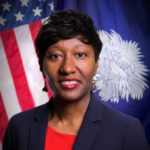
Interviewee: Christa Williams
Interviewer: Juliana Bozzo
Location: Remote interview (Columbia SC and Columbia SC)
Date: September 15, 2020
Accession #: ELEC 008
Length of Recording: 44:15
Summary
Christa Williams was born in 1984 in Orangeburg County, South Carolina, and raised in Santee, South Carolina. In this interview, Williams tells us about her childhood and hometown, her family and family traditions, and the work she does to engage in the community. Williams strongly believes in the importance of voting, but her main objective of her work with community outreach is to provide a service to the community and lend a helping hand.
Williams reflects on how her mother’s strong values have instilled the importance of civic engagement. She currently organizes voter registration drives, helping members of the community register to vote by providing registration forms and answering questions community members may have about the voting process. Williams also offers care packages with dry food items to community members at her events. Other topics discussed in this interview include the methods Williams uses to organize and promote her events, why some people may have a distrust in the voting system, the importance of visibility for the success of Williams’ events, and a thorough explanation of why every vote really does count.
Keywords
Community Engagement | Outreach | Election 2020 | Voter Registration | I Vote Too Campaign | Visibility | South Carolina Politics
Recording
Transcript
Juliana Bozzo: This is an oral history interview for the 2020 Election: Sharing Stories of Civic Engagement oral history project, part of coursework for Honors College class SCHC 326, documenting the perspectives and experiences of those who are engaged in some way in the 2020 election. This is Juliana Bozzo, the date is September 15th, 2020, and today I’m interviewing Christa Williams remotely. I’m in Columbia, South Carolina and Christa Williams is also in Columbia, South Carolina. Alright, Ms. Williams, Would you start by giving me your full name and spelling it, including your maiden name with it as well.
Christa Williams: Okay, my name is Christa Williams, spelled C-H-R-I-S-T-A, Williams W-I-L-L-I-A-M-S.
JB: Okay, where and when were you born?
CW: I was born in Orangeburg County, that’s in Orangeburg, South Carolina. And my birthdate is August 7th, 1984.
JB: Okay. So is that where you grew up? If not, where did you grow up?
CW: Well I grew up in Santee, South Carolina. Small town, two traffic lights, little retirement town, fishing town, no Walmart, no major – well, we do have Food Lion. But it’s a small town. You know, not much job opportunities, like I said it’s more of a place people come to once they have retired and finished out their career.
JB: Okay, can you tell me what the community was like at the time? I know you just touched on some of the economic aspects, but maybe religious or social activity aspects in the community at the time you were growing up?
CW: Well because it’s not… many distractions there, we don’t have a movie theater, we don’t have a skating rink, we don’t have a bowling alley, we don’t have a lot of options for entertainment there. Religion is very important, it’s in the South, so religion is very important, we have the Baptist churches, your Pentecostal churches, your Methodist. But Sundays it was always a big thing, a huge thing to go to church, to fellowship. Even throughout the week, your Wednesday night prayer services, your Friday night bible study. Church was more so, um, the centerpiece around engagement in the community and in the town when I was growing up.
JB: Okay. So, judging by the description so far in that you were saying it’s a small town, can I assume it was more rural than urban?
CW: Yes, definitely. Lots of farmland, lots of open fields with fresh produce and things like that. Growing up I think there were some fields with cotton in them. So yes, it was rural, farm town, the schools were not the best because you don’t have a lot of people that, when they’re finishing college that are wanting to navigate to those rural areas to teach and bring the best and brightest information. You don’t have the budget, those areas don’t get a lot of funds from the state level. You know, in so many ways that’s what makes rural country areas what it is because a lot of people like that type of environment. They don’t want all the funding from the state, they kind of want to be out there and do their own thing and just live a laissez-faire life, they don’t want all the structure, all the government, all the (unintelligible at 4:38) procedures, they want to kind of just live life the way that – simple, the way that they like to.
JB: Gotcha. Alright, now I’m going to ask you a few questions about your parents and grandparents, um, what were the names of your parents and grandparents?
CW: Well my family’s last name is Williams, Aiken-Williams. My mom is Lily Aiken, my dad is Willy Aiken. My grandparents last names were Aiken, I’m kind of a hybrid mix between biological parents and the parents who raised me. My biological mom’s last name is Williams, but the parents that raised me, their last names are Aiken. So, my grandmother, before she became an Aiken she was a Garden, and then she married an Aiken, and then the mother and father that raised me, they both have the last name of Aiken.
JB: Okay. And where were they from?
CW: Well, my parents, my biological parents, grew up in Santee, South Carolina, that’s the town where, you know I grew up. And Santee is in Orangeburg County. But the parents that raised me, they grew up, my dad – that dad grew up in Santee and my mom, she grew up in Clarendon County, in a small town called Davis Station, and that one is even more rural than Santee. I don’t think they have any traffic lights in Davis Station (Laughs). But I think they have to go to the next town over to go to the grocery store. Davis Station may just have one or two convenient or corner stores.
JB: Okay, what were some of the family traditions that you experienced – growing up, or now or anything?
CW: Family traditions, of course. Birthdays were always a thing to celebrate. I can remember, even if it was something small, every birthday there was a cake, probably, my mom liked to bake but sometimes there were box made cakes, sometimes she made the cake, sometimes she had asked a church member to make the cake. Birthdays of course were really big. The church that I grew up in was Pentecostal, so a big tradition there for Christmas, even though we spent the majority of Christmas Day with our family, that Christmas morning we had a breakfast, every single morning. And, most of the shopping were done for the Christmas breakfast, was from Sam’s. That’s before I even knew what Sam’s were because like I said, I grew up in a small rural area so we were traveling twenty-five miles to go to Walmart. So Sam’s was actually in Columbia, which is about an hour and ten minutes away from Santee, so I never went to Sam’s growing up. I went to Walmart, but not Sam’s. But that’s where a lot of the items for Christmas breakfast came from was from Sam’s. One of the members of the church, he worked for the Attorney General’s office in Columbia, and he would go to Sam’s and purchase all of the, a lot of the items that we… So we looked forward to that because there were hot chocolates and different things that we didn’t get on a normal basis that we had at the Christmas celebration. Most holidays, I mean this is the South, living in a rural town, with an African-American family, all of the holidays, Thanksgiving, anything that was involving food, those were all big traditions within our community. Fourth of July barbeques, like I said Christmas, Thanksgiving, trying to go through the list of… Oh, we would do a Christmas play every year at the church, Black History play at the church during the month of February. But mainly all of your major holidays were celebrated. And as I said, if you grew up at a Pentecostal church, so you know, we celebrated holidays.
JB: Have you or do you plan to carry any of these traditions forward?
CW: Yes of course. I still do these things now – I’ve been married before, don’t have any children, but planning to get married again soon. And the traditions are something that, you know, holidays or things that I would definitely do with my family. I know for now, for me while I’m kind of independent, not married at this point and don’t have children, I normally spent a lot of my holidays and that time giving back to the community. That’s just something that God laid on my heart to do. But I’m sure that once I start a family again, that I will be instilling those things into them. Because family time is very important, and I spend time with my family. As a matter of fact I’m sitting here in my sister’s driveway now, about to leave for her house. So family is very important. But I do believe as well, when you have an opportunity to give back you definitely need to do that. And I’ll be instilling those things into my children as well. That was one of the things that my mom did, she would go to the hospitals regularly to visit people who were sick and pray with him. So some of these things I kind of inherited from growing up, looking out and taking care of someone else.
JB: Gotcha. Who did you look up to?
CW: Growing up?
JB: Growing up, now, either way.
CW: Well, I don’t think there’s one particular person. I think it’s more of the person’s spirit that is attractive. And I tend to surround myself and look up to people that really have goals and ambitions in life. It doesn’t have to be necessarily monetary goals, or materialistic. Just if there out there and they’re trying to make whatever space they’re in a better place, I tend to navigate and network a lot with those individuals. Because that’s what we need to move forward towards more positivity and a more structure society, is having people who not only think of themselves, but try to bring other people along with them.
JB: Okay. How did you discover your passion for civic engagement?
CW: How did I discover my passion… Um, I don’t know if I discovered it, I think I just, like I said some of this stuff I’ve just kind of grown into, grew up in. My mom did a lot of stuff in the community, whether it be from passing out literature, or telling people about Jesus, to praying with them at the hospital, to baking cookies or baking biscuits and giving them out to families. So I think it’s just part of one of those traits that I just kind of grew up in, like I said a tradition. Traditions become normal habits, so living and growing up with someone who had those characteristics just naturally became a part of me. So these are things that I’ve just always done. As I’ve grown older I’ve realized that hey, everybody once I came out of the bubble of being home around my parents and coming out into the real world, you realize that everybody is not going to have those same goals and ambitions. And that’s what people look up to as something special, when people are doing things for other people, because for every person that you have doing something positive, you have somebody that’s doing something not-so-positive. So I’m just happy that my parents – the things that they did naturally are part of who I am today.
JB: Okay, how did you get started with organizing voter registration drives?
CW: Well – I’ve been a volunteer at some previous voter registration drives. I think what really has put the fuel to the fire for me to do them here recently in terms of even constructing my own voter registration drives, is the dynamic of us dealing with COVID-19. Like I stated in your class presentation that I gave, I’ve always been part of the Democratic and Republican communities, and networking with them, and participating in different events – you know, political events. Those things were so readily available before COVID. I mean, you could go on Facebook, or you could go online and find several events – that you could participate in or just be a part of. But when COVID-19 came around, it’s like all the boots on the ground action stopped. And a lot of people associated with the different political parties were told not to be out. Not from the standpoint of trying to neglect or not trying to help someone, but I think it was for safety precautions. So for me, I prayed about it and decided, hey I know COVID is out here, but at the end of the day we still need to try to help people. So because I wasn’t associated with any particular party, I didn’t work for a party, I decided to utilize some of my free time to say, “hey, let me just go ahead and try to keep this thing going. A lot of political candidates have their careers on the line, a lot of these people that work with them have their careers on the line, and if the general consensus among the parties, Democrat and Republican is to try to stay away from the public because of COVID-19, let me see if there’s something that I can do to help in the community. And to ensure that we don’t miss the mark with helping others register to vote.
JB: Okay. Can you tell me about the experience that you aim to provide for participants at your voter registration drives? By that I mean if I were to attend one, what could I expect to be doing – what is the process that the participant goes through?
CW: You mean a volunteer or somebody that needs to register?
JB: Somebody that needs to register.
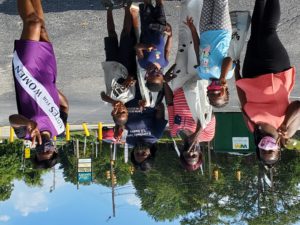
CW: Well we help them from start to finish. Participants, we will provide the voter’s registration form, we provide the pens, we provide the clipboards, we provide hand sanitizer, we provide masks. If someone cannot fill out the form due to being illiterate, we will help them fill out. But we ask that they sign and provide a date on that, because we don’t sign for anyone, but we will fill out their basic information that they need to register. If they have any questions, a lot of times we will answer them on site. But if it’s something that requires a printer, or more research or follow-up with the election office, we will get their name and number, and we’ll follow back up with them. I’ve followed up with some people that have come out to actually print off their absentee ballot application. So they could actually send it off and expect to receive a ballot, here in the coming weeks. So, I mean, also we not only do voter’s registration, we also do community outreach mainly through the form of food donations. So we ask everyone, whether they’re registered or not, would they like a care package. And within that care package is normally four to five items of dry foods, and if someone really needs assistance they can take two bags. As a matter of fact once I leave Orangeburg today I’m headed over to pick up food for the upcoming voter registration drive this weekend. So, not only are we providing voter’s registration but we are doing community outreach as well to build that relationship with the community. Because I for see the campaign that I’m doing not to just be a voting registration campaign, but also to just be outreach in the community. It could be the census… The community census that’s out there. It could be for drug and alcohol recovery – people that are recovering from drugs and alcohol that may need resources, or mental health if they need resources we can direct them to, some of those resources. There have been some volunteers, I don’t know from week to week who we’re going to get to volunteer until a couple of days before. But there have been some volunteers that have been active and provide resources for the mental health community, for people who are recovering from drug addictions and alcohol. So, it’s kind of a 360 approach to where someone that’s coming to register to vote, they may have other issues that they may need to address. And if we have personnel within our circle that can assist them, if not we’ll direct them elsewhere. So I would say we’re providing a 360 approach for people in the community – but the initial invitation, for them and us is through voter’s registration.
JB: Okay. What are your main day-to-day responsibilities that you hold with organizing voter registration drives?
CW: Most of the work that I do are on my days off from my full-time civilian job. So, on the days that I’m off I’m mainly doing things such as making copies, making sure we have all of our safety and sanitation equipment that we’re going to need doing the voters drive, making sure I’m stocking up on that, sanitizers, gloves, paper towels and things like that. Making sure that I’m doing an inventory of all the equipment that we need that we take out there, tables, chairs, tents because a lot of times some of the participants that are volunteers that come out there, they’re the ones packing all of this stuff up and they just put it back into the vehicles. And once it gets back to my house I have to take the time to do inventory to make sure that we’re keeping up with the equipment so we’ll have it for the next time we go out. I’m also coordinating with Operations Veteran Support, Dr. Brown is the director there, and we kind of coordinate on based on when he’s getting food in, when do we need to meet up to get food like I said earlier I’m meeting with him today to start getting food for this weekend. So mainly that’s, I guess that’s the leadership portion of it that I discussed with your class. The voter’s registration drive is what we’re doing, we’re just not setting up a table hoping people come to us, we’re wanting to provide a service to the community. We want them to remember us and make an impact on the community so if you want to make an impact on someone you got to be strategic in your approach. You can’t just be wilily-nilly and just go out there with paper and pen and say, “hey register to vote”. You want to make sure you’re providing a service that’s organized that’s well thought-out, and that’s planned, and the people that are helping you and volunteering are going to see that as well. And if they see that organization and leadership in what you’re doing, they’re going to be more inclined to come back and volunteer and invite other people, and that organization will also attract new people.
JB: Okay. What methods or platforms do you use to promote the voter registration events that you organize?
CW: Well – mainly what I’m using right now is word of mouth, being visible in the community, using social media, mainly Facebook, I send some emails, I have some text groups as well. One of the organizations that I’ve worked with, they’ve even suggested maybe I should go into putting stuff out of the radio. And maybe I will do that, I’m thinking after the 2020 general election on November 3rd I’ll probably start using the radio as a media outlet to get the word out, because we’re still going to be doing voter’s registrations after November 3rd. But I think the momentum won’t be there because it’s not a general election that everybody’s looking forward to. So in that case I would probably start using the radio to get the word out more on exactly what we’re doing and where we’re going to be because we’ll probably be one of the only organizations that’s still doing voter’s registration up until the next major election. But in conjunction with voter’s registration we’re also providing outreach for the community, so with us having food coming in and needing to get food out to the community we have to keep pushing as an organization to keep that flow going, with voter’s registration and getting food out to the community as well.
JB: Okay, why do you think these methods are most effective? I know you touched on why the radio one would be effective but maybe talk about Facebook or the messaging groups.
CW: Anything that can show visibility, those are the things that are most effective. Radio is good for coverage but it’s a lot of times once people have identified a kind of idea of who you are and what you know, the radio kind of broadens that. That visibility piece is a big one and that’s why I’m big on taking pictures so that people can actually see. Before I started this voter’s registration campaign I did a leadership conference every year at the South Carolina Department of Corrections, and I had no problems getting speakers because of the way that we took pictures, we put the pictures onto a drive, whenever we would invite a speaker in we would send them the link to that drive, and they would get a chance to see what the event looked like from start to finish. And I think the biggest thing for people, when you can show them what you’re doing, you can tell them all day, but there’s something about them being able to see what you’re doing, they will look at those pictures and it will create motivation or whatever they feel to say yes I will participate or yes I want to be a part of this. So anything that’s going to put your videos, I’ve been doing videos on social media, even in the text groups I send pictures. Also giving people something to look forward to I started doing a count down, so I use some of the pictures from the voter’s registration drives and the community pictures to do a countdown where every day it tells you how many days until the election. I think today was forty-nine… Forty-nine days as of today until the election so on my social media page I have a picture of us engaging in the community and have forty-nine days until 2020 election. Those types of things try to kind of keep people on track and motivated to be… motivated about what you’re doing.
JB: Okay. What are some difficulties that you encounter with the community while trying to register voters?
CW: Difficulties, you’re going to have individuals who are just going to feel that for whatever reason they don’t want to participate in the voting process. But you still have to maintain your professionalism and keep your opinions to yourself and things like that. Because you’re going to have some people that are going to challenge you, I’ve had many that have challenged me, what’s the purpose, why am I voting, I mean what do you get out of that. But you’re just (unintelligible at 27:07) and that’s the whole purpose of us having the food donations as well, to not only say we’re not only here for voter’s registration but we’re here to help you. And most people, they’re not going to turn down a helping hand if it’s offered to them, and some have not registered and they’ve gotten a bag of food from us, and they’ll take ten steps and then they’ll turn around and say “hey you know what, I think I’m going to go ahead and register to vote”. You have some that will come up with this wall of I don’t want to vote, don’t tell me about it, and I’ll ask the question, “hey, you don’t have any prior convictions do you?” And they’ll say, “Yeah – I do have a prior conviction”, I’ll explain the process to them of how they can vote even if they have prior convictions if they’ve completed their probation parole time, if they have paid all applicable fees they can vote, and right away they tell us “hey give me your phone, I’ll go ahead and register”. So some people because they may not be educated on the facts, they put up this wall to voting. Some for whatever reason they just never thought of it as something important, put up a wall, but most of the time when they see that you’re genuinely there to help the community it seems like their distrust kind of melts away, and they accept the helping hand that you’re trying to lend to them.
JB: Okay, do you publicly support one particular political party?
CW: No. I’ll tell anybody I’m a swing voter. I look at the candidate and what they have to offer, Republican Democrat Independent, whatever, my biggest thing is are they there for the people, okay and for the people you have to be inclusive. Because we’re all different shades and ages and everything in between, religions, so if the candidate is for the people, I’m for that candidate.
JB: Okay. What, if anything, do you think needs to be changed about the voting process in general in order to prompt more people to vote?
CW: Well, I think at a local level there needs to be more engagement with the community from the actual political parties. The political parties kind of have this image of only coming around when it’s time for an election. I feel like when there’s no election members in the groups should be out in the community, educating them, having classes, having barbeques or whatever they want to do at that time to educate people without expecting anything, without expecting a vote. I think that’s why a lot of people who are on the fence about voting have this distrust in voting because some of them have even asked me, “So you want us to vote for you?” I’m like no. I’m not looking for you to vote for me, I’m not a political candidate, we’re just simply here to help you. I think that’s a big piece that’s missing, a lot of people get so caught up in vote, and they want to just flood the community when it’s election season, but what about when it’s not election season I think that’s a grand time to get some of these people involved, who are not involved in the process. And that way there’s time and availability to do that without being rushed and being in the middle of all kinds of mixed emotions because it’s an election season.
JB: Okay. Can you tell me about the election… Or like, the past election that has had the greatest impact on you?
CW: Well one of the things from the past election that’s had the greatest impact on me to do what I’m doing now is the fact that we had twelve million registered voters who did not vote in the 2016 election. Twelve million people who were registered but did not simply think enough of the voting process to actually go and exercise their rights to vote. So I think to that twelve million… could grow, for this upcoming election. If we don’t have people out in the community who are keeping people motivated to vote… I think that’s one of the greatest impacts for me and what I’m doing, is the fact that we lost twelve million votes. Twelve million. In the general election for 2016, for whatever reason, working, or just didn’t think it was important enough to actually go out and vote.
JB: That’s crazy. Has your passion for civic engagement, or just like how you said it’s how you’ve grown up, has that ever prompted you to participate in protests?
CW: No I don’t have… I mean, as of now I’ve never participated in a protest. Not saying that I won’t ever, but at this point because I’m heavily involved in the process and I research who affects change, who’s responsible for change, I try to go directly to those individuals and try to express concerns. And if it’s a situation where the individual who controls the situation is not interested in changing or bettering that situation, we as a community need to vote that person out of office. So I understand the process… Protesting, yes and by all means I’m not saying… Those methods, outlets, need to be done in some situations to get the word out about various things that have happened within the communities. However, I’m more of the person that is going to be in the background pushing those elected officials, or writing those elected officials, or trying to set up a meeting or interview with those elected officials to get what we need to get accomplished. Okay? Because everybody has different skills and talents, and sometimes when you’ve gone that route of trying to meet and talk face-to-face and it doesn’t work, then that is the time to bring the public in and make it a public event because that’s the whole purpose of voting and that’s why we need to get people to be part of the process because a lot of people aren’t realizing that that’s part of it. And whenever you want certain things changed in your community, okay? You don’t have to beg anybody. You have to elect the people that are on board with the concern that the community has. It is not impossible to make changes in your community, you have to be on board with the voting process and getting the right people into those offices who are on board with taking care of the community.
JB: In your experience, which groups of people have you observed to be more hesitant to vote? I know you mentioned earlier the group of people who have convictions, but are there any other groups of people, or any type of group you’ve observed that has been more hesitant?
CW: Yeah – you’re going to have individuals, especially individuals that are in disadvantaged communities that have a distrust. They have a distrust because a lot of times they see politicians that grow up alongside them that become politicians and are in positions where they can make changes, and you know the whole attitude of ‘you forgot where you came from’. So they are not making any changes within their communities. They are in other agendas and forgetting about the community. So I think over time some people have just gained a distrust, and especially when it’s what we portray on TV as well in terms of the political system, when there’s a lot of confusion, arguing, different things like that, naturally some people who don’t see beyond that, it turns them off. It turns them off to say “you know what, I don’t even want to be a part of this or hear anything about it”, the only people that’s prospering are those individuals that they see on TV and they still see four years, eight years, twelve years, sixteen years later, that the conditions within the communities have not changed. So why am I voting? So in a lot of the disadvantaged communities you’re going to see that, and rightfully so. And that’s why it goes back to what I just said about politicians being a part of the community when it’s not election season. Let’s see more congruency and people trying to get out and educate and help people when there’s nothing on the table, when you don’t need anything from them. Let’s keep that momentum going of helping other people and not expecting anything. I think that’s going to bring transparency to the system, and it will improve peoples’ trust within the system when they feel that there are representatives out there who simply want nothing from them, except want to give back to the community.
JB: Okay. What resources do you use most frequently to keep yourself updated on current political issues?
CW: For current political issues my resources… Of course I utilize the news, I utilize one-on-one conversations with people. You learn so much just from a group huddle of coworkers, you’re out to dinner and somebody may throw something out there, and I’m like, “hey I didn’t hear that let me look that up”. Just get a network of friends, because we all are in different places and different locations. Also online you can keep up with what the state legislature is doing, social media’s a big one because a lot of your politicians they’re going to post a lot of current things that are going on on their social media pages. I have friends that work in different capacities, like I have a friend of mine that works at the election commission for instance, and I hear him talk probably about once a week. And they just have approved that absentee ballots can be done for COVID reasons. So we’ve accomplished that for the state and that’s a really good thing that people are able to do an absentee ballot because of COVID because that was a big concern going into this election, was that a lot of people were going to be fearful about coming out to the community with COVID-19, are they going to be able to vote absentee using the excuse of COVID.
JB: How do you respond to someone… I believe someone in my class asked you this when you spoke to us, but how would you response to someone who said voting doesn’t matter because of the electoral college?
CW: How would I respond, well I would respond to them and say that every vote counts, and that saying is very true that every vote counts because that’s what makes up the delegates that makes up the electoral college. The 2020 census also counts. People need to be counted because the more people that we can prove are in these areas, then we can have more delegates for these areas for these elections, so it all ties in together. People count, we all count and that’s why we tell people their vote counts. Their vote counts, their census application counts, all of that ties into helping increase the number of delegates in a particular area, and the more delegates that are in a particular area, then the more people that vote, then the more delegates that a particular candidate would get if they receive a certain number of votes in that area. So all of it ties together – my feelings on the electoral college, I mean… You’ve got a lot of big states, you know California out there, so some theory is that if it wasn’t for the electoral college, then some of those candidates would only have to win certain states and they would win because those states have so many people. So I mean with the electoral college, same thing, the popular vote, if more people vote then that’s going to improve the candidates chance of getting delegates in a particular area to win that particular state. It all ties in together and everybody’s vote counts, and we need more people to start making sure they complete the census. The Census Bureau actually comes out to the prisons and counts inmates, and these people can’t even vote but they will count them to that these particular areas, it will improve the delegates for those areas. So people that are actually out on the street, it is very imperative for them to complete the census as well because that will go towards the number of delegates that each state will have, so that will be counted in terms of an election.
JB: Okay. My final question for you today is what would you like to say to young people about the importance of voting in local, state, and national elections?
CW: Okay, what I would want to say to young people is something, of course you hear it a million times it’s very important, and we need to start… Every seventeen-year-old needs to start their generation out right, okay? Start their generation out right and bring the most productive and brightest people into these offices, if it’s yourself, run for that office and do the best job that you can. But every seventeen-year-old that’s coming out of high school, start your generation off the right way. And encourage others to register, you register to vote, keep that momentum going within your generation so that you will have a successful life on this planet for your generation. Because that’s who is going to carry this planet for the duration of your generation. And if you are encouraging the generations that are after you, you know, that’s like I hear people say “Well by the time that you all get into the workplace and we’re retired we won’t even have social security”, and that’s just an example. So if you see that stuff coming, then that’s the opportunity for your generation to get out and motivate and encourage the young people to do what they need to do to keep this thing going. Okay? So I say that in the same in terms of voting, every seventeen-year-old get out there and start your generation off the right way.
JB: Okay. Well thank you so much for taking the time to speak with me today Ms. Williams.