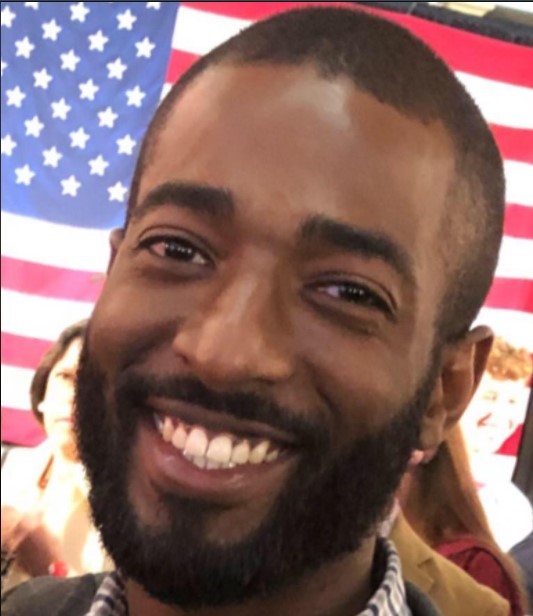
Interviewee: Travon Adams
Interviewer: Aakash Patel
Location: Remote interview
Date: October 11, 2020
Accession #: ELEC 017
Length of Recording: 47:55
Summary
Travon Adams was born in Manning, South Carolina on November 21st 1990. His family moved to Baltimore where he spent his early years before moving back to Sumter, South Carolina around age ten. This interview includes a discussion of Adams’ early life, his family, military service in the U.S. Army, and work in the political sphere. Adams highlights his father as one of his role models and a big catalyst of his political activism. He also cites his military service as an important aspect of his political ideology. Travon graduated from USC with a degree in Political Science in 2019. This interview includes discussion of his experience working on two political campaigns, including the Bernie Sanders 2020 campaign, and working in the mayor’s office in Columbia, South Carolina.
Keywords
Politics | Military Service | 2020 Election | Bernie Sanders | Voting | Political Campaigns | Joseph A. De Laine
Recording
Transcript
Aakash Patel: This is an oral history for the 2020 Election: Sharing Stories of Civic Engagement oral history project, part of the coursework for Honors College class SCHC 326, documenting the perspectives and experiences of those who are engaged in some way in the 2020 election.
This is Aakash Patel, the date is October 11th 2020 and today I’m interviewing Travon Adams remotely. I am in Columbia, South Carolina and Travon is also in Columbia, South Carolina.
So Travon, can you tell me about where you grew up or where you were born?
Travon Adams: Uh yeah, so I grew up, well first of all I was born in Clarendon County, Manning South Carolina. Before I turned one years old my father got a good job in Baltimore, Maryland so we moved up to Baltimore, Maryland. I spent the first nine years of my life up there and then we moved back down south to Sumter, South Carolina. Technically a small town called Gable, South Carolina. Um, and I went from the city to a farm, essentially, instantly overnight and uh, we went to my grandfather’s farm which was a far different lifestyle from the city.
AP: How did, well what did you see as the biggest differences between living in Baltimore versus living back in South Carolina?
TA: Well Baltimore was much more developed than, you know, South Carolina and it had mass transit, you know the MTA (Maryland Transmit Administration) Bus system, light rails, everything was pretty much a hop and a skip away. Didn’t really have a need for cars.
AP: So a more futuristic version?
TA: Yeah, much more high speed than South Carolina. Um, you know the biggest difference from up there to down here, you know in South Carolina you got to drive everywhere, everywhere takes about thirty minutes, forty minutes to get somewhere. You need a car down here.
AP: So you lived in South Carolina for what, from what around ten years old onward?
TA: Yeah, for South Carolina it was ten years, yup, ten years onward until now, yeah.
AP: Okay, tell me about your family.
TA: I had a pretty big family, both my father and my mother, their grandparents, there was twelve of them. So there’s twelve grandparents and grandaunts on each side of my family. So there’s, I don’t even know all of my cousins, our family’s so large than even when we get family get-togethers, or family reunions, it’s different sects of the family get together.
AP: Yeah, I can understand that, whenever my family gets together I have trouble putting names to faces like a lot of the time.
TA: Yeah, same. I don’t even know half my aunts’ names, I actually just had one of my grandaunts passed away just a few days ago actually.
AP: Oh, I’m sorry to hear.
TA: That’s okay, I mean her name’s Aunt Pat. She’s 98 years old.
AP: Oh so she lived a full life then.
TA: Oh yeah she lived a full life, yeah definitely.
AP: Did you get to know her well?
TA: Not too much, I only visited her a few times when I was younger. Doesn’t stay too far from where my grandfather stays, that’s where we moved when we came home from Baltimore. We stayed on my grandfather’s farm and it’s a large property, rather, my grandfather has 65 acres to himself. And my immediate family, the rest of my family, grouped together is 175 total acres.
AP: Wow that is a lot. Who would say was the most influential family member in your life?
TA: I’d have to say my father, my father was definitely the most influential family member in my life. As far as the morals and values I hold to this day he’s definitely responsible for, I’m pretty much a carbon copy of him. I would say I hope I was slightly improved and I didn’t take all his vices with me as well.
AP: Yes, yes of course haha.
TA: So some of those virtues would be honor, loyalty and integrity. Manners, self-respect, I definitely carry that with me to this day.
AP: Just being a gentleman.
TA: Yeah basically, being a gentleman.
AP: Was your family very political growing up, did you notice that or were you ever immersed in politics?
TA: So my father was very political when he was younger, so my family all my family, is pretty much from the area of either Hartsville or Sumter, Summerton, Manning. That whole Clarendon County, Sumter County area is where the majority of my family is from. And my dad, when he was younger, in the town of Summerton, actually quite uniquely and disappointingly, but one of the cases from Brown v. Board of Education came from my father’s hometown of Summerton. So you know that was a class-action lawsuit, lawsuits from all over the South that was going up with that case. And my dad, when he was younger, the town of Summerton was still pretty racist, still pretty segregated. It’s one of those classic southern towns, where it has a railroad in the middle and on each side there’s the white side of town and there’s the black side of town. And you can tell cause one side has rinky-dink houses and trailers and the other side had brick-and-mortar houses. The wealth gap was definitely stark. So my dad, growing up in this environment, he went to a city hall meeting where they were discussing appropriating funds for a new fire truck. So my dad stood up and he said ‘you guys are appropriating this money for a new fire truck but I actually went down to go see the fire truck today, the one we currently have. And it has brand new tires, and it has less than 2,000 miles on it so I think we could better use that money somewhere else.’ And they were like, ‘Oh yeah? Well where do you think we should put the money?’ And my dad was like “Well, we should build sidewalks on this side of town.” And someone asked him, “Well why should we build sidewalks on this side of town?” And he was like, “Well the same reason you have sidewalks on the white side of town.”
So he actually ended up getting some sidewalks built in the black part of town in Summerton and outside of that he also was a mentee of Rev. Delaney [sic Joseph Armstrong De Laine, 1898-1974]. I think his name was Rev. [De Laine], I can’t remember his first name, but he was a Civil Rights icon, I actually saw one of his pictures on the walls of one of the colleges at USC, I think it’s where they teach the teachers and everything, where the future teachers go. But anyway, my dad studied under him for a little while, how to take part in the non-violent movement and all this stuff. But Rev. [De Laine] actually fled from South Carolina because of a bombing, he was getting death threats and everything like that. So he actually fled up north. So yeah, that is an interesting point. And also, my father participated in this group called the Sixty-Niners, if I’m not mistaken. And they were like young, activist group fighting against racism and stuff like that. I think my dad eventually got out of that group because he felt like their mission kind of strayed away from what they had originally kind of founded it as to be. Since then he, that was kind of the end I think his formal involvement in politics. And all growing up my dad would always, you know he was a student of history. He loved history, he loved talking about the Civil Rights movement and educating us on why the world is the way it is, why was there segregation, why is there racism. So there were a lot often political discussions at the table, my dad would talk about what he heard on NPR, cause we also a truck driver. So all day long he’s listening to NPR or listening to Rush Limbaugh to see what he has to say on the matter, even though it wasn’t his own perspective, but just knowing the other side. If you’re going to argue against a conservative or a liberal, or whatever you want to call it, whatever side of the fence people are on, you need to know what their opinions are. So that you can better formulate your counter argument, so what solutions need to be had. I was always raised in a manner to where politics was first and foremost on my mind, and social justice was also.
AP: You’re father sounds like a very impressive man, it sounds like I could sit there and listen to his stories forever it seems like.
TA: Yeah definitely, this interview could almost become totally about my father because he is much more interesting than me haha.
AP: It seems like political activism does run in your family then.
TA: Yeah definitely, definitely with my father as far as I can see. I don’t know about anyone else, but my dad was definitely very aware and definitely educated us in that manner. Some side notes, some interesting stories about my father. He rapped against Run-D.M.C. one time when he was younger, he also got to, he knew Jada Pinkett-Smith, and a lot of people who are famous today. Even Tupac, a lot people they were in Baltimore at that art school in Baltimore. My dad was also around their age, and when he would go out in clubs at night and stuff he would get to know and mingle with these people who are household names today.
AP: That’s insane, it looks like next time I have to interview your dad.
TA: Yeah, right. Yeah, you totally can. We can set that up.
AP: Yeah I’ll let you know. Would you point to anything else that influenced your politics or your political activism in your life?
TA: I think that the biggest thing that started to pull me into activism was, I’ve always been a kid who, like my father he raised me to like history, so I was always watching the History channel and trying to figure out why the things I see today are the way the are. I was always a curious person, and as I started to dig more and more, I think the 2009 financial crisis is what really made me very, very interested in wondering why Wall Street gets to make all these risky bets and we ended up bailing out Wall Street. But we never bail out Main Street. We never take care of everyone who’s really hurting, you know, and I think that’s what, I saw that as being unjust. And graduating, I graduated high school in 2009, so there were like no job prospects when I got out of high school, the economy was a wreck.
AP: One second, I’m sorry to interrupt you, I forgot to ask you how old you were. So, just for reference.
TA: Oh yeah, I was eighteen, I was born in 1990. I graduated in 2009, I was nineteen years old at the time, well actually I was eighteen at the time I graduated but turned nineteen later that fall, when I went to college. Or that next spring semester I actually went to college. So yeah, that alone was tough. And a place like Sumter, it is a militaristic town, the only thing that kind of keeps it going is its history, related to Thomas Sumter, and Shaw Airforce base is the biggest attraction in that town and if that base wasn’t there nothing would be there so that’s, I guess, kind of why I grew up with a slightly militaristic leaning. Knowing that I would probably participate in the military, especially with there being so little job prospects when I graduated as well.
AP: Did anyone in your family serve in the military?
TA: Yeah my grandfather served in the military, he served in Vietnam, he was in the communications department. So he wasn’t kicking in any doors or anything but yeah he definitely served.
AP: Did that affect your decision to serve?
TA: Yeah most definitely. My grandfather, I think, he was the proudest, him and my father, were the proudest of me when I graduated from Fort Benning in Georgia for my basic training. I’d never seen my grandfather so proud of me ever in my life.
AP: That’s nice, can you tell me a little bit about your service? When did you start?
TA: Yeah, so um, I started serving, wow I’m getting old, in 2010. The summer of 2010, so originally when I graduated, like I said, there were no job prospects when I graduated from high school and my family was always like ‘Hey you’re either going to college or you’re going to join the military.’ So I did both.
So I went to coastal Carolina at first and I was in their ROTC program. And a lot of us would join over the summer and come back to school, because you get the little extra pay, you get a little money for college and everything, before you commission to become an officer. And I also wanted to get some of that enlisted experience, because you’re being enlisted as an officer class. I wanted to know what it was like being an enlisted soldier before I just come fresh out of college telling grown men what to do with no service of my own. So I joined in the summer of, I think it was June 16th, or 2010 was when I shipped off to basic training. After that, when I got done, I also went to AIT in Newport News Virginia to learn how to work on Apache helicopters and after that I turned back to South Carolina and submitted my application to join back up to school but was, uh, was informed that my unit was shipping out to go to Iraq and that I would not be able to attend school. So I rushed down to go see my unit in Fort Stewart, Georgia and then to go to Fort Hood for some more hands on training because you know, the Guard, we don’t do it 24/7. We’re not fulltime soldiers, there’s a lot of training and prep work that goes into getting the National Guard prepared to go to war. So we went to Fort Hood and flew our aircraft, with our pilots, and my job was to work on them. So we were working twelve hour shifts and getting trained up and ready to go for what was ahead. And after that, after we shipped out of Fort Hood, I think in that September or it may have been sooner than that. I think it was around early September though, we shipped out and arrived in Kuwait at first. It was so hot, coming off the plane, everybody thought it was the jet engines. We all knew what jet engines feel like cause we worked on them, actually Apaches have jet engines in them but they’re configured in a way to where they’re putting out high torque. They don’t have flames spitting out the back or anything like that, but they’re definitely meant to turn the rotor blades at a very high rpm. So we thought that that was heat coming off the exhaust but it turns out no, it’s just that hot in Kuwait. Like it’s, it feels like, I don’t know, like you decided to hang out under Satan’s armpit for the day.
AP: I understand exactly what you mean, last summer I believe we stopped in Dubai for a layover, it was a 16-hour layover. And, so we stayed in a hotel and I went outside just like, the next morning before we were going back to the airport. And I could not last in that heat for more than a couple of minutes before I had to run back inside.
TA: It is incredibly hot, and it’s incredibly bright. The sun is scattering, the light is scattering off the sand. You have to wear some shades over there or you’re going to come back with some eye problems.
So we got settled in in Kuwait for a little bit and then we shipped out to Iraq, to Baghdad actually. We had a base called Taji, it’s called Taji Iraq. I spent the first month, I think, the first month to month and a half of my deployment in Taji. And as soon as we got off the bus, with all our gear, we had our rucksacks on and our assault packs strapped to the front of us with the rucksacks on the back. So we had all our gear, duffel bags and all, soon as we got off the bus immediately there was an explosion. Like BOOM! It rocked the entire ground, and we all hit the ground, and we noticed that everybody else around us didn’t hit the ground, they were acting like everything was normal, like this was an everyday occurrence. Some of them were even laughing that we had hit the ground so fast, [cuts out I think] like we just got there and that we would have to get used to this type of thing every day. And when we got word back on what the explosion was it was what we call a VBIED, which is a vehicular IED essentially. So someone rushed the front gate with the IEDs in the car and they detonated it outside the front gate. That, I think, was so surreal to let you know that you are indeed in a war zone, and that this is not a fantasy, this is not a game, this is not… you know?
AP: I can’t even imagine. I cannot even imagine.
TA: It was pretty, it was a pretty decent reality check I would say.
AP: So as a veteran that served in Iraq, how do you feel about what’s going on right now with our President and our troops abroad?
TA: Ohh that’s complicated, you know, I think going I was a bit green-eyed; I still think my intentions were honest. I thought I was protecting my country, I thought that I was, you know I remember 9/11. I remember seeing, being in the fifth grade and watching. The teachers came back in the room with this somber look on their face and turned on the television. And we watched the planes run into the buildings, we watched people jump out of the skyscrapers. For someone that, I think in the fifth grade you’re around ten years old. That’s traumatic, and I thought that I was going to do the right thing. It turns out, hey I think fourteen out of the nineteen hijackers were Saudi, which complicates things more and it makes you ask the question we are we even in Iraq. And I get that Saudi Arabia is one of our allies, and mostly because of Saudi Aramco and oil, and its very complicated. But I do think that, I do think that what we did was wrong and unjust. And a lot of the soldiers don’t necessarily get that, we don’t really have the power. It’s mostly senators, and corporations who the senators are doing the bidding for, to send us over there to do that type of stuff. It’s not their sons and daughters they’re sending over there, it is the poor, the meek, the meager.
AP: I’m pretty sure I read somewhere that there are soldier’s sons who are going to war that are being assigned the same duties that their dads were, in the same place even. I think its crazy that a war has gone, has spanned two generations at this point
TA: Yeah, its hard. I didn’t even think about that, but yeah we’ve been at war, even for you Aakash. I think we’ve been at war for as long as you’ve been alive.
AP: Yeah I was born in ’98, I’ve in the US since 2001 so pretty much my entire life in the US we’ve been at war. And sometimes it honestly doesn’t even feel like it.
TA: I know, and that’s how, I think in the military learned a lesson about not showing how many soldiers come back home in body bags. It makes people, it lets the American population know how real this is. All these families that are suffering, the yellow ribbon families, they know that pain. They know that suffering, of the loss of a family member, a loved one, a song or daughter. Most Americans don’t get to see that, it’s not on the news, it’s a blackout when it comes to what’s going on over there. Because they know that Americans will lose their taste for war if they knew the tragedies of war, which is actual death, destruction. People coming back home, destroyed.
TA: There is nothing romantic about war, I [what] thought the movies that come out and give this inaccurate portrayal of war. I mean yes there is lots of heroism in war, there’s lots of courage and lots of selfless sacrifice, but its actually not really for the country. Even when we’re getting trained they tell you ‘fight for the guy on your left and your right’. We’re not worried about the complicated politics of everything, its about making sure that your friends and your buddies, even if you don’t like them. Even if he’s not your buddy, you guys are all in the same crappy situation where we have to lean on each other in order to make sure that we make it back safe. And its actually more, its more fear, and they don’t like to portray the fear a lot in war. Everyone’s running around like Rambo or something, but no. You’re scared, you’re scared and a lot of people, it’s a lot of friendly fire. I think at least a quarter of the deaths are due to friendly fire from your friend. Because war is so chaotic, nothing is clear, that’s why they call it the fog of war. Nothings clear, you don’t know if you just sprayed at the enemy or you just sprayed at your friend. You’re supposed to check that, your training is supposed to keep you from doing that, but when you’re in the situation and you’re so fearful, things happen. And for me, fortunately I was not infantry, I did not have to deal with what some of my other brothers and sisters have to deal with. Actually face to face all the time. I worked on aircrafts, my biggest issue was I kind of felt like a crab in a barrel. The airfield is long and flat, there’s not a lot of places to hide. They would purposely shoot at the airfield, shoot mortar rounds or rocket attacks at the airfield. Not being able to, its like someone throwing stones at you and hiding. You don’t really, how angry that makes you. The only thing that I can do it to make sure this aircraft is up as quickly as possible to make sure that we neutralize any threats.
AP: Would you say that your military service influenced your politics once you came home?
TA: Yeah, I definitely thing it made me more anti-war. I definitely, just like many of us, come back with hidden scars. Even if you didn’t get your leg blown off or some other mutilating type of injury, your mind has hidden scars. For me I came back and had to deal with readjusting right into college life when I came back from Iraq. I went straight back to school, I was different from my peers, I didn’t know how to relate to my peers. When you’re in charge of a twenty-million-dollar aircraft, and you mess up you can go to jail. Its negligent, you can kill somebody. So much responsibility at such a young age, I think, made me unable to even connect with my peers who were just worried about partying, living their best life. And here I was struggling with even how to even fit in, how to even process what happened to me and to bring myself from this constant paranoia of loud noises and snapping my head really quickly in the direction of the noise. Or like dealing with anger issues, dealing with depression, dealing with anxiety. It took me years to get reacclimated.
AP: Do you think that the federal government could do more to help you and your brothers and sisters in the armed forces reacclimate to life?
TA: I think they do a sufficient job after the fact. The fact still remains that we don’t need to go to war unless there is an imminent threat to the homeland. We do not need to go war. We do not need to demonize and otherize other people, just to exploit their natural resources. I blame Wall Street, I blame our senators, I blame everybody who was complicit in this because all it does is to take a little bit of ingenuity or a little bit of innovation to make us not so dependent on fossil fuels or natural resources. All it takes is an investment in green technology to make us self-sufficient.
AP: I hear you, definitely. We’re not moving forward as quickly as we could be or should be.
TA: For me you know, I definitely think the VA’s had numerous reforms and it is doing well, but I do think that we don’t, we shouldn’t be sending our children to die for somebody’s blood money. The truth of the matter is the majority of Amerians don’t benefit a single cent from what is being exploited outside of our borders. 48% of Americans struggle to pay their bills, one four-hundred-dollar setback could ruin them. Most people are struggling, most people don’t have enough to get by in a day to day society When you’re talking about housing is unaffordable in all fifty states in the United States, and is at least a third of your cheque. And then you got your car payment, you got your insurance, all these associated costs. Even the cost of eating, even having a roof over your head. Most people don’t have enough money in their pocket, or wiggle room, and they’re living off of credit cards. I mean is this America? Is this what America is supposed to stand for? I thought that this was a place of opportunity, a place where there was wealth mobility. But I mean, wealth mobility is… I can’t remember the statistics on it, but I do know it is a lot harder. If you’re born in the lower class you’re more than likely going to die in the lower class. For most people there is almost no class mobility and you kind of live and die on the same wrung on the ladder. And I don’t think that’s what America promised.
AP: That’s not the American Dream.
TA: I think its not living up to what is promised, like I said I think its highway robbery. I don’t understand how people can value jobs like hedge fund managers and your big wall street types. They’re making money off of money, that doesn’t even make sense. There’s nothing tangible about what these guys do, and then they walk around with their chest poked out because they make a whole lot of money but what have they done for society? They’re not as valuable as a teacher, they’re not as valuable as a doctor, they’re not as valuable as a social worker. And I think that America has to check its values, I think my military experience has shown me that a lot of people are making sacrifices for this country and aren’t getting any of the benefit. Somebody like Trump pays less taxes than someone that makes $33,000 a year. That’s absurd.
AP: There are numerous Fortune 500 companies in the US that paid little to no taxes the last couple of years.
TA: Yeah, Bank of America, AIG.
AP: Netflix, Amazon
TA: Mmhmm, we have to ask ourselves what is that we really want from this experiment, essentially. Our government is nothing but a social experiment. And I think that it’s time to change some things, time for us to make some amendments to the Constitution. Its not like it’s a holy piece of paper that you can’t adapt and change. It was made to be adapted and changed, and I think even I think it was Thomas Jefferson, I think he even recommended that we should ratify the constitution every nineteen years. I mean if you take that now, into the average lifespan of a person, maybe that’s like every thirty years. But he thinks that it should be ratified.
AP: I don’t know the facts on that, but it sounds like a good idea honestly. The Constitution was formed with the idea of it being a living breathing document, and it changing with the changing values of society and the changing values of, just, international politics. I totally agree.
TA: I don’t know, a lot of people seem to reference the Founding Fathers so much, and trying to interpret what it is that they wanted or did not want. But I think we should also relegate some of these 18th century ideas right where they belong, in the 18th century. We have to move forward. A lot from these mechanisms are not sufficient, but at times that we’re in. And every president can’t keep coming around here making executive orders and unilateral decisions without Congress. That’s a huge problem, I think our country is in decline. Honestly, honestly I do. I honestly think that.
AP: When did you formally stat getting invested into politics, or when did you begin working in politics?
TA: So I began working in politics, first I, formally, well stick with that. Formally I got my first internship to work for the Attorney General in South Carolina. I’m a Democrat, he’s a Republican. But I felt like it was, like my father always told me, that it’s best to know what the opposition thinks. To understand them, to try and put yourself in their shoes. I think you’re better able to, one, combat those ideas, you know if you know exactly where they are and what’s the root of them. I think that you’re just more prepared and more informed. And it allows you a certain amount of empathy too. I mean I think that the pain that Conservatives or democrats feel it’s all real, this pain is real. People are suffering economically in this country. But the causes of their suffering, the causes of their suffering they make think is different depending on who is telling them what. For me, the first time I got involved in that 2018 midterm reelection for Alan Wilson. Learned a great deal, learned how to be a field organizer. Although I don’t think it was too hard, Republicans tend to fall in line and vote. There’s not a lot of discussion of debate for who they’re going to go for. When it comes from the top, and Mitch McConnell is like “this is who we’re voting for, this is who we should vote for” that’s the way the party goes. So I didn’t run into too many people in that party who were not willing to vote. But I do think that the conversations that I had were invaluable. He did end up winning that election, and we got a pat on the back on it. Because I was an intern, wasn’t getting paid or anything. I was trying to gain experience as a political science student as USC. And then after that I got involved again at the Mayor’s office in Columbia which was an honor for me to do, especially for I think the first black mayor this city has had.
AP: Mayor Benjamin, yes sir.
TA: Yeah, so that was a great experience, learned a lot. It wasn’t any type of campaign mode, it was more of just doing the day to day tasks for what it takes to run a political office. Such as sending letters to constituents, putting together formal events, other mayors I think, specifically we had the Mayors Innovation project where there was Mayors from all over the united states that came into Columbia. We talked about different policy issues and how to get mayors and governors and people that are not of the senatorial class to start getting on the same page about what direction this country should go in. Really, mayors and governors run this country. As far as the impact they have on the day to day and running the city and running the state.
AP: Oh yeah, local and state governments have so much influence over the day to day versus the federal government
TA: So I definitely learned a lot from that experience and immediately after that experience I was given the opportunity, thanks to the mayor, to work for the Bernie Sanders campaign. I think originally they wanted me to work for the Biden campaign but that’s not really where my politics lied. I’m more progressive, so I went with my heart. I went with Bernie. I started off in the job process as a field organizer but then was quickly bumped up to another position, engaging with college students all across the state. That was quite the experience, but I think I have regrets from that experience. As far as what it showed me about, the passion is there with young people, but the actual activism is not there. Like its either they don’t, for instance on issues like Medicare for all. Most students are still on their parents’ healthcare and still will be until what, about 27?
AP: 26.
TA: Its not really much of a concern for them. They don’t see that immediately impacts them unless they themselves have some type of chronic illness or they have a relative that’s close to them that has one only do they understand. So what I’ve noticed is that most students that their experiences, their personal and limited experiences, is what make them lean toward one direction or another. I mean there are so many distractions in a college, as far as meeting up with friends or partying. Even studying, they’re not really focused on the politics. I think that was heart breaking because no one is going to be more impacted by this election than young people. Young people do a lot of talking but they won’t do a lot of doing. That’s what I think broke my heart the most about the election and working with young people to try and get Bernie selected through the nominating process.
AP: Yeah, it was a long grueling primary.
TA: Yeah, I was on that campaign for eight to nine months. So from August to March.
AP: Which, out of the internship, working with the Mayor, and working on the Sanders campaign, which one do you think you learn the most from?
TA: Hmm, I think they were both equally important. I think that working with the Mayor gave me a lot of insight. At least in the department, the special projects and we worked under someone named Ariel Cathcart who was the special projects director for the mayor. And I mean they gave us a lot of stuff to do, I learned how to interact with people. I don’t know how to quite phrase it, but the inner workings and day to day operations of the office. I think that was important to learn how to court people and show people around the town, or even help out other municipalities about what we’re doing that’s, for instance I think Sumter. I had to write an email to some politicians in Sumter about our housing program in Columbia, and about how we decided to deal with dilapidated housing. And so a lot of smaller municipalities lean on larger municipalities for resources to point them in the right direction and I think those interactions are important in the day to day running of America.
But on the other hand, on the Bernie campaign I learned a lot more about elections. I learned about how to do grass root organizing. Not just organizing events but how to actually motivate and scale up the activation of people. So I think that was pretty intangible for people to know how to do. For a democracy to work properly I feel like we all need to know how to participate in that democracy. And the only way we’re going to that is by having people who know how to organize and turn out people for certain causes.
AP: Where in the state, would you say, you got the most positive feedback. Or, would you say, seemed like the area most likely to be activists in the future.
TA: What do you mean?
AP: You said you went around to different universities to involve college students? Which Universities would you say cared more or were more involved than others?
TA: The ones that were most impressive were the ones that had leaders. The ones that would actually network and organize the students. We would give them the tools and they would do further implementation based on the structure that we taught them. So the college that I thought did the best job of that was the College of Charleston. They had a few well developed, what we called, Students for Bernie was the name of the program. And we developed those students, we showed them how to knock on doors. How to get information down on this social app that we had to tell them where to vote, when to vote. They had their friends on the social app as well, so it was like a friend-to-friend kind of networking thing. Their school performed the best, I think there was a lot of enthusiasm at Clemson University, surprisingly actually. Bernie was the most popular candidate at that university, which is in a conservative area of the state. We know a lot of students come in from out of state, so that can account for a lot of that. But it was definitely surprising. One thing which was hard to do was to maintain and keep the students engaged, the fallout rate, the flake out rate would be pretty high as far as who continued on in the program, who stayed.
AP: Yeah, I believe it.
TA: Yeah I think the upstate is going to be a good area for politics in the future. I think the low country is. Columbia, I think Columbia is interesting, I think its in the middle of the road.
AP: I’ve only really been immersed in the University aspect of politics in Columbia. So I’ve gotten to see the very progressive side of the liberal students here versus the generally conservative stance that a lot of the southern people take. So that’s really all I’ve seen university wise, not city wide.
TA: I mean, each university it depends on whether were able to target those students. Those students who are already leaders and those students who we can develop into leaders. There’s some, I think a lot of young people are, what’s the word I’m looking for? A lot of young people seem disenchanted.
AP: Disillusioned?
TA: Disillusioned.
AP: I believe it, I mean I’m 21 and I am exhausted with the political process. And I’ve only really been paying attention for four years.
TA: I get it, politics can seem like this game of power and this game of lying and weaseling your way around and manipulating people. But I think it’s a lot more than that, everything we see around us is politics. Some sides of the political spectrum do a good job in reinforcing the idea that the vote doesn’t count. And that young people, in particular, that their vote doesn’t count. And I think that if a lot of people realize if they voted, not only in just the presidential elections but the midterm elections, you must vote every single time because f you don’t other people are making decisions without your input and without your perspective and thus you’ll be left out of that perspective. It wont be represented, and I think that there’s not a lot to lose. I don’t understand how anyone has convinced, I don’t know if it’s a problem of lack of experience with, I think as a lot of these students grow and become older, and more of life starts to affect the, they’d start to realize how important the political process is. College is kind of like a bubble.
AP: I totally understand, for sure. Thank you for letting me interview you Tray, is there anything you want to add or leave off with?
TA: I don’t know, I think that the biggest thing I can is if any young people stumble across this interview, if anybody else does, I think that I would say to them that politics does matter. To whether that pothole gets filled in your road, to whether your schoolbooks are falling apart, to whether your hospital system no longer exists in your rural community. All these things matter, and the only way funding is going to get appropriated for the things that we think to matter to us is if we let our voices be heard. And not only just vote, but get your brother, your sister, your mother to vote. And I don’t care who they vote for, just get them to vote. First and foremost, we have one of the lowest participation rates of democratic societies and we got to up that. Especially if we care about this democracy and we want to preserve this democracy for future generations. No matter how imperfect it is, we need to get out there and fight for our way of life. Whether its for better or for the worse we have to get out there and fight for it. And I encourage anybody, if they feel their vote doesn’t count, use the logical that if everybody thought that way then no one would vote. And we don’t want that. So your vote does matter.
AP: I couldn’t agree more, thank you again Tray.
TA: Thank you Aakash!