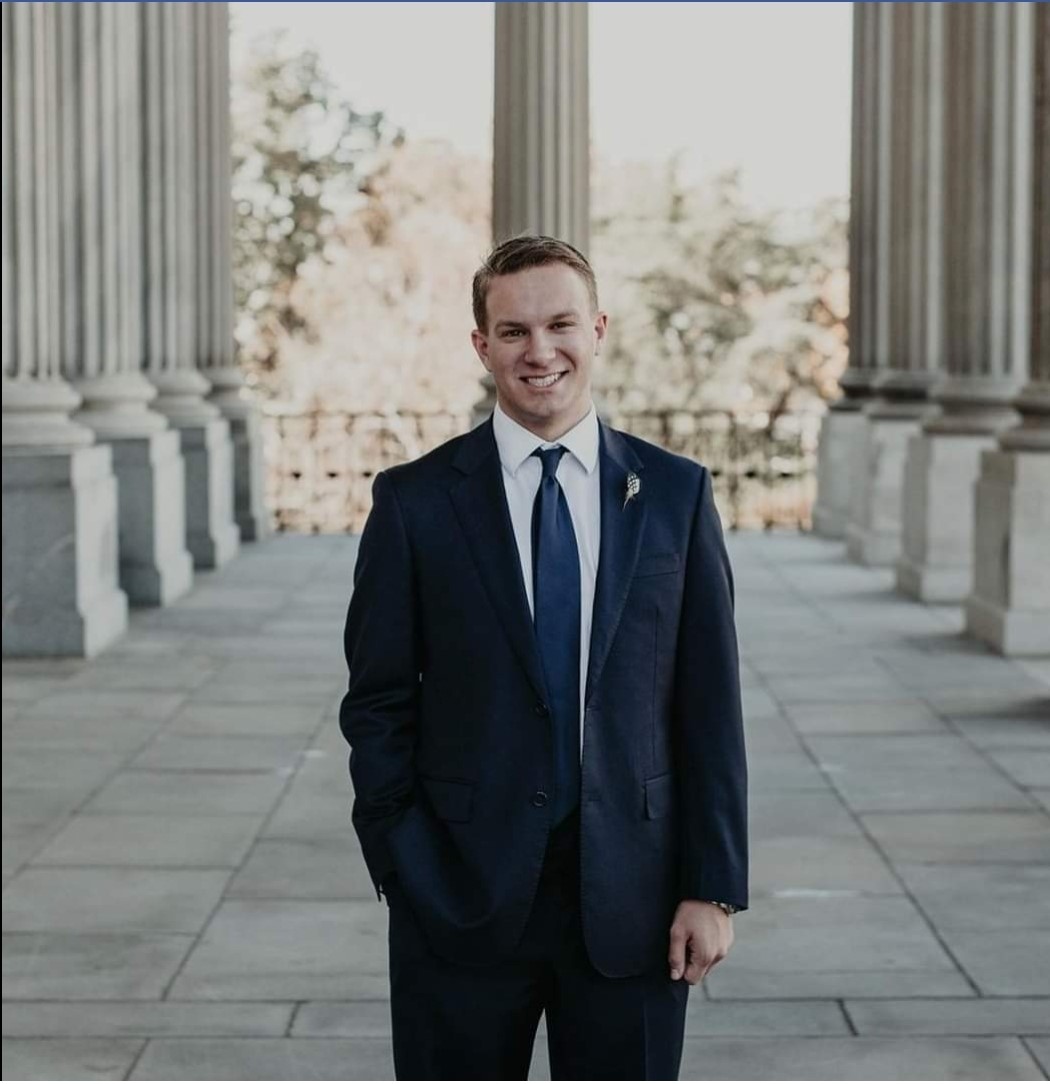
Interviewee: Will Galloway
Interviewer: Sidney Mullican
Location: Remote interview (Columbia,SC and Clemson,SC)
Date: October 4, 2020
Accession #: ELEC 012
Length of Recording: 57:39
Summary
William Wadsworth Galloway was born in 2000 in Northeast Columbia, South Carolina and grew up in Blythewood, South Carolina. This interview includes details of Galloway’s family life, his studies at Clemson University, and his start in the political sphere. Galloway became interesting in politics at a young age, starting a chapter of Teenage Republicans at his high school, where he also hosted then governor of South Carolina, Nikki Haley. He has been involved with a number of campaigns and political activism groups and is a political science major and military leadership minor. After serving as the president of the South Carolina Federation of College Republicans, he criticized President Donald Trump, recording a video in the summer of 2020 for Republican Voters Against Trump. Galloway discusses what led him to record the video and his experience as it gained national attention. This interview also includes Galloway’s experience and personal views of the 2020 election.
Keywords
South Carolina Republican Party | Lyceum Program | Clemson ROTC | Flood of 2015 | South Carolina Federation of College Republicans | Republican Voters Against Trump | Nikki Haley | Political Theory |
Recording
Transcript
Sidney Mullican: This is an oral history interview for the 2020 Election: Sharing Stories of Civic Engagement oral history project, part of coursework for Honors College class SCHC 326, documenting the perspectives and experiences of those who are engaged in some way in the 2020 election. This is Sidney Mullican, the date is October 4, 2020, and today I am interviewing Will Galloway remotely. I am in Columbia, South Carolina and Will Galloway is in Clemson, South Carolina. Would you start by giving me your full name and spelling it?
Will Galloway: William Wadsworth Galloway
SM: Where and when were you born?
WG: I was born on April 13th, 2000 in Blythewood – Northeast Columbia, South Carolina and grew up in Blythewood, South Carolina.
SM: You grew up in Blythewood, what was the community like there growing up?
WG: It was a great community. It had a very close-knit community with my church, sports teams that I was involved in, different parts of the community were all very much integrated into how I grew up and it was a great place to grow up that had something of a small-town feel, but also was close to Columbia. It was just a very great place to grow up.
SM: Tell me a little bit about your parents, your grandparents, their names and a little bit about them.
WG: My dad is Scott Galloway; my mom is Erin Galloway. Dad works for State Farm and runs a small family farm in Hartsville, which is where my granddad grew up, Harvey Galloway. Mom grew up in Pennsylvania, moved to Anderson, South Carolina shortly before she graduated from high school. They both went to – Dad went to Clemson, Mom went to Tri-County, neither of them graduated, but they both have been, I think, very successful in their careers. Dad works on cars in different capacities for State Farm and Mom has an interior design company that she started from scratch and my granddad worked for forty-seven years at BlueCross of South Carolina. My mom’s mom worked also in the healthcare industry, but more on the provider/mental health/social work side. So yeah, that’s kind of the family background—southerners, yankees, everything in between.
SM: Okay so you said your paternal family is from South Carolina and your maternal family is from up north?
WG: Yes, pretty much.
SM: So what were some of the traditions that you had with your family growing up?
WG: So, I had a really small family. I am the only grandchild on both sides, so we had a pretty tight-knit family of—we spent a lot of time together. I think most Sundays after church we had a family meal of some kind. We usually spent—just in terms of like holidays and that kind of stuff—Easter was always a big deal for us. We always had a little Fourth of July shindig, bring people over and do fireworks. That was usually the holiday that we hosted. And, then, Thanksgiving was usually at my paternal grandparent’s house. We would do Christmas usually a little bit before Christmas with my mom’s side of the family. Christmas Eve, my church always had outdoor Christmas Eve—like Christmas Eve in fields kind of thing where we would do bonfires and have a church service and that was always—at least it had become a really big church service or tradition for us. And then we would go on from that, do Christmas with my dad’s side of the family and then Christmas Day at our house. So that was—those were the big traditions. You know, having such a small family, it’s not like we had “oh we’re going to go here and do x with different people,” but we were, more or less, together pretty regularly and had a very tight-knit family unit.
SM: So you talked about church a lot, I was wondering if you could tell me about that a little bit—your involvement with that?
WG: When I was little, I wanted to be a preacher. No longer want to be a preacher, but I have—church has always been something that has been very important to me. I grew up in—grew up and was baptized at Northeast Presbyterian Church. Then an assistant pastor who was there, who had been my dad’s youth pastor growing up, left to start a church in Blythewood. We started that, I think I was like ten when that happened. And, my church—a lot of the people from the church, a lot of adults from the church had been people who spoke into my life, became mentors in different ways. People like Patrick Kelly, who had been both a leader in my church, was my cross country coach, back when I could sort of run quickly, and was my AP Gov teacher, just people like that that really were very formative and helping me become who I am. So the church was not just somewhere we were on Sundays, it was a very active part of my life. So, yeah, that was definitely a big part of growing up.
SM: Okay, that’s actually a great segue into my next question which is who would you say has had a big influence on you, or who do you look up to or did you look up to?
WG: Patrick Kelly, who I was just talking about, is definitely one. My dad and mom also very much so have been very formative to me. And then a couple of people who I would consider mentors from outside of my family, people like Tom Mullikin, who’s an attorney in Camden that, when he ran for congress, I worked on his campaign and he very much was an inspiration for me wanting to join the military. And someone like James D’Alessio, who is the Vice President of Government Affairs at BlueCross. I met him through a different campaign, but he is someone who—you know, family is something that is very important to me, and it also seems like a lot of times when people get very successful in whatever their career is, whether that’s law or politics or medicine or whatever, it seems like that commitment to family goes by the wayside. And he is someone that, as a mentor to me, has shown you can be at the top of your profession and still be the kind of person that I think someone ought to be, and that’s something that has been very inspirational to me. And then, in a lot of ways, both of my parents, who were kind of in different ways told “yeah, that’s a great dream you have, but that’s not going to be something that you can—that’s not achievable—that’s not something that you’re going to be able to really do” and both of them have found a way to do it and do it very well so, and all of those different people have been very formative to me.
SM: So now I want to talk about school: you go to Clemson—
WG: Go tigers!
SM: — and I was wondering if you could tell me a bit about your studies there?
WG: Yeah, I am in the Lyceum Program, which, first I am a Political Science major, Military Leadership minor. And I chose to do political science at Clemson through the Lyceum Program because it’s a political theory program, and I got very interested—I think there’s a lot of people who go through a political science undergraduate program, who can tell you exactly why foreign investment in southeast Asia is going to be conducive to the growth of democracy in X country, but they never sit down and ask questions like “why is democracy good,” “ what is justice in politics,” “what does equality look like,” “ what does it mean to have natural rights?” And I’ve found that reading things like Plato’s Republic, reading John Locke’s Second Treatise, reading some of these things, seriously engaging in questions, and taking all of that very seriously and very methodically deepens my understanding of both politics and of who I am as a person, and what it means to be a person. Because, you know, when you’re reading something that someone wrote three thousand years ago in ancient Greece wrestling with the same problems. If you’re reading the Republic and you see Thrasymachus or somebody that’s very much archetype of the types of people we interact with in a daily life. That seems to be something really worthwhile to me. And then, the other thing that drew me to Clemson was that program, and also we have an excellent Army ROTC program. Because the hatch I have to say is that any time I’m talking about politics, I am talking about politics as Will Galloway, not on behalf of the Department of Defense or the Department of the Army or anything like that, so very strong wall of separation there. But, those two things are really what drew me to Clemson, that ability to get a very, very good military education, and also get to ask some fundamental questions through the Lyceum Program.
SM: You mentioned the military, I was wondering if you could tell me a little bit more about your interest in that and what you’re planning to do with that?
WG: Yeah, so I—are you from Columbia by any chance?
SM: No, I’m from about halfway between Columbia and Charleston.
WG: What part?
SM: Saint George.
WG: Okay, that kind of like near Holly Hill?
SM: Yes.
WG: So, I’m sure you remember the flood of 2015. The street that my middle school was on, the first floor of my middle school was under water. There were plenty of buildings on that street that were completely underwater. And, the National Guard came in and really made a huge difference for my community and I think that’s true of people all over South Carolina. Anywhere that hurricanes are common, that’s the case. Anywhere there’s wildfires or earthquakes or tornadoes, the National Guard has a strong role in rebuilding communities and, also, in warfighting. 33% of our forces in Afghanistan right now are National Guard. And, I knew that if I were going to serve in the military, I would serve in the National Guard. So I started, and I wasn’t sure if I wanted to serve in the military, so I enrolled in Clemson’s Fighting Tiger Battalion, because you can do two years of ROTC without incurring any service obligation. So, I said “Look I’ll do a year, if I love it, great, if I hate it, no harm no foul” and I found out that I really liked it, so I contracted with—I did what’s called a Minute Man Scholarship. And, basically, they pay for three years of my tuition. In exchange, I’ll serve in the National Guard for eight years. And, while I’m in undergrad, I am doing what’s called the simultaneous member program, where I drill once a month with a National Guard unit. In my case, it’s the 263rd AAMDC in Anderson, which is an awesome unit. It’s an air defense unit. It has a really great mission that I really—have learned a lot from serving with those people, and it’s been incredibly rewarding.
SM: My next question is: how do you feel that your education has influenced your civic engagement, especially this year with all that is going on?
WG: So, I think for a long time, I—well, I’ve been involved in politics since I was 14, in some manner. And, for a long time I think I was an over-educated, un-thinking conservative. It was just like a reactionary kind of “I’m a conservative, so I have to believe this.” And, some of these experiences and the things that I’ve learned have helped me to be more thoughtful and more consistent about what I believe. So, like, I use the example of being pro-life. I’ve always been pro-life and I believe that preserving the dignity of a human being—if there is any purpose of the government, it has to be to preserve the dignity of a human being, right? Well, when we talk about that in contemporary political discourse, all that ever is is about abortion. Nobody ever talks about things like better sex education as being pro-life. Nobody ever talks about making sure that gay couples are allowed to adopt as being pro-life. Nobody ever talks about, you know, maternity leave as being a pro-life issue. Nobody ever talks about opposing the death penalty or prison reform as a pro-life issue. And so I think it’s forced me to reckon with what I believe. And, you know, a lot of stuff has stayed very much the same, but a lot of it has changed and I think become so much more consistent. I’ve also gotten out of the day-to-day activism stuff. I used to be very involved in campaigns, and part of that was I lived in Columbia, you know, it was really easy to do it. And, now being further from a major city, two hours away from the center of politics in South Carolina, has made that take a back seat and you can really see how shallow so much political activism is. Like, there’s so many people who their entire identity, or their entire worldview is so tied up in this “I am a partisan Republican” or “I am a partisan Democrat” and I’ve definitely been there. I feel like I’m, by not being engaged in that world as much anymore, it lets me be a little bit more—I don’t know, it lets me breathe I guess.
SM: Yeah, so you talked about kind of taking a step back from that, so have you found other ways to participate in civic engagement that doesn’t include activism or promoting a party or a leader?
WG: Yeah, and I can’t say that I haven’t done any of it. I was, up until this year or early this year, president of the South Carolina Federation of College Republicans, so I can’t say that it hasn’t been a part of what I’ve been doing at all, but I think that the most important part of civic engagement, for me at least, has become policy work. And, I do a lot of work for a group called the American Conservation Coalition, which is a group on the right that exists to say “climate change is happening, Republicans can’t ignore it, but a lot of the policy that’s coming out from the left is going to not be good for the environment” and I think that’s demonstrably true and we have to offer something better. And I have found a lot more fulfillment in actual policy work, learning about that and doing some healthcare policy work, than I ever had going door to door for a candidate.
SM: What exactly got you started in politics, and how has your role in that evolved as you’ve gotten older?
WG: It started as a love for history, and a love for history develops into a love for America, which morphs into an interest in politics, which morphs into “let’s go get involved in something,” and I got involved in my first campaign which was the primary challenger for Lindsey Graham in 2016—or 2014. I’ve worked on a number of campaigns, started a Teenage Republicans chapter at my high school, brought Nikki Haley to my high school my freshman year, did two terms as chair of the South Carolina Teenage Republicans for the state. I did some campaigns that summer, came to college, helped restart the Clemson College Republicans chapter, was chair of the South Carolina College Republicans. So, like, it’s been a pretty active process, and I think one of the pivot points was working for—I worked for Rick Santorum when he ran for president in 2016 and I—Rick is a lot more socially conservative than I am on some issues, but the thing that I really admired about him was he was the first person that I had really gotten to know in politics who wanted to have a serious discussion of ideas in more than just a soundbite. He was the first person that I saw that had really articulated a conservative healthcare approach from the perspective of making peoples’ lives better, who had clear principles and philosophical guide stones and everything grew out of that rather than just “I’m a conservative” “I’m a liberal” “I’m a moderate” or whatever and then things grow out of that. Instead, having someone who could say “I believe in this principal and all my politics comes out of that; if that happens to make me a conservative, great. If that happens to make me a liberal, great.” I don’t think there was any immediate change there, but that always stuck with me, even if I couldn’t articulate it. And that has slowly morphed into a much broader interest in policy and a much better interest in, I guess, the non-electoral side of policies—the side of thinking through principals and ideas and forming and influencing policies. So, I think that’s probably more where I am—if I started out in electoral politics, I’ve slowly moved and interest in policy politics.
SM: You talked about a few clubs that you’re in and I was wondering if you could tell me about some of the organizations you’re in at Clemson and what that experience is like for you?
WG: I was very involved in College Republicans until I made it very clear that I don’t like Donald Trump and that put a damper on that. As far as what I’m involved with here, the Lyceum Program is a big thing. Army ROTC and some military organizations like Scabbard and Blade, which is a military society here. I’ve been involved in student government. I did two terms in the senate and now I’m the Military Affairs director, which is a cabinet position. I had run for Student Body Vice President. What else do I do? I feel like I do other things. I’m part of a group called the T.S. Eliot Literary Society, which is an over-glorified book club. And then just some other small organizations and groups that get together every now and then and do different things, but those are probably the big ticket items.
SM: So now—over the summer, you posted a video on Twitter that got a lot of attention and I was hoping you could tell me about what exactly the video was and what led you to make it.
WG: So, I’ve never been a fan of the President’s. I’ve met him a couple of times. The first time I met him was before he—well, while he was a candidate, I got invited to a rally and they said “Well, you can sit in the front row” and so I was like “well this will be something fun to tell my kids about one day”. “Y’all remember that time Donald Trump ran for president?” And, little did we know. Other times were just different events at the White House. None of them were really political events. But—and it always seemed like there was this sort of shotgun marriage between conservatism and Trumpism, and I think a lot of concern is really with the Flight 93 Election approach to Trump versus Hillary. And, for a little bit over that summer, I was kind of there, right? Like, I don’t like the guy, but he’s got to better than Hillary, right? And then, the Billy Bush weekend happens. And I’m like, there’s got to be things bigger that just, like, tax policy or whatever. Like, I can’t say in good conscience that I support this. And so, I was an Evan McMullin supporter through election day for whatever that’s worth. And then, after he won, I was kind of like well, you know, let’s just see where this goes. And, for that first year, you know, you get Neil Gorsuch on the Supreme Court. I think Neil Gorsuch is a great judge. You get some policy wins and some policy losses and you go, “okay, it could be a whole lot worse,” and then, Charlottesville happens. And then you’re right back where we were Billy Bush weekend. Fool me one, shame on you. Fool me twice, shame on me. You don’t want to get fooled again. So, you just kind of separate from it.
we started learning some different things, I felt like I’m in a position where I can speak out. I should speak out. And, you know a lot a people said, “why are you doing this as a College Republican?”. Well, the first chapter of the College Republican’s National Convention says we have a duty to address where we want the party to go, and I did. And said, “This is not something I can support. This is not something conservatives and Americans should be supporting. Let’s have a conversation about who we are, what we are.” The breaking point really for me was when we found out that the Russian’s had most likely been paying a bounty to the Taliban for American soldiers in Afghanistan and that the White House was briefed on it and did nothing. I don’t know how anyone in good conscience can look at that and say “okay.” So, that was the straw that broke the camel’s back that led to the video, but I also felt like it was time for a real reckoning over what it meant to be a conservative. And I did the video, made a lot of people mad, made a lot of people happy, but I’ve gone back to sort of Twitter anonymity, which is a much more fun place to be.
SM: So, what were some of the responses that you got? Obviously, it gained national attention, but also within Clemson, within your own community, within your family, what was that like?
WG: First, I have a lot of family that voted for the president. I have a lot of family that didn’t vote, and I had a lot of family that voted for Clinton. And they were all—even if they didn’t agree with me, they were all very supportive of me. But, there were definitely a lot of College Republicans who were, at least in private, agreeing with me. I had a lot of messages of support, and I had a lot of people who were very mad. I got some very angry e-mails, learned some new racial slurs, was told to stand up for my race a couple times, as if white guys haven’t had enough people standing up for them. I got just a whole gambit of different kinds of insults. My favorite was “room temperature IQ”, which I kind of want to start using. But, it was—all the Twitter stuff, if you want to attack me and hide behind an anonymous profile, I really don’t give a flying flip what you have to say. But, the crappy stuff is people who I knew, that I would have considered a friend or a mentor, well not really a mentor—nobody like that said anything. But, there were definitely people that I would have considered friends who said things that I thought were ridiculous, and it makes it clear who actually liked you and respected you and who just saw you as a young person that was shiny that they could use to fill their agenda, which sucks, but it’s fine. I had, you know, just some really nasty things came from—well, heck I’ll say it, Kevin Thomas, who’s chair of the Fairfield County Republican Party, who has a history of saying nasty things on Twitter and in real life to people. That was probably the most vicious person to come after anything. And, a couple people just said stuff like “the Will Galloway that I knew wouldn’t have said any of this.” Well, then, you must not have known Will Galloway. But, there were just some very nasty things that were said that it kind of, you know, just shows me again that I’m glad I took a step back from some of this. But, also I had a lot of messages of support, so it was an interesting couple of days, but it was fun.
SM: You talked a lot about the Republican Party and I was wondering: what message would you give to young Republicans right now that are going through a really hard time, this election is unprecedented. Whether they are voting Donald Trump or not, how do they face this election while preserving their integrity?
WG: The first thing is to draw your politics from your morality and not the other way around. The second thing is: we as a country and as a people have been through the fire before. As much as people want to say it’s unprecedented, it’s not. Look at the 1850s, we had a congressman beat a senator almost to death on the floor of the U.S. Senate. You have a president, who at one point, openly defied the U.S. Supreme Court and then, shortly thereafter threatened to march down to Columbia, South Carolina and hang a U.S. senator. Look at the 60s, you have, within like a seven year period, you have a president shot, you have his brother shot, you have Martin Luther King shot, you have George Wallace shot, you have the Vietnam War. We’ve been through the fire before and we’ll be through the fire again. This radically left populism will not last. But at the end of the day, the only thing that we have is the ability to look at ourselves in the mirror and be proud of what we did. So, if you as a young Republican think that Donald Trump is the best person to lead this country, think about that and if you think that is the case, don’t hide from that. And, if the converse is true, if you as a young Republican look at things the way I am and say that you would rather have Joe Biden as president than Donald Trump, then don’t hide from that. Don’t be afraid to use your voice. Don’t be afraid to articulate what you believe, as long as you’re doing so in a thoughtful and kind manner. So, ultimately, just remember that there’s things bigger than politics, but remember that politics does matter, and we have to live in a country where everyone’s voice has equal weight. So, don’t be afraid to think, and then act on how you think.
SM: So, we’re the same age and this is the first presidential election we’ve been able to vote in, and I was wondering how your experience with that has been, especially with everything going on and claims of voter fraud—I just wanted to know how you’re feeling about voting and how the voting situation has affected how you feel about the election.
WG: Yeah, I don’t put a whole lot of stock into the voter fraud claims. I mean, there’s always going to be impractically or illegally cast ballots. I have never seen any evidence where that has become statistically significant or altered the outcome of the election. That’s not something I’m really worried about. I am planning to vote in-person on Election Day. I don’t see any problems with mail-in voting or anything else. I think that it has to be a public safety concern and it’s not something that I know enough about to have a “this is how it should be” opinion on it. Other than the fact that I don’t feel any worry with votes being cast either way. I think the biggest concern is that the President is laying the groundwork not to concede, which is really, really, dangerous because the bedrock of a democratic republic is legitimacy of the people’s voice. And, once the Electoral College meets and casts its votes, the President has to abide by that. And, if we have a president who is, at the very least, open to not abiding by that, that is a really dangerous place as a country to be. So that’s my concern, not about the actual integrity of the election. Maybe there will be a reason to be concerned about that—maybe there is that I’m missing, but I don’t have any worries about that right now. So, sadly, I don’t have anything particularly interesting to say about that.
SM: Okay, I want to talk about COVID a little bit, especially as we document this year. And I was wondering if COVID-19 has played a role in how you’re involved with politics or how you’re involved in your community in general, and what your experience has been like adapting that?
WG: It’s interesting—this has been the year of COVID. Clemson canceled on March 13th I believe—I’m going to go with that. Yeah, it was because it was Friday the 13th, I remember that. So, I was supposed to be in Italy for spring break. I had a friend who was studying abroad there and we had talked about—like, I can go over there, pay to go over there. I can stay with you and that saves me, like, half the costs of the trip, and when else am I going to be able to do that? And, so that was the first real impact from the coronavirus for me. It was like, oh crap, I can’t go do fun things in Europe. And, then, the first real outbreak in South Carolina was in Camden, and my granddad went to Cameron High. Several members of his graduating class died from it. And I remember thinking, well crap, this isn’t just like, you know, we remember the Zika virus and Ebola and all that. That was, like, it kind of felt like that for a while, like “oh crap we’re on the verge of a global pandemic” and then “okay, we’re not.” Well, we people, not that I knew, but people that were important to people that were important to me started experiencing this, like alright something is happening here. And, then, it just completely wrecks everyone’s plans. I am not convinced that it is just somehow still April and we’re living in time warps. The good thing about it was, you know I was supposed to spend this summer doing the Hudson political program in D.C. and next summer I’ll be in Fort Knox with the Army and I honestly wasn’t expecting to have another extended period of time home with my family. But I did, unexpectedly, this year and that was really, really good because it brings you back close to your family and that stuff.
The really nice thing about it for me, I hate to say the “nice thing” during a global pandemic, but is that it shakes out the noise and it makes you think about what’s important and what really matters. When you’re stuck at home, you’re not going to have friendships of convenience. You’re going to think, “okay, this person matters to me and I am going to invest in that friendship”, “ this thing that I’m involved in matters to me and I’m going to find a way to still be involved in that.” And, so, it shakes out the noise in a lot of ways, and that’s been really good for me, and I think that’s been the case, kind of with political involvement. How fulfilling did I really find this? Do I want to still do that? Yeah, but not in the same way. Well what way do I want to do it? And, then the flip side of that is the coronavirus shows the importance of: one, I think, federalism. Polls have shown that the majority of people in every state in the country believe that their state handled the pandemic better than the federal government. That shows me that when we empower local communities to do what needs to happen in local communities, problems are solved better. And, it shows, I think, the importance of competent government at all levels. So as far as political activism and political involvement and civic engagement go, I think those are the two lessons important to me. But, beyond that, the other things, for me, are the most significant aspects of the year.
SM: Have you been following any other elections, especially in South Carolina?
WG: Yeah, I’ve got a state senate election back home that’s really important to me. It’s Mia McLeod versus Lee Blatt. I’m a big Lee Blatt fan, really excited about that. I think he’s a great candidate and he’s the person I am most excited to vote for. I’ve been following the first district. I like Nancy Mace. I don’t dislike Joe Cunningham. Actually, I think Joe Cunningham is one of the better democrats in the House, and I am really interested to see just from a political science-y perspective, how that pans out. Here in Clemson, somebody that I think the world of is running for mayor and I’m excited for that. And, then, some of these Senate races just around the country have been interesting for me to follow. So, those have been kind of the main things. In the area where I grew up, I think Kirkman Finlay is an interesting race. He’s always an interesting race and he always somehow pulls it out. I like Kirman Finlay. I think he’s a great advocate for transparency in government. A lot of these local race, I think, are going to be very interesting.
SM: Is there anything that you wanted to talk about specifically in regards to the election, your personal experience through it or anything like that?
WG: I don’t think so—I’m just thinking back through this week, like this week has been an election cycle itself.
SM: It has, it’s been an insane week for sure.
WG: So, I guess for posterity, this is the week of the tax returns, debate, and the president gets hospitalized during a pandemic. One thing that’s going to be interesting to me is if Biden wins this thing, it’s going to be really interesting how he governs because his coalition, the group that puts him in the White House if he wins, is everyone from as far left as Bernie Sanders to someone like me or Bill Kristol, who is a dissatisfied Republican who is still pretty conservative, to your, you know, Clinton/Obama carried neoliberal democrats. That’s going to be something that I think is going to be really interesting to watch and it’s kind of been on my mind a lot lately. Of course, that might be counting the chickens before they hatch. But, the vice presidential debate is going to be interesting, assuming that happens because I don’t see Pence as the future of the Republican Party, I think he’s the past of the Republican Party. But, Kamala is the future of the Democratic Party in a lot of ways and it will be interesting to watch the interplay between Trumpism and what comes next on the left. And, then, the reckoning of what is going to happen to the Republican Party moving forward is going to be really interesting to me. I think we’re already starting to see that with different candidates emerging in terms of what direction we go, whether it’s in a couple months or a couple years. So, those are some of the things that are on my mind. And, just ready to get the circus behind us. If the circus ever gets behind us. Maybe, in five years we’re looking back on 2020 like “those were the good ole days.”
SM: So, I do have one more question because you brought it up earlier and you said that you’ve met Donald Trump a few times, and I really just want to know what that was like.
WG: So, I’ve met him in a couple different environments. I’ve met him at a rally. I’ve met him at an airport, and twice in the White House. The White House is awe-inspiring. One time was in the Rose Garden; one time was in the East Wing. And, you’re walking around like “holy crap, I’m in the most important place in the world right now.” And, it’s just awe-inspiring. The rally and the airport are really different because it’s like being at a NASCAR concert because the people that love this guy, like, they really love him and it’s remarkable. It’s like, if you’re, well, I can’t say at Williams-Brice whenever the Gamecocks win, because y’all need to win first, but if you’re in Death Valley right after Clemson wins, or whatever sports team you’ve got. It’s that level of energy all the time. And the other thing is when you’re near the guy, you want to like him. Like, he’s really personable and really nice, as far as interactions I’ve had with him. You know, like I want to like this guy, and then you leave and he does something stupid and you’re like “we’re back now.” It’s a weird experience to be around him. The hair is real. Do you watch Friends at all?
SM: Yes.
WG: Okay, you know the episode where Ross does the teeth whitening thing?
SM: Yes.
WG: Do you know the episode where Ross forgets to turn every time in the spray tan?
SM: Yes.
WG: He’s like both of those episodes in the same person, and then that person becomes the leader of the free world.