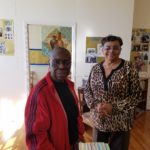
Interviewee: Betty Gunthrope and Betty Dorsey
Interviewer: Mary Alexander
Date: October 26, 2017
Accession# EDLP 011
Length of Recording (min/sec): 88:12
Sound Recording
Summary
Betty Gunthrope attended Fairfield High School and was valedictorian of her class. She was a teacher in public schools after integration. In retirement she worked with at-risk students.
Betty (McDowell) Dorsey attended Fairfield High School. Betty Dorsey’s children went to school during integration, as did Betty Gunthrope’s son.
This oral history interview with Betty Gunthrope and Betty Dorsey on October 26, 2017 includes discussion of growing up in and attending schools in Fairfield County, incidents of racism, discussions with family and friends about race issues, segregation and integration of society and schools, public transportation, race relations after integration, racism and prejudice after integration, the Civil Rights movement, Martin Luther King, Jr., the NAACP, African Americans and voting, the Summer Community Organization and Political Education program (SCOPE), Historically Black Colleges and Universities (HBCUs), Betty Gunthrope teaching after integration, volunteering with at-risk students after retirement, lessons learned while growing up & advice for future generations, racial divisions in the local churches and in the north/south division in the Presbyterian Church, and fostering better race-relations today.
Transcript
Mary Alexander: Alright, so my name is Mary Alexander and I am a doctoral student at the University of South Carolina. Would you two tell me your names and if you grew up here in Fairfield?
Betty Gunthrope: My name is Betty Gunthrope, I did grow up here in Fairfield.
Betty Dorsey: My name is Betty McDowell Dorsey, married name is Dorsey, and I grew up and graduated high school here, and grew up here. Left for a few years and came back here to live. This is home for both of us.
MA: Can you tell me about what it was like growing up here as a young child?
BG: I thought it was just wonderful. I enjoyed it. I really did. I was a happy child.
MA: Can you give me some stories of growing up here, what it was like? Any memories that you have?
BG: Not really, just playing and having a good time. Now if you want to talk about segregation, you know, we knew there was, but I never even thought of it, it was just something that…it was just that we went to school here, the white children went to school over at Mt. Zion. You didn’t know it was there, well, we had to pass them every day going back and forth. And we’d hit each other and, you know, I never had any problem with that. I remember once we, you weren’t probably born, they said we were going to have a Ku Klux Klan rally. Well! I was scared, I was so scared.
MA: How old were you?
BG: I must’ve been about, oh I guess about seven or eight, I don’t know . . . you know what? I’m crying now, because I cried then, because I was always scared; I was getting under the bed and stuff. But my parents were angry with me for being afraid. They were loading up, you know what my mother, she say, “Oh, I know exactly who it is! I know who the Ku Klux Klans is.” Isn’t that something…?
MA: Yes. How’d she know who they were?
BG: Chief of police–and your mother worked for him, right?
BD: Um-hum.
BG: Rice (sp.)… McBee. She called his name!
MA: So the chief of police was in charge of Ku Klux Klan?
BG: That’s what momma said, I don’t know. Momma said, “Ain’t nobody but Rice (sp.) McBee.” That was one time I was nervous about racial. And then another time, my daddy had gone upstairs to an office–and he was scared too–to pay a bill, and it seems that, on the way down the stairs, a white woman was ahead of him, and she fell down the stairs. Well, being the gentleman that he was–and he was a gentleman–he was so nervous because he wanted to help her up but he was afraid, so he came home and said to my mother that this woman had fallen, he said, “But I didn’t touch her.” Right now I get nervous thinking about that. Isn’t that something that he was afraid to help her because he was afraid that they would’ve said . . .
BD: Because he was a black man.
BG: Yeah, that he had maybe pushed her down or something. He said, “It was terrible, but I just walked on out.” He just stepped over, he did not touch her. But I didn’t have that many. Well we did have incidents now, I know sometimes like going–and I got bad teeth now–because going to the dentist was a terrible experience cause the dentist never gave us anything for pain. We were just like animals: he just snatch your teeth out, you know, or just–it was never the kind of thing where you were offered any kind of human comfort. So you just–snatch your tooth out and that was the end of that. But I’m tryin’ to think of–but lemme say this…what’s your name again…?
MA: Mary.
BG: Mary. I had some very pleasant experiences, too, with white people. I’m just gon’ be very honest with you; it has a lot to do with character and class. My mother worked for some white people who were well off. In fact her boss was the manager down at…where…at the United States Rubber Company then–that was the place–and Mr. and Mrs. Drurie, (sp.)–they came from New York–and her thing was this–and I’m gonna give this to you–she said, “Never work for poor white people. They have attitudes.”
Every afternoon after school I went to their house. They lived right on the corner of High Street, which is an apartment building now, but it was a huge house, they used to have parties there. I went there, and sat in their kitchen, and did my homework while my mother finished supper and stuff, before we went home. And they were extremely kind to me. You know, they were always very kind, and they liked the fact that I could read and do that kind of thing. I had that, that was a good experience. And what else?… Oh, let me say this: I don’t know how it worked in other churches, but I’m a Presbyterian, and periodically some of the Presbyterians from up north would send us gifts, you know, to the black–I need to bring, I got a book right now that one of the women sent to me, and wrote me a little note–I must’ve been four or five–encouraged me. And she said, “If you writing sometimes . . .”, she said–I don’t know how she found out, “I hear you can read, but if you would write to me I’ll send you things.” Wasn’t that nice?
MA: Oh, that was very nice.
BG: I felt good, you know. I’m trying to think… There were some other incidents. I think it just mattered, the people, you know, I mean, because just the people that you dealt with. I’m trying to think if I had bad experiences other than that Ku Klux Klan thing. But I know another thing, too. I was surprised when I went away to college; I had never had a new textbook. All our textbooks came from the white children, we got them. I was shocked to get a new book, this was exciting in school, you know, to get a new textbook. Never. And . . .
MA: Where was your school? Was it–is it the one that they all went to right down this hill?
BG: Yes, it was a school. But we didn’t complain about it. We should’ve been mad, shouldn’t we? Our books always came from the white people, when they finished with them they sent them to us, I don’t think I ever had a new textbook. Let me see . . .
MA: Were they at least well cared for or?
BG: No, the children would’ve written in them. But they were okay, we did okay with them.
MA: Did you have desks in your school?
BG: Yeah, like that. You know, used desks, and we were kind of–I guess just not . . . well let me say this: we had devotion every morning–I liked that–so we prayed, and did the Pledge of Allegiance and (unintelligible 7:19)–I was pretty happy as a child growing up here, I don’t know.
MA: Did your families talk about different race issues or problems that they had?
BD: Well you know, back then our parents just thought that this is the way it’s supposed to be. What I always wondered as a child, how are we all human beings and we have to separate ourselves by race. Now that bothered me from a child, but I had nothing really traumatic to happen to me. I’m old, but I didn’t have to pick cotton. My mother worked for white people, washed and ironed for white people to bring a few dollars in. At Christmastime she wasn’t able to buy us anything, so the white people would give us their old toys: sometime a leg off of a doll-baby, and they would tell us that Santa Claus had a wreck. (laughter) And we had to–when we sat on the bus, we had to get at the back of the bus and it always bothered me, you know, how could that be? We’re all human; it does not matter the color of your skin. You didn’t say anything at that time.
MA: Did you talk among your friends, like did your friends and you talk about it?
BD: Oh yeah, uh-huh, we talked about it. And even when it came to a water fountain, we could not drink out of the same water fountain that a white person drank out of, and I thought that was terrible. But at that time parents taught you, just ‘don’t say anything’, you know, just go ahead with whatever’s going on. So finally as Dr. Martin Luther King and others began to fight this thing, I was happy because I say it’s not fair. And if I never remember anything that Dr. Martin Luther King says it’s not the color of your skin but the content of your character. Betty can attest to this, I can–it’s some black people that I may not associate with and it’s some white people that I don’t care to associate with, so I’m saying that to say, it does not matter. If you are an intelligent black person, I don’t see why any white person should have any problem with dealing with you. You’re smart–Betty’s smart–I mean, she’s super smart.
BG: But you know what?
BD: She was valedictorian of her class, and she was a very smart student. And I mean, I’m just happy when this integration came about; that my children didn’t have to come up…
BG: I probably was much more naïve than you were because I never thought of…I just–well, you know, I’m gon’ tell you something–all kinds of crazy things that just comes in and out–Once my mother and I went to Detroit, Michigan to visit her aunt–Aunt Frances. You know what? My mother was not an educated woman, but she was extremely smart, oh bless her! On the train coming back–I think it must’ve been maybe in Ohio–you would have to change seats; the black people have to go in . . . guess what?–You would love her–she didn’t understand anything the conductor was saying…(whispers) Wasn’t that smart?… I kept saying, ‘we got to move’. She didn’t understand that the conductor said, we got to move. We didn’t move because momma didn’t understand it! “Momma! You’re going to get us thrown off the train!” (laughter) “The white man say this is where the black . . . “
BD: Well, that’s unusual in that day.
BG: She just didn’t understand a lot of things, a lot of things, you know…something else about that: I was never allowed to drink water in a public place. Momma would carry water in the car. You just don’t drink it. The same things like going to the back of the bus station and get a sandwich: you just don’t buy there, you just don’t. We kept food–if we went somewhere she would carry food. You just don’t participate in that kind of thing. Now I’ll tell you another thing. She just wouldn’t do it, she just didn’t know what they were talking about. (laughter)
BD: Wonder she didn’t get beat up back in there.
BG: No! Wait a minute, I was gon’ tell you something else about her. My momma–back in the day, pesterin’ little thing–her living room was very special to her, and we all went to the side door. White people did too. When they came to collect the insurance, they knew not to come up to her front door. Because nobody goes there, you have to come around to the side. And I’m just looking now, and I guess it’s good to go back and talk about it–how she just got by with stuff by not knowing. That was pretty smart. And you know something else? About that day? Like you say, struggling with them white people, she would say, don’t fool with the ones who don’t, you know. I used the, low class. But that’s true, like you say that’s true even today, isn’t it?
BD: Um-hum.
BG: That’s true even today. Now I’ll tell you something. My grandson came down here when he was in, oh…junior high school. Let me see, he’s forty-one now…that must’ve been I guess about twenty-something years ago. I had the worst time with that… He came down here to spend a year with Shirley, things were not going that well in New York, and I had to take a week off, he got suspended….For five days.
BD: Had the school integrated then?
BG: I think it might’ve been, guess why? I don’t know why he did that, and I begged him, he would not say “yes, ma’am” to the teacher over there at Mt. Zion. I begged him, “Terry, please say ‘yes, ma’am’.” Of course then he called his mother, she say, “You don’t have to say ‘yes ma’am’.” So he wouldn’t say “yes, ma’am”, so they put him out of school for a whole week.
MA: Crazy.
BG: Because he wouldn’t say “yes ma’am”. I’m trying to–I want to think of some bad things that happened.
MA: Were you in school when they integrated or do you know people that were in the schools?
BD: My children were in school when they integrated.
MA: How did that work? How did that happen?
BD: They were fine with it at that time, they were happy about it and they were fine with it at that time. But of course there were times when I had to go to the school, if they came home and told me something that happened, that a white child got to do this and they didn’t, I would immediately go and get the teacher and him and the white child together, and try to find out what happened. And eventually, you know, it got better. But to begin with it was hard when they started integrating the school.
MA: Did they get a choice of which school to go to? Either this school or the all-white school?
BD: Well, actually the white schools were by grade level, so it was–at that time my oldest son went to Mt. Zion, he was the first one being–he went to Mt. Zion after he left the old school. And then he then went to Winnsboro High School.
BG: Let me ask you this: how old is he?
BD: My oldest? He’s fifty-seven.
BG: Good, because Shirley, my sister, went to Mt. Zion, too. And she–this is with white people–she whispered to me, she said, “Betty, you know I’m actually learning a lot of things.” She liked it. But now this was the problem: coming from Mt. Zion, you got to come through the black neighborhood to come to our house. Didn’t the black children fight them and tease them and throw rocks at them? …Because they got a choice, they can either go to Mt. Zion or go…to the school…and we insisted that they go to Mt. Zion. The black children were angry with them for going to Mt. Zion, which is where—you can actually learn something over there. So there is a . . .
BD: Well you know, actually it was not–and they probably were angry–but black people, and I mean, and some white people, they dwell on what happened a long time ago. When I worked at Manhattan, supervising my department, the guys over there would tell the white people…just talk so ugly to them: “Oh yeah, you got a new car? That’s the money you should’ve paid my grandmother.” Or “You worked my grandmother for nothin’.” And all that kind of stuff…. And I said, ‘leave it alone, never go back! Do better!’ You know, ‘do better’. And it makes me sad…
BG: She said she learned from the white teachers. She was afraid to tell anybody else but the black kids, the ones who didn’t go there who had a choice, shoot, they would fight us every day when we come through, going up there to Mt. Zion. But I think…you know what I’m thinking about? I think I grew up with fear, I think I was afraid of white people. I think I was scared.
MA: Well you had every right to be.
BG: You know, I think I was scared, but I don’t know–but there were some ones who were not, like you say, were kind to us.
BD: And when the schools began to integrate, I talked to several of the teachers as the time went on, and the teachers would say to me, “Now I hate to say this, but the white kids,overall, are more–they’ll listen to what you say. –Well behaved. And your black students, those are the ones always getting in trouble… “And I don’t know if it was a mind thing with them, thinking back when their parents and fore-parents couldn’t do this and couldn’t do that, and they resented it, but even right now, you know, the teachers will say . . .
BG: But, but Shirley, and Tony, my son, they had problems when they first went to Winnsboro High School. They had problems with subtle discriminations. But I’ll tell you something: now I was working for the government in the white school, so when the movement started, you know, the few blacks they had, they wanted to act up and act up and do the thing; but you know, the white teachers resented it. There was always, now look, they were always integrated but there was always that little…black/white thing…even then. I remember when we were going to go from manual typewriters to electric typewriters, so we were going to do so many per year. So we would put the manuals over near the wall. (unintelligible 18:21)“Betty Sue, I’d let those black boys sit over there at those older ones that we’re going get rid of cause they got big hands.” What?! Okay.
BD: I mean, you were teaching then.
BG: I was teaching then, but I had–it’s always in their heads that there was a difference between black and white–now I could write a book about that, too–about northern segregation, now you didn’t get to that… But they put the black kids at the machines that they were, you know, the older machines, because they had bigger hands–would break the machines. Oh, you would like this kid, this kid was doing very well in my class. I want you to read this paper, a good paper. The kid ends up with a ‘B’, and that’s probably true now–now I’m getting angry–with a ‘B’ or a ‘B+’. If the kid is so good, how come the kid’s getting a ‘B’? If the kid is good, a white kid gets an ‘A’; a black kid gets a ‘B’. Number Three—you wanna turn—I was so mad with him. Oh, talk about sayin’ a prayer. Ooh, ooh…to see a black quarterback…and I asked the coach one time, I said, “This kid is good. How come you (unintelligible 19:45)?” Know what he said to me? “Betty Sue! Have you ever seen that play book?”
“What?”
“Do you know how many plays they gotta learn to be a quarterback?”
BD: So what he was saying was, a black kid could not qualify.
BG: No, because I didn’t know (unintelligible 20:00) learn the play book, there’s a lot of stuff in there! Lots of X’s and O’s; they can’t do that….
But now back to Winnsboro and segregation. Ohhh, let me tell you something: when they started to integrate–that was just too much. I couldn’t believe it–it was a . . . whoever thought–but now let me say this: I had heard Dr. Martin Luther King before, because you know he was a preacher, so I was in school and preachers would come and preach, so I had heard him preach but I had never heard him talk about civil rights–you can’t go sayin’ that in front of white people! you’ll get killed!
(laughter)
We’ll just say it in the—now you’re—
(laughter)
I was rollin’, so… …And I love my black men: oh they was so beautiful [sic], they say, “Now y’all got to stop screamin’ y’alls heads off…” And “We gonna come and pick you up, and we gonna go protect.” And we did, “We gonna pick you up . . .” at a certain time, but we were nervous. I’m telling you, I said, ‘huh-uh’. But you know something? I guess it comes with old age, but there was–and that’s why I cry right now, when I see the way things are going, because there were so many white people who marched with us, there were so many white people…I was in Greensboro…Who helped us? The Quakers–the Friends–those people marched with us. The NAACP was filled with Jews and white people and all kinds of people, it was not a black organization. It wasn’t. And there were so many people who really worked, and I hate the way it had gone, inclusiveness, you know. I don’t know, but.
BD: I mean, right now it’s good, you know. You can’t restrict, you can’t restrict us from doing whatever we want to do, unless it’s a private organization, then you can be restricted. And it saddens me to see our children, and of course there are some Caucasian children also, that are hanging out–they don’t want to do nothing. They don’t want to work, they want to do drugs; they want to sell drugs to make an easy dollar. But it saddens me to know that so many of our black heroes fought to get us where we are now, and yet the young people refuse to want to do something. Not all of them: we have some very, very fine black young people and–but when you walk a street here on Zion Hill and other places, you see these guys– eighty, ninety degrees, with hoods on their head, pants hanging all down–and they don’t really want to do nothing. They’re not inspired to do anything. But I’m just happy about the ones that do.
BG: But Betty, don’t you think it’s so sad that they don’t know the history, that they don’t know the history? Don’t you think it’s . . . you know what? Our people struggled and fought so hard.
BD: They know, because we as parents have told them that. So they know right now what a struggle we had, and look like that would make them want to be better, want to do better. I mean, I never had any problem, I, as old as I am–I never had to pick any cotton. I never had to work on the farm, I never had to milk any cows. I guess we were so poor we didn’t have to do that, but I had nothing really traumatic to happen to me. The only thing that I had a problem with is, ‘why do the white kids get to be praised, and the black kids seem to…they didn’t want us to do anything.
BG: But now, (unintelligible 24:11) I was just talking to my son this morning… You know, I’m back home, cleaning up down there–it’s just ghetto, it is falling down–and I said to him, “I just had a lot of trees cut down,”–even down there at (unintelligible 24:24).
BD: I came to your house one day.
BG: Yeah, but you haven’t been there since I had all those trees cut down. And I had some lights, ‘cause it’s dark…most of the people died or done moved. And I had (unintelligible 24:34) (whispers) Blythewood. But I stayed so I say to my son today, I said, “You know, I’m here Tony, I’m here because of the legacy that my parents worked so hard to leave this little place for us. It’s not a big deal, but they worked hard. I can’t just walk off and just leave it. They did without to give us a good place.” They never went, like you say, we never went to bed hungry or without clothes. How can…that’s what I say: if our children know the history, then don’t you think they would do it? And you know what he said to me, well he was just having a good time, he just said something, well yes, he agrees with me, he wants to bring some friends home with him and let them see, isn’t that something, where he grew up. You know, these are white friends and these are Puerto Rican friends. And he wants to bring them to South Carolina. Isn’t that wonderful?
MA: Um-hum, it is. I wonder if families actually talk about their history. The more interviews I’m doing, I hear that no one really talked about what it was like with your parents, how they grew up. You guys, it sounds like it was just forbidden to talk about it in the house. Do you think that it’s still forbidden to talk about it in your house, what you went through? And do you think that’s why the generation now doesn’t realize the struggles that you had gone through to get where we are?
BG: That’s what I’m worried–that’s what I’m saying, do they know what we went through?
MA: Because we’re learning in our history books is not what really happened. We’re learning–
BG: It’s not, is it?
MA: –No, we’re learning from a white man’s eyes what happened.
BG: Right.
BD: Right.
MA: We don’t know the struggles that you have gone through.
BG: …My house is so filled…with junk… I have a chair, it’s about this tall, was made by hand, it’s got cowhide bottom. It’s the chair where my great-grandmother sat to milk cows. She was short and fat, and they made a little chair for her to milk… sitting in my house… In my little chest down there I’ve got little crystal, individual, salt servers, most people don’t know what they were, when people used to have formal dinners everybody had their own salt servers.
BD: Well now see you value that type thing.
BG: Nobody else when I die will. Guess what? When the Yankees came through they threw that stuff out in the yard and my great, great grandparents picked that stuff up. That’s how I got it. Nobody knows that, you know, they just come through the houses, and threw all good stuff up, and the slaves picked it up, and threw the meats out, and threw everything. I got a lot of little things that my great, great grandparents–it belonged to the slave people…
BD: What I’m saying, Betty, is you value, you value—
BG: I do! I do!
BD: –everything that you have, but when you are gone your children and grandchildren are not going to value that.
BG: No, they gonna throw it right out….
BD: And if the way you feel about the piece of property that your mother and father left for you, your kids are not gonna think about that and they gon’ find homes and condominiums and thing–they won’t come back. Once you’re gone they won’t come back to Cemetery Street…
BG: You know what? I am eighty-one years of age–this brings tears to my eyes–when I was in the fourth grade, the teacher taught us about Africa. I had an African friend–‘cause his picture was in the book–his name was Lem Wishee (sp.). My kids have no sense of the motherland. What in the world are they learning!? Don’t you know?!? Don’t you see pictures of what a beautiful country Africa is? Don’t you see the blue waters and the green grass? Don’t you see those little beautiful black kids? No!… No!… How come I know this? I’m gon’ say this to you: when I went—I guess it was to New York–and somebody say to me, “Where’d you learn all these things?” What? What do you mean, doesn’t everybody know this? They just think they’re people from South Carolina know so little, but we do have these things in our head, okay?
BD: You did a lot of reading.
BG: Huh…?
BD: I said, you did a lot of reading…
BG: I did! And kept my eyes opened. I love that Low Country, I love that ‘Geechy-Goo’ [Geechee], that’s me!
BD: That’s right. That’s right.
BG: But my . . . what are we doin’ wrong?…You two, what are we doing—why are we not teaching our children about Lem Wishee (sp.)? I don’t know (unintelligible 29:40) country, I know the Belgian Congo. I know the Gold Coast….They said, “Where’d you learn?” “I don’t know. I don’t where I learned it.” I just had…people just…I just had good parents… Now my daddy was educated–but my mother wasn’t educated–she come out of the county—but she was smart…
BD: Uh-huh…common sense…
BG: …Not only was she smart, she was a survivor. Now back in those days–Lord don’t let me go tell that…all the bad things that went on but–you know, they did a lot of mixing. It was no big thing if you got white children back in the country, white was—and number one: it wasn’t no big thing if some of the women had white children; they wasn’t ashamed of that… “Well, Mr. Bedenbaugh was your daddy.”
“What?!”
BD: That happened a lot…
BG: It happened a lot, and we weren’t ashamed of it. I mean . . .
BD: Well, I was always ashamed of that…
BG: You were?
BD: I mean, yeah… I mean, although it didn’t happen in my family, but I was always ashamed that this woman has to go to bed with her boss. To keep a job. And yet the black women cooked, they washed and ironed, but they were not good enough to sit at the table with the white family.
BG: You thought about that as you were growing up; see I didn’t even think about nothing… You thought about that though.
BD: Um-hum, yeah.
BG: I didn’t, as a child growin’ up that was a, I never . . .
BD: But that’s a whole–my mother worked for white people, and every white person she worked for–it wasn’t much money then–but if they had extra food and stuff, she could bring it home. And when you talk about Mr. McFee (sp.)–my mother worked for them for years–and when my mother died–my mother was married, to my daddy, and when they–they didn’t stay together long, because his father didn’t like my mother so they were only married briefly–but they were married, I have their marriage license. When my mother ready to retire–she was not married to her second husband, they lived together and had children–but when my mother got ready to retire, my daddy had a good job in Providence, Rhode Island, so Mrs. McFee (sp.) said to my mother, says, “Bessie Mae, do you know if ‘B’ was married to Ms. Daisy?” And she said, “I don’t know, I don’t think so.” She say, “Well, I’m gonna check into it and see if they were really married.” She checked into it for my mother, they never had married until their last child was born, so my mother drew his social security.
BG: But see, you (unintelligible 38:16), she was more aware of these things. I never felt bad about segregation. I never thought about it, I just accepted it.
BD: Well, I did.
BG: See, you thought about it, you felt bad about it.
BD: I mean, not that you weren’t happy children but I always, when I lay awake at night and wonder why is it a difference between black people.
BG: You did?
BD: I did.
MA: Did if affect your self-esteem and how you did your job in school?
BD: No. Hum-um, it didn’t affect that but I always wondered why the black kids were not treated the same as white kids.
BG: That would just show you how immature I was. I accepted it, I just . . .
BD: Well, you had to. You had no choice at that time.
BG: Well no, you didn’t have . . .
BD: You didn’t have a choice but I felt bad about it.
BG: No, there’s one thing, there’s a difference, you can tolerate it or accept it. I accepted it, you just tolerated it. You just…I didn’t think about it, I should’ve been thinking about it, but you know, I’ll tell you something about that also, you know, when I got the store, where I’m living right now–and that was another thing: my granddaddy built that store for me when I was, I guess I must’ve been about nine or ten years old… You know what he said? “This will be an income for you.” He built that store for me, he said, so that I wouldn’t have to work in the white women’s kitchen, that’s why I stay in that store.
BD: Okay, very good.
BG: Okay, that store was to keep from having to cook. So that’s what I’m saying, I’m trying to think of . . .
MA: What store was it?
BG: Just a little store that’s in my yard.
BD: That the young people used to go and dance…
MA: Oh, it’s the one across the street from here?
BD: No, it’s down on Cemetery Street.
BG: …same kind of store though…
BD: Same kind of store, we would just . . .
BG: …(unintelligible 34:16) I was the manager of that store. Then they added to it, and added to it, that was making money. But that store was built so that I would have something that I could do. Now nobody never thought I would–not run a store, ‘cause I didn’t want no store–but that was to keep me from–because inevitably…I had a couple of cousins who did work in a white folks kitchen, and guess what? They ended up with white babies. …Because it’s just like it is now: the daddy comes home and want to have sex with the . . . um-hum, so…
BD: Um-hum… And what I used to do, a long time ago–it doesn’t bother me now because it happens a lot–whenever I would see a white woman with a little khaki baby, I would just go to that child and pray for their beautiful children, I’d say, “Oh what a lovely baby you got.” But I could tell it was by a black man. I have no problem with black and white if a woman–a white woman–wants a black man, and she’s an intelligent woman, get you an intelligent black man. Don’t get a man that does not, you take care of him and he doesn’t have a job; vice versa, if a black woman wants a white man, get one of your…you know . . .
BG: No, no, these were not black women–
BD: No, I know it, I’m just sayin’ . . .
BG: These were little young girls working in the kitchen.
BD: Oh yeah… I’m sayin’ that–what I’m sayin’ now–you don’t pay any attention to that, because it’s just as many white women that are havin’ black babies.
BG: I pay attention to it.
BD: Yeah, uh-huh, and it doesn’t bother me now, but when it first start happening, I would just praise them, ‘cause they are beautiful children. But just like I say, the best thing I ever heard from Martin Luther King is, ‘contents of your character’ [sic]…And association with people, but contents of your character, you know…
BG: Well see, she was ready for it, it just blew my mind, because I never thought–I never thought that we would be integrated. Now isn’t that somethin’…? I just went along just–I just figured it’d always be black and white. But see she was, that’s a (unintelligible 36:31).
BD: But you really, that really didn’t bother you growing up–
BG: What?
BD: –that we had to have a separate school, that you used used text books?
BG: No.
BD: From the white kids, that didn’t bother you?… Okay…
BG: I just thought that the way the world was. I was just, I should’ve . . .
BD: I always thought about it though. I always thought about it, that it was unfair.
BG: You did?
BD: That was unfair that we had to be on the background all the time.
BG: At the time you thought about it.
BD: As a child. I mean, I knew there’s nothing that we could do about it, but I thought about that as a child, growing up.
MA: Were you around during the Civil Rights? And I heard that there was a group called SCOPE [Summer Community Organization and Political Education program] that went in and did sit-ins and kind of pushed–
BD: Um-hum, um-hum.
MA: –the black people to get out and vote. Were you around during that time, and what was your experience with them?
BD: Well, by then I was married and all, but anything that I could do to help in that era, you know, I would do it, um-hum.
MA: Was there a lot of civil unrest here in Fairfield County or was it . . . .
BD: It wasn’t a whole lot here in Fairfield County, as I can remember… It may have been, but it wasn’t a whole lot as I can remember here in Fairfield County.
MA: Did you know the group of several men that were getting together and doing the sit-ins and–I heard there was someone going door-to—door, as soon as you turned eighteen, to make sure that you registered to vote.
BD: Oh yeah, um-hum, yeah that happened, um-hum.
BG: They worked hard. And the churches worked hard, too. They really educated the people about voting.
BD: Um-hum.
BG: And they voted. The black people really turned out (unintelligible 38:04), they were very, very excited about voting–much more so than they are now, don’t you think so?
BD: Um-hum.
BG: They did–the churches did a good job educating and telling the people about the . . . and my mother, she was just so excited about that. Oh, she just was so excited about the races coming together and about integration. Oh, oh, that was the best thing, I am so happy that she lived to see. I am–you know what I wish, whatever–I wish she could’ve lived to see?…But it probably would’ve given her a heart attack; she probably would’ve died–I wish she could have lived to see Barrack Obama become the president. But she was so glad for that integration and, and to see Dr. Martin Luther King and John F. Kennedy and . . .
BD: Right, and others that . . .
BG: . . . just excited about that time.
BD: . . . so instrumental in getting us where we need to be, should’ve been.
BG: John F. Kennedy, Jr….now he’s–I think he just was out there on that TV talking and Lyndon Johnson, he was . . . “Oh Betty Sue,” she say, “Have you seen them (unintelligible 39:18)?” It wasn’t just the black people she was excited about, all of those who talked for equal rights she was excited, and that was a good thing. You know, I really was happy about that. “Ooh!” she say, “You should’ve seen Lyndon Johnson.” (unintelligible 39:24) And John F. Kennedy–of course everybody loved him–he don’t get that many (unintelligible 39:30).
(laughter)
MA: So when you guys were in school, what did you dream of being? Did you, what did you want be when you grew up? Did you have high dreams or high inspirations or?
BD: I wanted to be a nurse. But my mother had thirteen children and there was this—Pluck Heath’s brother–what is his name? The one that–he was a teacher and his wife was a–
BG: John. John.
BD: He was a teacher/principal and his wife was a nurse. And they came to the house one day and asked my mother, say–I was the oldest child, ‘Let me have that–let us have Betty, let us raise her’. Momma say, ‘I ain’t gon’ give you my child’. Not knowing that would’ve been better for me (laughter), because when you have thirteen children, it’s not anything you can do for them, you know, and especially, you know, at that time they didn’t know–my mother didn’t know to really stress an education. You know, she didn’t know to stress things, you know. So I did not go to college, but I’m satisfied with my life. I have always lived, tried to live, a good life and I’ve had jobs; I made a little bit of money, and the biggest thing is I’ve always had self-respect for myself. And to me that–that’s a lot.
BG: You’ve done very well.
BD: And other people.
BG: She’s done very well, I’m so proud of her. I am, see she’s younger than I am, I’m proud of her. But you’re still energetic and able to help people, she a caregiver around town, and got a job—I wish you’d get at job for me, I’d do better than anybody I know. Oh she has.
MA: What about you, what did you want to do when you were in school? Did you dream of having a career or?
BG: Yes. I wanted to be a lawyer. Yeah, I wanted to be a lawyer or something like, writing books–an author. I had great dreams because I read a lot. But you know what people said, ‘not very realistic for a black girl’. There’re two things you could do.
BD: And Betty tell her–what Betty did, she had a child and that didn’t stop her. After you had that child she went on, she went to college, the top of her class here at this school, and went on to college, top. And that child didn’t stop her, you know, a lot of times, when somebody had a child they just give up and say, ‘I’ll just go out and get me a job, take care of child’. But parents like hers, they kept her encouraged.
BG: Betty, you know what? That was–at that time that was the worst thing that could happen to me, because that was the most embarrassing, disgraceful thing that could’ve happened in 1952.
BD: Back then it was.
BG: Yes. And you know what? At one time I called it a mistake, but I didn’t call it–I don’t call it a mistake now, I call it a bad decision. The timing was wrong, see timing is everything (unintelligible 42:33). The child was born at the wrong time. He should’ve been born when I–if I had ever got married. But back to that–and see it caused a lot of confusion, you know, people don’t know that, because a lot of people resented me. I was the first child–or the first person–to go back to school after you [sic] got pregnant.
BD: That’s right, cause usually they didn’t.
BG: They usually had to drop out of school.
BD: Right, um-hum.
BG: So a lot of people resented me for it, and they still do ‘cause somebody say to me, “You were the one–when you was in my momma’s class, and they let you back in school…” But I wasn’t going back to school… Thank God for good people… Thank God for Mr. Charlton (sp.)…Because I wasn’t going to go to (unintelligible 43:15) Academy. Oh, thank God for a little bit of money; my parents had a little bit of money they had stored…
BD: And they were supporting you where they would keep your child while you did what you had to do.
BG: (Unintelligible 43:24) the private school. I didn’t have to go to back to the school. But the principal came, I thought he was coming for the, for the book. He said, “No.” He said, “That’s why we put erasers on pencils. People make mistakes.” So my mother said, he say, “Come on back to school.” She said, “Well if you can hold your head up, I can hold mine up.”
BD: Okay… (laughter)
BG: …Okay? It was a good step but then that was that year, then, the next year…that was when… we had a oratorical contest, every year—I wonder if they still do that?… Alright, we used to always have an oratorical contest. They gave it to them…I got second; (unintelligible 44:11) first… I always got first in everything. They gave Joey (unintelligible 44:15) first, gave me second. But like we said, ‘well he’s a boy’, you know, ‘you a girl’, so he got the first prize, I got the second. Then it came time, talking about the valedictorian: if that wasn’t a lot of hemmin’ and hawin’ and swippin’ and strugglin’ and tryin’ to manipulate the numbers… Because they wanted more Marlene Moore–she was a very lovely girl–very pretty and hair, and didn’t get in any trouble–she wasn’t fresh… And somebody had said one time–told my mother–thank God my mother wasn’t educated!– you know… (laughter) Somebody told my mother that I was ‘precocious’. Momma thought that was something good, big word. That wasn’t! (laughter)
MA: It is good.
(laughter)
BG: I write the book. (laughter) …If she had known what ‘precocious’ meant, she would’ve set it all…’cause she had that kind of temper… (laughter) Oh, I know all kinds of crazy stuff…but anyhow, they couldn’t figure it out. They was trying on how to do it and divide the grades and that, they wanted to give it to Marlene Moore, but they had to give it to me. I cried the whole time I was speaking because I wrote the speech and everything. They didn’t want me to have it, they wanted Marlene, but dammit I didn’t have nothing but eights!—I did . . . using vulgarity…(laughter)
…I’ll tell you something–I gotta go to the bible with this– those were people, don’t mean for harm, it turned out for good. Now guess what? Walked here, you know, everybody was, teachers (unintelligible 45:54), to North Carolina, my grades–they were excited about me, they were good to me. I learned a lot up there. Now, let me just say this: put this in your record! I was born at the right time! Do you know, in 1957 when I graduated from college, everybody was integrating and needing a black teacher? I had a choice of any school I wanted to go to, halleluiah! –Talk about being born at the right time. Now listen to this: (laughter) see that’s same thing as timing. Timing’s everything. I was supposed to work down at Allen University, well you know I went, I figured I’d come back here, but they didn’t want me, it was their loss, I ain’t worried about that.
So I was sitting up there at (unintelligible 46:52), now listen to this: I’m going to tell you how I got to Columbia University. …Timing’s everything…. They were integrating, well they had–they wanted to bring some more blacks in. I got a choice, I had a choice of going to Syracuse or–you probably never even heard of these places–they was wanting black people in the school system. (laughter) Okay, so every year they would take students from historically black college and take them to Ivy League schools to give them a chance to integrate. Okay? The first year, Millan (sp.)–she was from Greensboro–she went to Columbia. Okay? The second year Caroline Norwood–she comes out of Sumter, no Florence–she went to integrate Columbia University. The third year they said, ‘it’s your time to go off to Columbia University’. … I don’t want to go to no Columbia University; I’m happy right here doing what I do. See, I just–I’m just happy wherever I am. They say, ‘no you go’. And that was an experience; it was a wonderful experience. It was really, it just–I never, see ‘cause when I–you go to the University of South Carolina…
MA: I do.
BG: No, ain’t no problem about it. As a child if I had wanted to go to a college–you know where I went to college?…Where?
BD: At Benedict or Allen.
BG: No!
BD: Well that you wanted to go you say…oh, I said…
BG: Um-hum.
MA: …Better not be Clemson….
BG: How did you know?
(laughter)
BD: You wanted to go to Clemson?
BG: Yes! The university was too big. There’s nobody I would–that ain’t what nobody want, to go down there…Clemson! If I’d had a choice I would’ve gone straight to Clemson!
MA: Why didn’t you go?
BG: You couldn’t go! (laughter) …That was in 1953! (laughter)…Are you serious?!?
(laughter)
BG: (laughter) …Oh God, I love it!
MA: So you could only…what schools could you go to?
BG: Black schools, no white schools.
MA: Which were what?
BD: Predominately black.
MA: Like Allen?
BG: Benedict.
BD: South Carolina State.
BG: South Carolina State. Claflin.
BD: Voorhees.
BG: So we never thought about those white schools; we couldn’t have gone there. Hum-um. But anyhow, so with Columbia University, because they were trying to–and see the schools down here didn’t think of that. They didn’t think of giving a couple of blacks a chance to come into their universities–am I making sense?… That would’ve made a–because see, that’s what they were doing out there. They said, ‘okay we need more blacks, so we’ll give the ones in the historical black colleges a chance to come to Yale and . . .’
BD: Oh, okay.
BG: Um-hum, ‘cause that’s how I went–you don’t think I just was so . . .
BD: So where did you go after A&T?
BG: I went to the university.
BD: Columbia–and that’s in New York?
BG: Yes.
BD: Okay.
BG: Then–timing is everything–when I graduated from Columbia, the high schools needed black teachers, okay?… Where you from?
MS: Originally, from Virginia.
BG: Oh, okay.
(laughter)
BG: (pause) …Listen, Virginia’s like a–I’m gone say this–
BD: (laughter) …Talkin’ about the girl’s home town…
BG: When you cross that…it ain’t the Mason-Dixon Line– when you cross that North Carolina–that South Carolina/North Carolina line, there is a big difference, I can’t explain it. You know what I’m talkin’ about…?
MA: Yeah.
BG: Even though it’s the south, it’s a different kind of thing. Even in North Carolina, the people think differently. People in Virginia think differently than they do in South Carolina. But anyhow, I had taken a job at Allen University, because one of my professors was working there so they needed somebody. But then my advisor in college, at Columbia, Dr. Mary (unintelligible 51:27), bless her, she said, “I want you to go to White Plains, New York and teach.” At that time they had had some black teachers there, but they never stayed more than a month or two, ‘cause the white people were not that–they weren’t mean, but you know, they were not welcoming. Because you could do this—that’s why I’m asking you, where you from, who would believe that the superintendent of White Plains High School–now let me just tell you this about White Plains High School–White Plains High School, at that time, Westchester County, at that time, was the second richest county in America. The first one was Orange County out in California, and White Plains was the second, so it was a top notch school. The school was built on the property that belonged to JC Penney. That’s how big, and the Board of Education belonged to the editor of the New York Times, so it was a school where you didn’t have to run around and try to find stuff; whatever the kids needed, they had it. They told you, don’t–we want our kids to have the good stuff.
Now, you ready for this? They were very excited with my education and my training and all, but you know what they said? “We don’t want you to come here and teach our children the South Carolina dialect.” But they were honest with me and I appreciated it. So I took a speech class. They don’t want, children don’t do that now, but at that time there was a different dialect, “We don’t want our children to say ‘PO-lice’ for police. We don’t want our children to say ‘doh’ for door.” Because that was a thing with southern children. Okay? Segregation. “We don’t want our children to say ‘flo’ for floor.” Just certain things, so you know, I got that straight. So, but then once I got there–the superintendent of the Board of Education at White Plains High School came from Georgia. And so did the principal of the high school. The superintendent–they both came from Georgia. They hired me knowing that originally, I came out of South Carolina because they–I wanna speak right into your computer…
(laughter)
BD: Go head, Betty. Go head, Betty.
BG: … I should’ve been a preacher….
They were educated southern gentlemen. …And there’s a difference. I hope that recorded. There’s a difference… Am I making sense?
MA: You are.
BG: …And I appreciated that. And even after Dr. Darrell Long–and retired and moved to Florida, he still asks about me. He said, “I hate to give you this job cause you might not stay because of (unintelligible 54:47).” Well, they didn’t tell me it was a lot of stuff, ‘cause they say, ‘you came so highly recommended, so you ought to know everything, but you don’t know everything (unintelligible 54:58).”
MA: What did you teach?
BG: Business courses, shorthand, typewriting and that–business courses. And they were very kind to me.
MA: Very nice. How long did you work there?
BG: Thirty-five years. I had planned to leave but once I got there, I promised myself, I said, ‘you can’t let this job (unintelligible 55:20),’ because they had had some–I’m just telling you about integration and how things went, okay? Back–even then, there was still some whites who were kind to blacks (unintelligible 55:33) say, ‘you probably won’t stay’. You know, teachers get there, and stay two or three months, and they leave.
MA: What would the white students do?
BG: It wasn’t the students, it was basically the other teachers. Just, you know, you in a school and nobody talks to you or, you know, they just kind of leave you alone. But there was some who were very nice to me, very, very nice and I enjoyed it. And I did have an attitude also, so you had to be careful, some of us had attitudes, but, and I didn’t live in White Plains, I lived in New York City so I didn’t get back to black people, you know, kind of get back to my roots. And then, you know…you’ll find that out once you get out of school (unintelligible 56:31)… they say, ‘well you came so highly recommended’, you know, when people recommending you highly that make other people a little—‘you oughta know—‘ You go in the book room, and you decide which book you want to get for your class. Well, Lord have mercy there’s so many books–the school got more money than Carter got liver pills—‘what book are you using for your class’? ‘Well you ought to know what book’–I mean, I just want to use what everybody else is using. You come with all of the recommendations and, you know, so they weren’t very . . . now, I was good for that school, ‘cause guess what? They had rooms–I never been married–but there were a bunch of old maids there. (laughter)
BD: Old maids…(laughter)
BG: …(unintelligible 57:26)…Jesus Christ. They have paper, stacked up to the ceilings almost, that were yellow and falling apart because the…are you married? (M.A. murmurs to the negative) Thank God!—because the first of every month, they brought us paper for the children. The children didn’t have to buy paper. These old maids, they wouldn’t give the paper to the children, they like, ‘why you (unintelligible 57:55) allowance of paper, when the Board’s giving it to them?’ So we had paper—yellow papers and things… so that’s why I say it. So I was just letting the kids (unintelligible 58:06) let the kids use the paper up and they was, ‘no it ain’t my stuff’, the Board gives it to them. So they were still, and then you know what? Then they, wait a minute, I don’t let nobody even say this, then the kids got mad when they would integrate down here with their children marching, they had a few little kids marching at White Plains. So our kids they got mad and they took some rocks and threw and knocked some windows out.
MA: So up in the north they heard that the south is integrating and they got mad about it.
BG: Um-hum. So our kids– the black kids–here knocked out windows. I didn’t say a word, I let them knock them out, but anyhow. So they decided they weren’t going to come back to school anymore, they’re mad, until they changed the policies in White Plains and give them more this and that. So they went to the church, it wasn’t like them black kids up there in the first place. They went to church and the black people took their children to church for school. I ain’t had no problem ‘cause I sent them all with paper and stuff they needed. (laughter) They had all this paper. (laughter) I’m sending paper after the black children, for the black children. I’m sitting up there keepin’ the whites kid, my children (unintelligible 59:31). They ain’t no problem, I said, I got to stop it now [laughter]. You got to have fun though. So they had all the paper and stuff they needed. They was having school in a church, using the Board of Education’s stuff. (laughter)
MA: So why’d you decide to move back here?
BG: My mother was sick and I thought she was gone live forever, you know? I should never had come back here. I shouldn’t say that.
BD: This is home.
BG: It’s home. But you know . . .
BD: But actually it’s so little to do here in Winnsboro that only a person that would wanna retire would be here.
BG: You know what? I’m let them tell you, you can tell her, I am quirky. Now when I first came here I decided I was going to do some volunteering in the school, you know, was gone volunteer. Well, that’s what people do.
BD: Did you do any subbing after you moved back here?
BG: No.
BD: In the school? You didn’t?
BG: No. Old silly me, I was going to volunteer so I’m volunteering over there, going up the school, sitting in them blue chairs, eating breakfast with the kids and just helping. So they were going to a Christmas showdown at the Koger Center so I volunteered to go with the kids. So I get on there and, so I was waiting for them to bring me my children I was going to be chaperoning. They didn’t bring me anybody. Where are the children? I be sitting on the bus having the worse time. They didn’t call, I, look the kids who misbehave don’t get a chance to go on trips, they don’t let them go out the school. Those are the ones who need to be exposed. That’s why I’m here, I’m here to do one-on-one with the kid who does not know how to act.
BD: Okay!
BG: Oh no, they was . . .
BD: And no kid showed up or they didn’t let the . . . .
BG: They didn’t let the ones I was going to chaperone go, cause they let anybody go who didn’t know how to act.
BD: Oh, okay.
BG: The kids they took already know how to act. So what they need me for? So I start with that because this my thing, these are the kids who need to be exposed. They’re the ones who need . . . am I right?
MA: You are.
BG: Who need to be taken . . . if you got one adult who’s willing to sit with this child, use me! Use me! I will take this child who has never been to Koger Center, I’m gone take this child, I’ll have lunch with this child. I might not be able to teach him anything but I would like to try and have a relationship. (unintelligible 1:02:24) the kids who misbehave go. It’s something that you got to earn points or something before you can go on a trip.
BD: Now if they had somebody to volunteer knowing the children’s behavior problems, looked like they would have let them . . .
BG: They should’ve said to me, or the teacher could’ve said to me, I got this here, you know, could’ve gotten with me the day before, you know, that’s a way of using us. Saying, I would like for this child to go but this child has problems with behavior. And I could’ve taken the child, I’m not saying I could’ve–but I could’ve set with the child one-on-one . . .
BD: To see . . . if you–
BG: . . . and to give them a chance—
BD:…right…
BG: —and to let them know that they are loved and somebody does care about them, and we do want them to have this exposure (unintelligible 1:03:08).
BD: Right, right, that’s true.
BG: I don’t know, I’m just not . . . so that’s why I’m here but….I been doing a lot of things: having block parties and working on the neighborhood, ‘cause the neighborhood fell down… working in the church. I was kind of active with the school thing at first, but I’m kind of of a Johnny-come-lately–you haven’t been here and be [sic] established, you know. So…what’s your thesis?…
MA: I don’t know yet; I just started the program–the PhD program. I want to do women in leadership, because there’s such a lack of women in leadership–especially within higher education.
BG: Yes.
BD: Oh, yeah.
MA: So that’s what my . . .
BD: Um-hum, that’s good.
MA: . . . . that’s what I’m planning on doing.
BG: I thought you were going to–you’re not going to necessarily do desegregation?
MA: No, this is a class we’re taking.
BG: Oh!
MA: So the class we’re taking is teaching us that the history that we’ve been learning in the history classes tells us nothing about the true stories. About Rosa Parks and who she really was.
BD: Oh, okay.
MA: You know, all of the stories, we, in the history classes we’re taking we don’t know anything about that, so . . .
BD: Okay, I see.
MA: . . . we want to get the true stories out there so that the generations that come up hear your stories and can understand the struggles that you went through and the barriers that were put up in front of you.
BD: Um-hum, very good.
BG: Okay.
MA: So what would you–what are your lessons learned from growing up? How can we move forward and continue the forward progress rather than falling backwards? What are some lessons learned that you would like to share with the next generation?
BD: I don’t understand anybody that would want to even look back. Whatever happened then it’s over. Our children need to know it and some of the parents did teach the children what we went through. Maybe some did not know. But I never look back. I just move forward. It’s no need in me thinking about what happened to me back then and how I wasn’t able to do this or whatever, I wasn’t able to do that, it’s over. So.
BG: I think that’s a good point. I really . . . as a Godly–I’m saying religious–but as a, I would like to think I’m a Godly woman, I’d like to see a diverse world. I really, really, really, that might just be pie in the sky, but I don’t see why—I sound like that guy in California–how come we can’t embrace each other and learn from each other? I’m like you about going back. Sure that was fact, that was history. I’m not saying it was fair, but what is wrong with us getting together, what is stopping us, what is it? Is it economics? Is it poverty? What is it, you know? I got a little . . . and I have my problems, too. I have my…idiosyncrasies and my prejudices…I have a great grandson who goes to IMT–that’s a private school in Orlando–it’s not in Orlando, it’s in Bradenton, Florida. Now, let me show you how prejudiced I am. This school, except for my great grandson, got lots of wealthy kids going there, okay? They come from all over the world. Guess who they put in his room?
BD: Who?
BG: He’s in the room with a Muslim. Well, I almost died, no! (laughter) Great Lord. I just cried…I’m just crying… How does (unintelligible 1:07:18) some kid, facing east, three or four times a day, praying? Are you crazy? (laughter) But I still say I gonna. . . (laughter) Oh Jesus! Help me, Lord!
(laughter)
BD: Betty, you a mess…(laughter)
BG: Oh, Jesus…. (laughter) …Now, you talk about being prejudiced. (laughter) …And I know some Muslim people, and they’re fine people, but you don’t put them in the room with my great grandson. (laughter) I am prejudiced… Lord, I had my–I had a hysterectomy about three years ago…
BD: …You’re not prejudiced though, are you…?
BG: What is it?… Is that prejudice…?
BD: Do you call that being prejudiced, if you–
BG: –I’m very prejudiced when it comes to that. Look–
BD: But it–because their Muslims–it don’t matter whether they’re black or white Muslims–just don’t put them in there with . . .
BG: No! (unintelligible 1:08:19) like that. Listen, they (unintelligible 1:08:22) so nice and everything was so warm and the nurses was there, and I’m getting ready for my surgery, and I was just so pleased, everybody’d been so nice. The bed was warm, warm socks, had prayed with me and everything. I’m laying there, (unintelligible 1:08:45), the doctor came in with the anesthesiologist, he say, “Ms. Gunthrope, this is the anesthesiologist.” (unintelligible 1:08:55) I’m going home right now! (laughter)…Allah, come and get me! (laughter) Jesus!… I don’t think they gave me anything, I just passed out…when I woked [sic] up… (laughter)
BD: Betty, you a mess…(laughter)
BG: I don’t think they gave me anything cause I didn’t need none. Anyone that see the anesthesiologist (1:09:32). (laughter) Why didn’t you tell me?
BD: (laughter) My goodness. Oh my goodness…Betty, you’re a mess!…(laughter)
BG: …I don’t think they gave me anything!…’Cause I didn’t need to; especially when they said the anesthesiologist was…(laughter, unintelligible 1:09:20)…
BD: …my goodness…oh, my goodness!…(laughter)
BG: …Why didn’t you tell me?…(laughter) …(unintelligible 1:09:28) …Now, I got prejudices…and I do have… And you know what? …Not to talk about white people…mmm…I feel the same way about them, that they feel about us…
BD: I’m not prejudiced…
BG: You do. You do…Don’t you resent the ones who are kind or–you know–cordial and not (unintelligible 1:09:54)? I can say that’s with anybody though, black or white–not respectable to each other.
BD: Well yeah, yeah, but I don’t call that ‘prejudice’.
BG: …whatchu call that?…
BD: —I don’t, I don’t care about–I’m not prejudice against white people, you know, if you treat me nice, I’m gon’ treat you nice. And I try to live by “do unto others as you would have them do unto you”. Treat me like you want me to treat you.
BG: Um-hmm. But let me ask you this, aren’t you glad—we’re going to be very honest–to see blacks in places where you never saw them before?
BD: Very happy. But that’s not prejudice.
BG: What is that?
BD: I don’t, I don’t count that as prejudice. I’m glad they . . .
BG: You call it pride. Pride.
BD: I don’t call it prejudice.
BG: Whatchu call it?
BD: I don’t know whatchu call it, I don’t know if there’s a name for it?
MA: About time.
BG: (laughter) I’m just bringing up things that I knew, don’t you feel good when you go in places?
BD: Oh yeah, of course.
BG: Um-hum, and some of them are so well behaved and professional and treat you nice and thank you. It makes us feel good, doesn’t it?
BD: Um-hum, right it does. I love to see them. And also I like to see white people progress. If you, young lady working on her PhD, good! Very good! The other ones that are working on trying to be a lawyer or whatever, that’s good.
BG: I don’t know any poor white people.
BD: You do… Yes, you do.
BG: (laughter) Do I?
BD: Yeah. You might not know them, but it’s lots of them. It’s people right around here in Winnsboro that live in poverty–white people.
BG: Really?
BD: Um-hum. Yeah. They live in poverty.
BG: But, what is it we can do though to make things better? How can we, is there enough of us talking or what?
BD: You can talk sometimes all you want to, but a person has got to be willing to listen and do something about–my main thing is, even with my children–if you make mistakes in your life, we’re all going to make mistakes, but you don’t continue to make same mistake over and over and over again. If you make a mistake, correct that mistake and don’t do it again. You know.
BG: But what do you think the races could do to get along better? What could we do? If we met together? How come the white people left the NAACP? Why do we drive them out?
BD: Oh, I don’t know.
BG: You know, things like that. How come they not working together anymore?
BD: I don’t know. I can’t answer that.
BG: What can we do?
BD: And the most divided–the way we’re most divided I think is in our churches. That’s the most divided. We have some churches that have some black members but here in Fairfield County–or Winnsboro–we segregate ourselves again when it come to church services, and that’s the most important way to me that you ought to come together.
BG: Betty…
BD: Um-hum.
BG: You are so right…
BD: In our churches….That doesn’t bother me either…Um-hum. But that doesn’t bother me either.
BG: That doesn’t bother you?
BD: Hum-um, that don’t bother me.
BG: I hear they had a nice program Sunday, did you go?
BD: Um-hum.
BG: The First Baptist Church and St. Mark got together.
BD: Um-hum, they go there to school.
BG: I didn’t go, but that might be a start…. Yeah, we’re in the little rooms every Sunday praising, and going on and that’s the way it should be, we’re talking universal love–loving everybody.
BD: And I have a dear friend, Norma, the treasurer here in Fairfield County, she invites me to her church all the time and I’ll go, and I enjoy the service there. But there are some people as soon as you go in are, “Hey, how you doin’?” and “Norma’s up there.” Blah, blah, blah, but yet when you’re coming out, you’ll meet some that really don’t want to greet you or say “good to have you” or smile at you. But that don’t bother me, I’ll go anyway, you know.
BG: No way.
BD: Um-hum.
BG: I was going to aerobics, just having such a good time just (unintelligible 1:14:11)…
(laughter)
BG: …You know Betty Martin?
BD: Um-hum, I know Betty.
BG: (laughter) She was in my aerobics class, you know…Now…showed up one day at a meeting over at Zion–that’s where she was a member, and been a member over there–you know, and she knows me, and you know what she came up to me and said: “Hey Betty, how you doin’?” (unintelligible 1:14:49) She say, “But you know we like our church just the way it is. The way it always has been.” Well, we’re friends in aerobics.
BD: What did you take that as? You took that as, we like just white people here, is that the way you took it?
BG: Uh-huh.
BD: Okay.
BG: Cause that’s what it was, she just let me know that they like their church just the way it was. She was not . . . she didn’t want any change.
BD: I mean, how, how did she come about saying that? What was the conversation before she said that though?
BG: We were just talking and, you know, because we were meeting, but you know, it was a women’s meeting–you know, she’s Presbyterian, and so am I—
BD: Yeah, um-hmm…
BG: —okay, and I said, you know, we was supposed to be integrated now–and that was another thing: when they decided to leave the (unintelligible 1:15:37) in New York, and integrate with these Presbyterians down south it was the worst thing, but then—everybody in New York was so excited, ‘we going to be one!’…No: we are not one!
BD: And still not.
BG: No. And I was born Presbyterian. I am not . . . so Betty let me tell you something: watch me…And we like ours the way it is, too, ‘cause ain’t no way in the world at Calvary they would serve nobody a cucumber sandwich. You got fried chicken over there, do you hear what I’m tellin’ you? Don’t start with me….Them cucumber sandwiches…we have fried chicken wings and turkey…we eat good…
(laughter)
BD: That’s why most people with the cucumber sandwiches were slim (laughter)…and we (laughter, unintelligible 1:16:20)…
BG: Are you having a good time?… But you can understand what I’m saying, you know–she let me know, you know, because we supposed to be doing things that’s “Presbyterian”, we’re supposed to be one. It has nothing to do with color, it has nothing to do with gender, it has nothing to do with sexual things…
BD: And it ain’t got nothin’ to do with cucumber sandwiches, neither… (laughter)
BG: Open face cucumber sandwiches: ‘is this what y’all having for lunch’? (laughter) Say no, ‘we like it like we got it’. Well good, so do we. Don’t try to…she was just shocked to see me there, because we been down there on Main Street—
BD: …okay…
BG: –(unintelligible 1:17:02) dancin’, or…she never thought that I would show up as her church member [sic].
BD: Well, you weren’t showing up–well you Presbyterian and she . . . you, in church, you are Presbyterian’s but not . . .
BG: But we supposed to be getting together and doing things….
BD: But I mean, I know Betty and–
BG: –And you know her attitude too, don’t you?
BD: I don’t know her attitude. If she said that, if we like our church just the way it is, I’m just, I just can’t understand what was the conversation before she said that. The reason for her to say that.
BG: Well, we had been invited there . . .
BD: I want to say that she didn’t mean it like that.
BG: Oh yeah, she did.
BD: Maybe she meant it another way.
BG: Very, very condescending. Now that’s a problem I got, too. You know, they’re nice but I don’t need them talking down to me. You know, patronizing me. See sometimes white people make the mistake of doing that with black people also. No, she, no she, she didn’t, no she caught herself talking down to me. I didn’t, she can get out there and cut the cross and do hoeing in her flower garden if she want to. But you know, they’re real proud of Zion and I’m very proud of what I am. And we supposed to be getting together and doing things. We’re right in the town. Do you ever hear of us getting together?
BD: Hum-um, I don’t.
BG: Why? Huh?
BD: I don’t know why, hum-um. I don’t know why.
BG: That’s what I’m telling you.
BD: Okay, well that’s right. I said that’s right.
BG: It’s segregation.
BD: Uh-huh, that’s right. Okay.
MA: Did you go to schools together, I mean, did . . .
BG: No, I didn’t go to school with them, we were segregated at the time.
MA: Okay.
BG: See, she’s an old woman like I am. But no, I didn’t go to school with any white people here. But we just (unintelligible 1:18:50) with them, you know, the church is supposed to be, we’re supposed to be kind of together. Now, you remember this…
BD: Well, I was AME but we’re not–now we’re independent.
BG: Okay. Okay, but you know the United Methodist . . .
BD: Huh-uh.
BG: . . . supposed to be coming together. Like you say, we start a little church and we need to get rid of all these . . . it’s crazy.
BD: Um-hum. It is.
BG: Now, my son want to come bring some of his friends you know, I told you that.
BD: He’s what?
BG: He wants to come and bring some friends cause they want to see South Carolina. And, and I don’t know what we can do? The young people’re going to have to come up with something, old people, we have just–what can we do?
BD: They’ll think of something. They’ll think of something they can do.
BG: Do you think it’s getting any better?
BD: Hum-um.
BG: I think it’s getting worse.
MA: I don’t know.
BG: What do you think?
MA: I just–I have two girls, and I try to communicate constantly, talking about where we came from and where we need to go. But I’m just one person. How do you get the whole . . .
BG: Yes, yes, exactly. Are they teenagers?
MA: Yes.
BG: That’s hard. And you know something? Yes, I think we do have to talk to our children about a lot of things, don’t we?
BD: Um-hum, and hoping that they’ll listen.
BG: Hmmm?…
BD: …and hoping that they’ll listen…
BG: But it’s so hard, it makes–now I’m teary at this age because I don’t…
MA: It sounds like here you have such a community where the older people help those younger kids coming up. It sounds like it’s just, like you’re one big family. Is that how you see it in your areas?
BG: (unintelligible 1:19:45) but, you know something? I have to be honest and say I just (unintelligible 1:20:50). And I say to my great grand boys, I have a, one’s 18 he goes to Johnson City Slim, I have another who’s going to be eighteen next month, he’s the one down in Florida at this expensive prep school, and I have a little bad one up in New York City and I’m constantly saying, I don’t know, maybe we should . . . we trying to educate these young black boys to enter white men’s world. Why do we have to say that? Okay? But why do we have to say that? You was still saying you got to do such and such a thing because it’s a white man’s world. Do you get it? They don’t get it. See, they don’t get it. They don’t understand. Oh Jesus. They don’t understand what I, what it means when we say, ‘you got to do such a thing, ‘cause this is a white man’s world. They don’t tell children that, here in Winnsboro I don’t think, do we?… I never hear anybody say that to children.
BD: And you say, saying that you can’t do such–certain things…?
BG: Or you got to do it better or you don’t have it like they have it. You got to be better. You can’t afford to be sloppy and–nobody can afford to be sloppy–and not focused, and undisciplined; not if you want to make it in a–(unintelligible 1:22:39) white man’s world–but this is the bottom line: You got to focus, you got to know what you’re doing. You got to study, you got to work hard. But because we’re saying– I’m talking to a black child in a white man’s world–and it is a white man’s world, isn’t it? What do you think?
BD: Well, there is some segregation still going on. But I wouldn’t consider this a white man’s world anymore. Cause we have an opportunity to much, much more than we had years and years ago. Some of you took advantage of it and some of us didn’t. See what I’m saying? So you gotta, they got opportunities now, but . . .
BG: But you don’t know, she’s got a good point of you, it’s good for her to talk to me. You don’t call it a white man’s world.
BD: Hum-um. There’s integration now–I mean there’s segregation, don’t get me wrong–there’s some segregation going on, and I could say maybe a lot, but I don’t consider any more that this is a white man’s world.
BG: I’m glad to hear you say that.
BD: I mean, that’s just me. That’s just me.
BG: But we do, we can get together as one, and live as one.
BD: I don’t know if you, you know, as far as what we’re saying about the churches and things, I don’t know if that’ll ever happen, but I do know we have an opportunity to do things to be educated and to do other things that white people do. I know all . . .
BG: But can we do it together? I’m not just saying we can’t do it, but can we do it together?
BD: Well, some people are maybe. You know, maybe some people are doing it together, you know, organizations and stuff, but I just don’t want to say this is a white man’s world anymore. Long time ago when we came along, yes this was a white man’s world. But even long time ago when you went to school you were educated, you did what you had to do. Okay? And just like you say you came along at the right time when they needed black teachers. But you did what you had to do.
BG: But Betty, wait a minute now, wait, wait, wait, wait: when somebody sits down and says to me, ‘you need to become a teacher, okay you go on to school and . . .’, hey, that wasn’t what I wanted to do, but if you want a job . . .
BD: But you probably could’ve done anything if you had . . .
BG: No, I couldn’t. Or you had to have a college education to get a job, as they would say, in the government.
BD: In the government. Well, why did—
BG: Um-hum, in the government…(laughter)
BD: you said you wanted to be an attorney. A lawyer, did you say that?…
BG: Mmm-hmm.
BD: Well, then why didn’t you go to school?…
BG: …Because the chances of getting a job in a reputable law firm was not as easy as getting a job as a teacher.
BD: Okay, you thought you could get a job teaching.
BG: They thought so, and I did.
BD: Okay, okay.
BG: But that’s what I’m saying. So it was a white man’s world then, you know. Like you say about women now, back in those days you don’t, a black woman to be a, okay? That was sixty years ago. So that’s what I’m saying. And maybe it’s not so . . .
BD: And you know what? I find myself, that it’s a lot of prejudice–black people against white people.
BG: Me?
BD: (unintelligible 1:26:16) No, no, not you. (laughter) But what I mean, it’s a lot of black people that just hate white people, for what used to be. And they haven’t experienced any of it, but they just hate white people because of what their parents and fore-parents went through. There’s a lot of that.
BG: ‘Cause they don’t know.
BD: I mean, prejudice don’t come with just white people against black, ‘cause black people–or some black people–are prejudiced against white people.
BG: That’s just meanness.
BD: Uh-huh, right.
BG: And ignorance. And not knowing. . .
BD: But I just–I don’t dwell on black and white, green or blue anymore.
BG: Whatchu do (unintelligible 1:26:54)–what do you do dwell on [sic]?…
BD: Huh?
BG: What do you do dwell on [sic]?
BD: Alone?
BG: I said what do you dwell on? You say you don’t dwell on black and white…
BD: Oh, I just dwell on people. You know…I feel like I’m not as smart as her, but I’m just as good as her, you know, as far as character, personality or anything that, I mean, I don’t, I don’t degrade myself as the white person being better than me.
BG: Well no, it’s not that but. But you know what, you’ve had–what is that (unintelligible 1:27:31) we having such a good conversation…
(laughter)
BD: Her time gonna be up, Betty, we got to wrap this up.
BG: But it was nice. But you know what, you’ve had such pleasant experiences with local white people, you work for them so you know that I could never work with them. I’ve never worked (unintelligible 1:27:45) It’s not that I’m prejudiced.
BD: I mean, when I worked I worked on jobs. It’s just when I retired that I . . .
BG: But you had a good relationship with individual white people.
BD: Uh-huh, yeah.
BG: But you know what?
BD: I worked with white and black all my life.
BG: I would like for us to have more conversation about it. I really would. I think the university need to follow this up, I really do.
MA: Thank you.
BD: We certainly enjoyed.
MA: We did, too.
End of interview