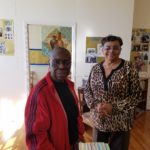

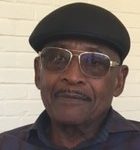
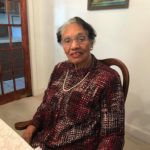
The thirty-six interviewees in this collection describe community, family, educational experiences, and race relations in Winnsboro, Ridgeway, Simpson, and surrounding areas of Fairfield County, South Carolina. Interviewers asked about parents and grandparents, livelihoods and traditions, segregation and integration, and memories of Fairfield High School, among other recollections of daily life.
The majority of interviews were conducted by students in Dr. Doyle Stevick’s graduate class (EDLP 807). Two interviews were conducted by Andrea L’Hommedieu, director of the Department of Oral History, who worked with the class to record, preserve, and give access to the collection.
Interviews include a sound recording, summary, and full transcript of the interview, allowing multiple ways to access the collection.
Click on a name below to read or listen to the interview:
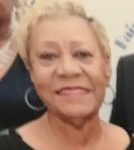
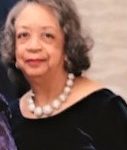
Gladys Allen & Jean McCrory
Gladys Allen: “You have to have a thick skin, you really do. Because it’ll keep you weighed down, you know, if you let everything that’s said or done to you bother you, it won’t allow you to grow.”
Jean McCrory: “Well my dad was born in 1918, so maybe in the late thirties he went into the Navy, and he stayed in the Navy two years. When he came out, he was able to purchase his own land and he bought forty acres of land and from then on he was, I guess you would say, an entrepreneur; he had his own business. He ran a pulpwood business and he also farmed.”
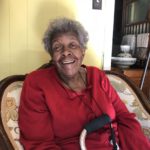
Eva Armstrong
Eva Armstrong: “We had to walk about six to eight miles to school. And that was rough… And when we went to school, it would be so cold sometimes—I know you probably done got this story—until your hands would be frozen. And the teacher would have this big pan of water on the stove. We had a wood stove. And you had to thaw your hands out before you could get your lesson.”
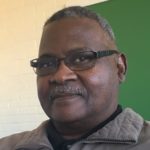
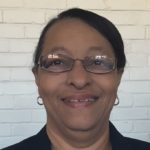
Jerome & Nadine Boyd
Jerome Boyd: “We rode a bus. Matter of fact, it was unusual because most of the children in our community, because we were kind of a close-knit community. We rode the bus. They had a bus for us that only black children rode.”
Nadine Boyd: “I remember the teachers actually knowing who parents were, who grandparents were, and when kids were disobedient or acting crazy, what we called in that day, they would remember ‘who’s your mama,’ ‘who’s your daddy.’ They wanted to know, so they could report to them how we were conducting ourselves. And I think in that there was a caring about people and about students and it wasn’t like, ‘I’m here to teach, get a paycheck,’ [it was] ‘I’m here to take care of these children that eight hours that they’re not home. They’re with us.’”
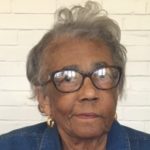
Thelmer Cook, Mattie Squirewell & Hattie Brice
Hattie Brice: “I can remember my dad making the little toys, it was a place where he got this chalk-like mud and used to make toys—little animals for us—and bake them in the oven. And we would have that in our Christmas box, along with our other little stuff, because there were no bought toys.”
Thelmer Cook: “My fondest memory as a child…I grew up on a thirty-six acre farm, and we were one of the few lucky blacks to own our property. It was handed down to us by my grandfather. He had a four hundred-acre plot, and he divided it up among his children, and so we just farmed that—about fifteen acres of that thirty-six acres. And we had one mule and maybe three or four cows that we ran in the swamps to feed and everything.”
Mattie Squirewell: “So my daddy always was an outgoing person, and always involved in stuff. And when black people got so that they could register to vote—well he was one of the people that was registering people to vote. So that was a tough time for my family and the other black families there in Blythewood because—I guess I can say this—the Ku Klux Klan was real active at that time in Blythewood. So we used to could look out the window at night, and see them riding with their white hoods and stuff. And so, they wanted my dad to stop registering people to vote, but he didn’t. And so one Friday night somebody woke us up; our barn was burning down.”
Ruth Chavis
“I think now things have moved on and have progressed. As a society we get along better now than we did back then, ‘cause you have all type of friends now and races and you work with people, you get close to people, you send your children to school, you teach them how to be able to associate with anybody, no matter what color their skin…you teach them how to be kind and respect people.”
Mae Nolia Davis & Robert Davis
Mae Nolia Davis: “When I was—well I was almost six, like I said, we didn’t have a school house, we used our church (in the Blackjack community).”
Robert Davis: “I remember being extremely sick when I was in the fourth grade. I had diphtheria, and at that time doctors would make house calls because folk just didn’t have transportation. And my mother brought me…downtown and the doctor…gave me some red medicine. I will never forget, and he said, ‘You’ll be well enough to run rabbits tomorrow.’ The following day my family doctor came out, and he had them take me directly to the hospital, and carried me right straight to the operating room, and operated on my throat for diphtheria, ‘cause I was just about gone, just about gone…”
Queen Davis
Queen Davis: “One thing, we did learn our black history…we sang the songs, we learned the poems, we knew all the people who were involved, and all the historic blacks, and all the literary blacks. That was one thing that we had.”
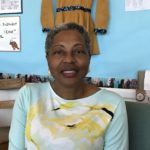
Fannie Ford, Charlie Belton, & Easter Samuels
Fannie Ford: “I mean, because things are happenin’ all over, and when something happens we come together and work together as two human beings, not as black and white.”
Charles Belton: “When I left high school a year later I joined the Navy, 1972. Most of my work experience was kind of either government and I did eleven years active duty. I got out of the Navy and went to work for the Department of the Army up at Fort Eustis Aviation Research and Development as a welder. And I actually left there and went to Desert Storm from ’90 to ’92, like I say a lot of travel, as a Merchant Marine, as a civilian, as a Navy Sailor, all over the globe.”
Easter Samuels: “And our teachers, they cared so much for us, they would come to our homes and make home visits.”

Edwinda Goodman
Edwinda Goodman: “I would love to see everybody know that we have to get along, I guess you could say I’m all about the preaching, but—they have to realize that we all are one, you know? God didn’t separate no white and black. We all are one, so we should…If we can’t get along down here, and love one another here, how you think we’re going to get along in Heaven?”

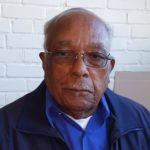
Leola Gripper & Weldon Haire
Leola Gripper: “My sister and I lived with my mom’s aunt for the first two years [during high school], because we didn’t have school buses at that time. We had a homeroom teacher, and we changed classes for our different subjects. We had a different teacher for each subject, and that was very exciting. My high school experience was a major learning environment for me.”
Weldon Haire: “I worked for a Dr. Buchanan the whole time I was in school. I would go there and clean up his office and so forth. And that way I was independent from my mom and dad having to buy clothes and things for me. I was able to do those things myself. And also help my brothers and so forth.”
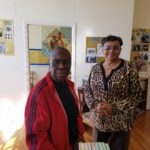
Betty Gunthrope & Betty Dorsey
Betty Gunthrope: “I was never allowed to drink water in a public place. Momma would carry water in the car. You just don’t drink it. The same things like going to the back of the bus station and get a sandwich: you just don’t buy there, you just don’t. We kept food—if we went somewhere she would carry food. You just don’t participate in that kind of thing.”
“I’ve got little crystal, individual salt servers….when the Yankees came through they threw that stuff out in the yard and my great-great-grandparents picked that stuff up. That’s how I got it….the slaves picked it up.”
Betty Dorsey: “At that time parents taught you, ‘just don’t say anything’…so finally as Dr. Martin Luther King and others began to fight this thing, I was happy because I said, ‘it’s not fair’. And if I never remember any [other] thing that Dr. Martin Luther King said: it’s not the color of your skin but the content of your character.”
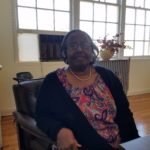
Margaret Holmes
Margaret Holmes: “We had history, math…as a matter of fact we even had music… do you see that short lady right there along with the tall one? That was Ms. Manigault—Dorothy Manigault—she was the music teacher, and she was the homeroom teacher, and she was the English teacher. I remember taking music lessons under her.”
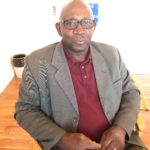
Larry Irby
Larry Irby: “I grew up in a family of nine kids, eight boys and one girl. We grew up on a small farm, had the opportunity to pick cotton, pull corn, peanuts, sweet potatoes. We grew most of our food, raised pigs and we had a milk cow. You know, and be cutting wood for the fire. Those were some great days…and grew up in the church in the Old Testament; on Sunday you didn’t do anything, it was a day of rest.”
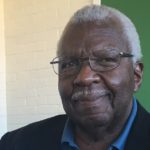
Carl Jackson, Jr.
Carl Jackson: “Before I finished Benedict, Dr. King and the ACLU came through here, Freedom Riders and so forth, and they were into the lunch counter stuff and all of that, and marching. And King’s vision for the march was that you march non-violently. No matter what happened, you be non-violent. And I told them, ‘I can’t march. I can’t do that.’ I said, ‘Because if somebody spit on me, it’s on.’ But I will participate in the voter registration, and I’ll take people to knock on doors to get people to register to vote.”