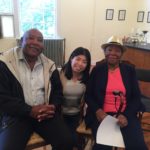
Interviewee: Mae Nolia Davis & Robert Davis (unrelated)
Interviewee: Jingtong Dou
Date: October 26, 2017
Accession# EDLP 006
Length of Recording (min/sec): 1:01:17
Sound Recording
Summary
Mae Nolia Davis was born in Blair, South Carolina. Her father was a sharecropper, and her mother was a homemaker, raisng five children. She attended Fairfield High School, but left school at fourteen to get married. While raising seven children (all boys), she earned her high school diploma and later an associate’s degree. She worked in the Fairfield school system as a teacher’s aid for twenty-two years.
Robert Davis was born in White Oak, South Carolina, one of ten children. His father worked in the pulp wood mill, and his mother worked in a plant in Winnsboro. He attended what was to become Fairfield High School in the mid-1950s. In the 1960s he was drafted, but not sent overseas. He returned to South Carolina, received a college degree, worked, and ran for political office, winning a seat on the Fairfield County Council for eighteen years.
This oral history interview with Mae Nolia Davis and Robert Davis on October 26, 2017 includes discussion of growing up in Fairfield County, South Carolina, attending Fairfield County Training School (later to become Fairfield High School), daily life, attending college, race relations past and present, societal segregation, the Civil Rights movement, and African Americans employment.
Transcript
Jingtong Dou: Could you tell me a little bit background about you, your name and your family? About your growing up background.
Robert Davis: You got two Davis’ here, no relation but two Davis’, yeah.
Margot Gore: Spell your name for me.
Mae Nolia Davis: My name’s in two parts, M-A-E N-O-L-I-A.
MG: N-O-L-I-A.
MND: Davis.
RD: I’m Robert W., um-hum, Davis.
JD: So maybe we can start from Mae Nolia, could you tell us a little bit of background about your family and your memories of your childhood?
MND: Well, I’m a child of five, had two sisters, two sisters and two brothers. They’re both deceased. I really wasn’t born in Winnsboro, I was born in Blair. So, in 1941 we moved down to this side. And I was the oldest child and I had a good childhood, well you know, back then, well now you know things are very different from what it is now. Yeah, so my daddy was a sharecropper and yeah. We moved from, like I say we moved from, well really stayed (unintelligible 1:49) from Blair, you know. We moved down here when I was about nine years old. So I lived in Winnsboro, but Blair is still my home. (laughter)
MG: …Blair’s still your home…
RD: That’s a community about fifteen miles west of here.
MND: (unintelligible 2:11) down Hopewell Baptist Church. Yeah, I stayed (unintelligible 2:18) until I got married. And then I joined the Shiloh Presbyterian Church. …Been a long time, I got married when I was fourteen years old.
MG: You got married at fourteen? Oh! (laughter)
MND: I sure did. We stayed together, but he’s dead now. We had seven boys.
MG: Seven boys. No girls…
MND: No girls. And two of my boys are dead, one killed in Vietnam and one just died.
MG: Oh, I’m sorry…
MND: So being here–I didn’t finish out school here. I was fourteen. But I had three children, had finished high school, when I went back. And I went back and got my diploma, too.
(laughter)
MG: Good for you!
MND: It took so long–I was working and…working–I worked for the school for twenty-two years. Teacher’s aid.
MG: You were a teacher–you worked in the schools?
MND: Um-hum, in this one, all of them just about, I think (laughter) ‘cause we rotated (unintelligible 3:41). But I had three boys had already graduated and I got my diploma, too.
MG: Good for you!
JD: So yeah, will you mind if I ask a . . . I’m sure your story may be a little bit different from, yeah—could you tell, as a little background, about your family and your memories; about your childhood.
RD: Sure. I’m Robert W. Davis. I’m the second of ten children in our family, there were five boys and five girls. We lived about six miles north of Winnsboro here. I started school at five and the–I guess you’ll call it the truant officer–put me out once she found out I was five, to come back when I was six, and that was a little small country school north of here where they had from first grade all the way to the twelfth grade. We lived about a mile and a quarter from the school, so when the bus would–as they were coming to Winnsboro they would pick us up and bring us to school, and in the afternoon they would pick us up and take us back.
MG: What’s the name of that school?
RD: White Oak, right. We–from a large family we could always eat. I don’t ever remember being hungry, you know, lack of food, when I was a kid. We didn’t have anything but we had, from my memories we had, we were always, was something to keep us from being hungry. How my parents did it I have no idea. But we lived right on 321 just three hundred, four hundred feet off the main road coming through at that time. And the childhood, we came to Gordon which is a school–elementary school–that was built in I think ’54 or ’55. Yes, the school is still there but it’s not used as a school, it’s just west of here, down the hill there. Started there in second grade and from there we–I spent five years there and came to this portion as a seventh grader and we finished seventh grade through high school at this location–yeah, Fairfield High. At that time it was called Fairfield County Training School at that time. And I think I started in ’55, ’56, I believe. But as far as, again, you know, we didn’t have anything; we were with a car sometimes, sometimes we didn’t have one.. Our neighbors pretty much kept a vehicle, and we kind of caught them for transportation to and fro into Winnsboro here.
My mother worked at a plant here, my father worked pulpwood, and at the same plant down through the years and finally ended up International Paper, which is another paper company. But my childhood was–we really didn’t know what we were missing because we didn’t have it initially, so you know, you’re comfortable where you are until you find out different. So basically we received a decent education. We didn’t have a great deal of experiences, you know, like traveling and vacations and things of this nature, that just wasn’t in our repertoire. But other than that we pretty much had a normal, what I would call a normal, childhood.
I remember being sick–extremely sick as a matter of fact–when I was in the fourth grade; I was about ten years old I guess. And I had diphtheria, and at that time doctors would make house calls because folk just didn’t have transportation. And my mother brought me–now we caught the bus, pay a quarter to ride to Winnsboro here–and our doctors was closed, which is downtown, and another doctor was five blocks on down, so she and I had to walk to the second doctor and he told me–gave me some red medicine. I will never forget, and he say, “You’ll be well enough to run rabbits tomorrow.” And the following day my doctor came out, my family doctor came out, and he had them take me directly to the hospital, and as soon as I got in they gave me an injection and carried me right straight to the operating room, and operated on my throat for diphtheria. I was about the age of ten, and I guess I stayed in the hospital probably a week I’m thinking. But other than that—‘cause I was just about gone, just about gone…
(laughter)
JD: So how were the facilities at the school during that time?
MG: Yeah…we’ll start with Mae Nolia…
JD: …We’ll start with Mae Nolia…
MG: When you went to school in Fairfield, what were the facilities–what was the building and the books and . . .
MND: When I was–well I was almost six, like I said, we didn’t have a school house, we used our church. That’s where I first got (unintelligible 9:33) and when we moved down here, I was in sixth grade and it was in Blackjack—at a little school, and I started one there. And you know, my daddy was a–he was in the old times, you know–but when we moved down from Salem Crossroads, we just was kinda like a sharecropper, but when we got down here– it was still was like a sharecropper. But, it was where he could…buy the land…And he couldn’t write his name, but he could print it, but he was a, he was a go-getter man (laughter). We moved down here, we called it ‘government houses’–they built the house–nice house and everything, and things they had never had before. We always had things, just like he say, my daddy was always a go-getter.
But anyhow, after I went to Black Jack school–it was a small school about that big, for three years… no, one year…And then I started coming up here. Yeah, we didn’t have a school bus or nothing like that.
MG: So, your sixth grade year…
MND: A family that build it up, helped us. They children was going too, they was grown, they was going to school, and we’d catch a ride with them most of the time. And we never walked to school but we always walked from school sometime, and that’s about…how far we stay out there?
RD: About three, three and a half miles.
MND: (unintelligible 11:34)
(laughter)
MG: …but I bet it seemed like twenty…(laughter)
MND: But you know what? Some would be walking from Simpson, right down the road. And some of us would be walking, like the blacks, or some people might be walking from Middle-Six, and it didn’t seem hard for them, you know… Well, and I don’t know what happened to me, I met somebody down here, and then I got married.
MG: So, can you explain this ‘Simpson’? Is Simpson…was that a school or?
RD: Simpson? That’s another community, there were different little communities scattered throughout the county and yeah, that was south of here.
MG: And Black Jack was the name of your school?
MND: Yeah, it was a little school, it must be right near Blackjack…
RD: Yeah, it’s in the Blackjack community is what it . . . that’s the community as well, right.
JD: So it was during the 1950s, right? …The year we’re talking about school. . .
MG: When you were in school, when you started here what year did you start?
MND: Oh, my God, I can’t remember…(laughter) But I know, I was in the seventh grade with Thelmer… we was in the same class.
RD: Who was this?
MND: Thelmer.
RD: Thelmer Cook?
MND: Um-hum.
RD: That was, I don’t have any idea. He’s about, Mr. Cook, what, about eighty-four? He’s about eight-four now.
MND: He more than eighty-four.
RD: Is he? Okay. (laughter)
JD: Why I ask this question because I know, Robert, you are talking about your schools, the childhood memory, it might be in 1960s or during the 1970s? Is that . . .
RD: I started, it was earlier than that for her. Yeah, it was much earlier than that for her.
MND: Yeah.
RD: She probably talking in, what, the, in the ‘50s or?
MG: ’41 she moved to Fairfield.
RD: Probably early ‘50s I would imagine.
MND: My oldest child born in the ‘40s, ’44.
RD: Forties, yeah okay. Yeah, George, yeah, okay.
MND: You know, George wasn’t my oldest child, Terry Lee was… Yeah, my oldest child was Terry.
RD: Terry Lee, I remember Terry, yeah, okay.
JD: I just want to make sure we’re on the right track.
MND: All my children, they came out good, never been in no trouble. And all of them had the little over, what you call them when you be over the people in the jobs?
RD: What, supervisors?
MND: Yeah, all of them, four of them are supervisors. And I got my two youngest sons, they’re now retired. But all of them finished school. And I say it was a better time than it is now in a way. ‘Cause people was more, you know–I don’t know what you would say–but everything is good now ‘cause we doing alright. You know, all of my children got their homes and stuff.
MG: How do you feel it was better? In what ways was it better?
MND: Well, the people was more–I don’t know how I say…they’re not–everybody knew everybody, and there was real–not like ‘I’m better than you, or I got more than you’, ‘cause didn’t none of us had anything that much–but that’s what part of the…that’s the way I think about it. Some people . . .
MG: Most everybody was poor.
RD: Yeah.
MG: But some were poorer?
RD: Yeah. (laughter)
MND: And like I say my daddy raised his own food. Only thing we bought, meat-kind– was fish; you’d have to come to Winnsboro.
JD: So my next question is about school. When you finished school what did you do? Or during the school what were your ambitions?
MG: When you came to McCrory what did you want out of life when you came to McCrory, sixth, seventh grade?
RD: Went to Fairfield.
MG: Oh, Fairfield.
RD: This is Fairfield. You mentioned McCrory?
MG: This is not McCrory?
RD: No, this is . . .
JD: Is it Fairfield County?
RD: . . . No, this is Fairfield–previously Fairfield County Training School, but we changed the name later to Fairfield High School.
JD: So maybe we can start from Robert this time.
RD: Okay, what’s your question again, please?
JD: What did your ambitions, when you were at school, after graduation what did you, where did you go?
RD: Okay, initially when I was in school I wanted to be a detective, I guess that’s from watching TV shows and things of this nature. But once I left school in May of ’66, I didn’t want the military, so I worked a couple of months here, and following that I went to Hartford, Connecticut with my brother where he was working. Went to work at a plant called Pratt & Whitney, they made airplane engine casings. Following that, we came back home after about a year and a half. I got my mother to sign for a car for me. Before I made my first payment on the car I got my draft notice. So that pretty much knocked me out of the ballpark (laughter) for having . . . I tried all I could to get out of the service, Ms. Davis.
MND: Yeah, your brother and my son . . .
RD: Yeah. And her son and my brother were classmates and both were killed in Vietnam, so those, and I lost two classmates in Vietnam, from Vietnam while I was in Basic Training. This was in ’68.
MG: So your brother and her son.
RD: Yes, uh-huh, killed in Vietnam. Anyway, I went to the military on my twentieth birthday is when I went in service. And went to Fort Riley, Kansas after training and I asked to be an MP and I was granted permission to be an MP at Fort Riley, Kansas and I stayed there for two years. My wife and I got married at twenty, just as I was about to go to Kansas and she came out two weeks after I got there, so we just had a little space about the room size here as an apartment. And we stayed there for a year and a half until I was discharged. And following my discharge . . . cause let me back up, through high school I worked part-time at a country store in Winnsboro there. And previously my brother had worked there, he was a couple years older than I and when he left I assumed the job and, delivering furniture, picking up furniture, things of this nature, after school and on weekends.
I can’t remember what we made but had to be just roughly a pittance cause we just didn’t get, you know, salaries weren’t large but something is better than nothing financially. So we did that, let’s see where did I leave off? Following the military, I think I told you about the detective that I wanted to be and somewhere along the line I lost that, but I know when I left school I wanted three things: I wanted a new house, I wanted a new car, and I wanted a boat. And I was able to get new car December–probably eighteenth, of ’68, I remember the dates–ordered that car in October, two months to get it. Jane and I were in Kansas at the time. And so I got the new car, I got the house once I was discharged a few years later, and somewhere along the line I just lost the boat. As a matter of fact that’s my house right there. Yeah, yeah. So, that’s our fifty years class reunion, May gone was a year ago. But anyway, those were the three things that I wanted, and following that . . . you want me to progress on?
MG: Yeah, go ahead.
RD: Okay. Following that I became interested in politics just by helping all the candidates run for office; I’m talking early to mid ‘70s.
MG: You’re back in Fairfield by now?
RD: Yes, yes, I’m back in Fairfield. And after a few years of helping candidates get elected or not get elected, someone mentioned the fact that I should run, and sure enough I ran, and I was elected, and I stayed on council for eighteen years and I was, and this is… This was, elected in ’84, went on in ’85; and eighteen years afterwards is when I lost an election and I haven’t (unintelligible 21:12) into it yet.
MG: What position did you have again?
RD: I was Fairfield County Council member, and I served as vice-chair and chair about nine and a half years out of those eighteen years.
JD: So you went to politics.
RD: Excuse me?
JD: You went to politics.
RD: Yeah, got into politics, yeah.
MG: (unintelligible 21:30)…just trying to get the camera…
RD: (unintelligible background conversation throughout answer, 21:36)And I started school, I worked for Verizon telephone company, at the time it was General Telephone, I started there in ’72 and I started going to Palmer College the same day I went to the phone office. And I got my associate degree at Palmer and worked for the telephone company for thirty-seven and a quarter years. I’ve been retired nearly eight years now. …go ahead…
MND: I did get two years of college, too. For my job; I was a teaching assistant. And you knowed Mr. Lyles…
RD: Yeah, William Lyles…
MND: He had it fixed when he–somebody, you know, if they wanted to go back to school (unintelligible 22:36). And, my mama was sick, and the children was grown [sic], and had a husband to go home to (unintelligible 22:45) but he went with me, and I stayed two years in college, well you know . . .
MG: You got your high school diploma, and then you went and got two more years of college.
MND: Yes, yes, yes.
JD: What did you do after your school? Where did you go after graduation?
MND: I always though I was kind of smart…That’s what I thought. (laughter)
MG: …you’re amazing…
MND: Well, I did…(laughter)
MG: So you just–it was just to get–was it for a promotion or anything, or you just wanted to have that degree?
MND: What?
MG: Did you get a promotion in the school when you got that degree?
MND: No, I stopped work at the school. It went, the school part–what you call it the (unintelligible 23:33)–stop having stude– teacher’s assistants.
MG: ohhh…
(background conversation 23:33)
MND: …Come up here, it’s just really helpful to get my diploma, because (unintelligible 23:51). I’m so old now I can’t remember that, I done forgot what was (laughter and unintelligible 23:56).
MG: …that’s wonderful!…
JD: Were you hoping to stay in Fairfield County or somewhere else after school, after graduation?
MG: When you finished school did you want to stay here, in Fairfield, or did you wanna try to go somewhere different or did you, you had no desire to . . .
MND: No, I, when I finished school I had seven children. (laughter) I didn’t go nowhere!… After I (unintelligible 24:21). My husband, he went to work for the Highway Department and that’s where–he worked there thirty-five years, so…. We just–we wasn’t rich but we got along.
JD: So Robert, were you hoping to stay in the Fairfield County or somewhere else?
RD: Well, I went to some other place but we didn’t stay very long there. And I guess I was hoping to stay here because this is where I came back to. And following military I had planned to go to, I thought about going to California, but Jane and I headed straight back to Winnsboro in that Chevelle. (laughter) And that’s where we’ve been pretty much since then.
MG: How’d you like Kansas?
RD: Kansas was cold. Plus I was in the military, so that didn’t help at all. They took me away from home and I didn’t want to go.
MND: You say you was in Kansas?
RD: Uh-huh, Fort Riley.
MND: That’s where my son–one of my sons finished out of school…
RD: Is that right?
MND: Yeah, he’s still up there.
RD: Oh, is that right?!
MND: Wichita, yeah… He still got a college–I mean, service. I had three children in the service. He, I wouldn’t sign for him to go in there (unintelligible 25:50) got somebody else to sign off.
RD: Oh, my goodness!(laughter) …okay.
MND: Yeah, he made his time. He’s, he, he’s in his late, he–I got one got a birthday today; he’s older than them, he’s sixty-six.
RD: Okay, a couple years younger than I am. The one that lives here?
MND: Yeah.
RD: Yeah; work for the Highway Department?
MND: Yeah, he retired now.
RD: Yeah, right, right, yeah I know him.
MND: Today’s his birthday; he’s 66.
RD: Oh, okay. Yeah, I’ve got him by about three years. (laughter)
MG: I was going to ask (unintelligible 26:32), while she was here?…
RD: Yeah, that’s my wife out there. She’s, she pretty much had the same experience I had…What’s the question again?
MG: Did she work in the school system at all?
RD: No, she didn’t work in the school system. Once we came back she worked at Uniroyal for a brief period, then we got married and went on, she came on to Kansas with me. And, well she worked at a bank once we got back and got settled and got a house and everything, she worked locally as a bank teller, bank supervisor teller. That’s what she did for . . . my wife.
MND: Yeah, I know. But one of your twins . . .
RD: Oh, that’s Marlise and Elise, yeah.
MND: Yeah, one of them work in the school system, isn’t it?
RD: Yeah, she’s in Ridgeway, I think, yeah.
MND: (unintelligible 27:22) for me when I was working for . . .
RD: Oh, did she?… Well, yeah. Yeah, she’s been there a long time. Yeah, yeah.
JD: You were in different times, but both of you, I would like to ask, what were black and white relations like in Fairfield County?
MG: With the community, how . . . we’ll ask each of you because it’s different times. And what were your experiences with the black and the white people . . .
MND: Now or then?
MG: Then, let’s think about the times…maybe 1970, ’68, you know, when the schools were . . . ’70 was when the schools were desegregated, integrated. What did you feel the race relations were like back then? Your kids were in school about that time. Were your kids in the schools at that time? Your children?
MND: Yeah, (unintelligible 28:17) some of them was.
MG: During desegregation times?
MND: Well, they got along.
MG: …they got along?…
JD: Did your family teach you about race relations when you were in the school–while you were growing up? I mean, your families, your parents teach you . . .
MG: About white and black—
MND: …I can’t hear you…
MG: …Okay–with the white and black situation in Fairfield. What were the race relations like and did your parents talk about it at all? Did you talk about it with your kids at all during that time when desegregation was happening?
MND: I guess we talked, you know, I never had no trouble with them.
MG: Okay. Did your children complain about any dealings?
MND: Sometime, sometime they would, yeah cause it was kinda tough.
MG: Yeah, so your kids had more issues you think than you had with whites and blacks getting along? Did your kids have more issues or problems?
MND: Never had no real problems. All of them finished school and I had one to go to college on a basketball scholarship. And he got along with them, he would, it was, what your school is down there? In Columbia?
RD: Benedict? Allen?
MND: Hum-um.
RD: USC? University of South Carolina?
MND: Yeah, the big school. About that time he was going to college, he finished college in Spartanburg but the time he was going he went to Union College, so he went to two, you know–I don’t know did Spartanburg didn’t have a college, or what.[sic] I know he went to Union two years.
RD: Union? Okay.
MND: And then he finished his other two years at Spartanburg.
RD: Spartanburg Methodist?
MND: Um-hum. I don’t know it was Methodist, but there’s two you know–two schools in Spartanburg.
RD: That’s the only one I’m aware of.
JD: So Robert, during your school years what were black and white relations like you feel in Fairfield County?
RD: Well, in 1965, that’s the first year students from Fairfield transferred to Winnsboro High, that was the all-white school, this is the black school, and that was all white at that time, ’65, we had, out of my class there were about three or four students I think that went to that school. And we didn’t communicate, you know, on a basis after they left here, but I’m sure those would be some nice, some informative people that can tell you about the intermingling, that was the first time. And I do remember in that same area there’s a gentleman by the name of W.W. Lewis, he’s gone now, he had a sign, huge sign in his yard at that time “Save Our Schools”, and we had to, when we left and when we came to Winnsboro we saw that sign “Save Our Schools”, you know, sitting right in his yard there. And he was a member of the ABC Board, that’s to issue a liquor license at the time, so he was on ABC Commission, state ABC Commission. And that was about a mile from a little small country school that I attended as a child. And one other experience dealing with racial, I mentioned the bus, catching the bus to go back to Winnsboro, there was a segregated bus station here, white side, black side–same as doctor’s offices waiting room, white side, black side; water fountains same thing.
And loans and things of this nature were not accessible to our folk, if you were able to get it, nine times out of ten you paid a higher rate, different requirements. Same thing on purchasing vehicles, things of this nature; you paid three thousand dollars, somebody else may have gotten it for twenty-five, twenty-eight hundred dollars. But you had no way of knowing, you know, cause you didn’t view the records. Once I caught a bus from Winnsboro to my home in the White Oak, St. John community, I got on the bus and just before the driver pulled off he looked in the mirror and saw there were about three people on, three whites on the bus, Greyhound bus, and I got on the bus there and I just fell into the either second or third seat. And once he looked in the mirror and saw my seating, you know, he wasn’t disrespectful, he wasn’t mean or anything, he said, “You need to move back.” And I was about twelve years old at the time, twelve, thirteen years old. And I just moved back two seats, drove the bus on, nobody said a word and let me off at my proper spot. And one other time on coming to Winnsboro from my home, at that time, I don’t know if you’re familiar with this, you just stood by the road and just, when the bus came you just flagged it down, gave a quarter and you stepped on and came to Winnsboro. But at that time I stepped on the bus and there was a white kid sitting right behind the driver, and I proceeded to step on further on the bus there and he slid over and said, “Sit right here.” And we, the difference in . . . and strangely enough the driver didn’t say anything, and I’m sure there were passengers . . .
MG: Were you a child then?
RD: I was thirteen, fourteen–around about the same age–and we came, got off the bus, both of us got off in Winnsboro. We walked the same way for about a block and a half, he was headed to somebody’s house which was about a block and a half from the bus station, and I had to continue, but we walked together from that location to where I left him at some relatives house there. And that was probably my different areas of racial happenings at that time. Back to the furniture store, I worked for the man up there, Winnsboro Furniture Company was the name, and his—Wednesdays the stores closed at twelve, and his secretary wanted me to do some work at her house that afternoon. So her car was out back there so she said, “Get in the car and I’ll be out shortly.” So when I got to the car–a ’55 or ’56 Ford (laughter) I don’t know how I remember that–but I proceeded to open the door to the car, and she had a pie sitting where the passenger would sit. So I just slid the pie over and got in the front seat. And once she got out, “No, you’re gonna . . .” once she came out to get in the car, “You gone disturb my pies.” So I proceeded to get out and just told her, “I’ll walk on to your house.” Which was a few blocks away. But her motivation was the pies was supposed to deter me from getting into the car, getting into the front seat, to sit in the back. So I said, ‘no, no, I’ll just walk on up there’. And that was the first last time I went to work at her house there. And that was . . .
MG: That’s interesting. What year was that about?
RD: This was ’65, probably ’65.
MG: Civil Rights Act was signed in ’64, right?
RD: Um-hum, yeah. This was probably ’65, yeah. I think I was a junior in high school.
MG: So racial tensions, were they starting to stir up a little bit like that or is that just the way it was?
RD: That had been the way it was. I don’t know if any real, I wasn’t involved in any real tensions other than the accepted norm at the time, you know, and it was a normal atmosphere so to speak. But there were no confrontations that I’m aware, I’ve heard of some but I wasn’t privy to those. And there was one section in town where blacks didn’t drive through, which is called Mexico, the Mill Village, the old, across the railroad track, probably anybody can tell you where it is, but blacks just didn’t go into that area.
MG: Called the Mill Village?
RD: The Mill Village–Mexico, it was called Mexico and the Mill Village–you just didn’t travel through there. Everything was separate, two movies, buses, there was a white bus coming from the county into the City of Winnsboro, and you had the black kids riding one bus. White kids coming, you going basically two or three blocks apart, like this school and the school across the railroad track there, basically going to the same area, you’re using twice the transportation cost. So, which is just silly, but that’s the way it was…
MND: You telling them about the Mill, or–you know, Black Bottom down there…
RD: Yeah.
MND: (unintelligible 38:11) they had to run all the way from, you know, the top of the hill . . .
RD: Top of the hill, right.
MND: . . . to the . . . and a lotta time they had to hide.
RD: Yeah, yeah, okay.
JD: Do you remember about the Civil Rights Movement? What stories would you like to share?
MG: Um-hum, the Civil Rights Movement, just when it was happening in the rest of the country, what was happening in Fairfield?
RD: I think Fairfield at the time, I don’t . . . we just pretty much I think probably heard about it from TV and other experiences. And I had a cousin in Johnson C. Smith in Charlotte at the time–my grandmother was living in Charlotte at that time. When she would come home she would tell us about what was going on around Smith and the city and demonstrations, that was probably ’62, ’63, somewhere in there. But to my knowledge in Winnsboro here, we weren’t involved in those. It was usually in the larger cities, I don’t . . . and I’m not aware of, it may have happened but I’m not aware that anything occurred in the Winnsboro area.
But there was always, you’ve got those folk who think you should know your place mentality. And strangely enough that’s carried on to kids that are my age, they have the same, they may have adjusted themselves but they were indoctrinated with that, that’s the way it was. Like we are of a higher echelon and you are less than a whole person, so that was the mentality in the general area. At that time little grocery stores were scattered throughout the county and some folk traded–I say ‘traded’–charged items with those merchants, and that’s how they, that was their livelihood. You know, if you were coming to me for your resources to get you through the sharecropping, you know, and then you pretty much had to, you know, jangle at the end of my chain, so.
JD: Yeah. So what do you remember about the Civil Rights struggles in Fairfield County?
MG: When everything was happening in the country, when you saw what was happening in the news, and marches and things? Was there any, when there were marches, moving forward maybe to about 1968, Martin Luther King and that era. Did anybody in here, were there activists in Fairfield during that time or, that you remember?
MND: I can’t remember.
RD: I don’t remember any activists. I left here in ’66 and I know prior to that I don’t remember being involved in any marches or movements or anything, and I’m talking May of ’66 when I left. But I don’t remember anything of that nature.
JD: So do you mean all the tensions weren’t in this, some people can feel that?
RD: Yeah, yeah, yeah. Well, there was one, like I said, you know, earlier, there were two waiting rooms, the bus station even, white’s waiting room side and they had a little restaurant there, you had to go to the little window to be served at that. But they had booths and tables on the other side. And I don’t remember of any, there may have been some isolated incidents but I’m just not aware of . . . personally I never did have a confrontation with anyone.
MG: I didn’t see anything, I researched all the newspapers.
RD: You didn’t find anything?
MG: Seems like one, maybe two. Well, I was actually searching for schools because, you know, my dissertation is on the schools primarily.
RD: There may have been isolated incidents but on a whole I don’t remember anything. Now some people may have, I’m sure there were isolated incidents but on a whole the masses, I don’t remember hearing about,–I definitely wasn’t involved in anything.
MG: So you were back in, like ‘70s, you came back in, what, about ’72?
RD: I came back after the military in ’70, and things in the ‘70s were . . .
MG: (unintelligible 43:01)
RD: Excuse me?
MG: The good schools had already been integrated.
RD: Had already been–in ’65 is when they integrated here in Fairfield County. But . . .
MG: But then you apparently went, like (unintelligible 43:13) I’m not finding that much, in ’65 . . .
RD: You got involved in integration?
MG: Yeah.
RD: Yeah, like I said my class, there were about one hundred twenty-five of us, and I think about three or four left to go to Winnsboro High. And I can probably give you the names and maybe the phone numbers of a couple of people, they can tell you a little more about those, yeah. Okay, sure I’ll get those.
MND: (unintelligible 43:42) left on here?
RD: Excuse me?
MND: –when they integrated and went to Winnsboro High?
RD: Yeah, left here, some students left here in ’65, ’66.
MND: Yeah, my son was one of those.
RD: Your son was one of those?
MND: He the one that . . .
RD: Is that right?
MG: He went to Winnsboro? He chose to go to Winnsboro High School?
MND: Yeah. But had some friends–the Grippers–you know the Grippers…?
RD: Grippers.
MND: Goins.
RD: Goins, I remember . . .
MND: They lived down there where we lived.
RD: Yeah, I know Helen Brabham was down from there.
MND: Yeah, that was one of the . . .
RD: She to the . . . yeah.
MND: …some of ‘em was cousins, they didn’t know…
RD: Yeah, okay.
MND: And when my, (unintelligible 44:22) he say, he was a–he’s a basketball player and so, like he say the coaches and everything was white and everything, and he didn’t have any trouble.
RD: He didn’t have any trouble?
MND: Hum-um. He say it was something up there.
MG: That was when they went to Winnsboro?
RD: Right. Her son.
MG: McCrory then was . . .
RD: McCrory Liston, that was a school out on the western side. That was the black school on the western side, they went from elementary I think until high school.
MG: Okay, and everybody came.
RD: And everybody came when they built the new school, Fairfield Central, everybody came from, county-wide to that school.
MG: Okay, so well she made me think about it when you said basketball. Because the only thing I saw in the newspapers about, you know, as time went on, as I went into the early ‘70s or so, African Americans, but you didn’t see anybody that was African American until maybe 1970 in the papers. And when it was it was about the basketball team winning at McCrory.
RD: Yeah, McCrory was, what, fifteen miles to the west of here? Yes, McCrory Liston School.
JD: Do you remember the Brown decision, when the Brown decision happened?
MG: Brown v. Board of Education.
RD: ’54?
MG: Do you remember that?
RD: I don’t know, I was . . .
JD: Or teachers or your parents’ view about that.
RD: That’s probably when I got kicked out of first grade. (laughter)
MG: You might remember that, do you remember that? Brown v. Board of Education? When that case happened, were the, they said separate but equal education was not the precedent, that they’d set precedent . . .
MND: I know I was old enough to know it, but I don’t remember it. (laughter)
MG: So maybe not a lot happened after that.
RD: Maybe not. Not here cause being a small community it probably, we didn’t get the magnification of other areas. Like it’s probably–the conflict probably was more on a one on one rather than in general.
MG: Yeah, in the bigger cities I think . . .
JD: So here we only have the integration process, right?
MG: Um-hum, and (unintelligible 46:53).
RD: In the interim–I forgot to mention–around the same time, ’65, ’63, ’64, ’65, somewhere in that general area, Richard Winn Academy, you’ve heard of that, that came up around the same time. And I got in an argument, a discussion if you will, with one of my coworkers, he was not from Winnsboro, he came out of Rock Hill and came to Winnsboro here. And I was telling him that the reason this school developed, Richard Winn I’m speaking of, was because of integration. That’s the only reason that school, and it’s still functioning today, but I don’t think they’re as, let me, isolated as they once were.
But that’s the reason that school was established, founded. And that was mid to I’m thinking ’64, ’65, someplace in there. But just as integration was coming up. And you had the whole hardcore segregationists which probably initiated that, and other folk, because there was a charge, there was tuition they had to pay. And I know for a fact that some of those folk couldn’t afford to send their kids there any more than I could. But somehow that’s where they went, that’s where they went. So I don’t think it has the stronghold, if you will, today as it did back in the mid ‘60s initially. Yeah. But you still have that, that old established . . .
JD: The mentality?
RD: Yeah, it’s still prevalent in Fairfield County. One example, I work for the phone company I told you earlier. And consequently you had to go to everybody’s homes to work on the phones. One Saturday I had to work Saturday, one Saturday, and this lady in the area, Forest Hills area, just a little area out of town there, I went to work on her phone. Got it going and she was taking me through the house and at the time we had just gotten into multi-colored phones, different colored phones, and she was asking me about a phone, this, that and the other, and could she get this color. And casual conversation fine. The Monday morning following that she called my supervisor at the phone office and complaining that she didn’t want me back at her house anymore.
No problem, no, she was asking me for information. Cordial, walking through the house, you know, and to me, I’m still baffled at her attitude, I just don’t know why. You know, I just don’t know why, you know. I’m here to do a job but you asked for the other attention, cause I’ve had, again on the opposite side of the fence the same thing and the other lady down 321, white lady, every time I would go there we would sit down, she would have tea or something, we’d sit down at her kitchen table and had a conversation. You know, so that’s the difference in the . . . and I remember her name–Cindy Derrick was her name–I don’t think she’s with us anymore. But each time I went there—
MG: …just…nice…
RD: —extremely pleasant, no problem whatsoever, general conversation, drinking tea—and I liked tea, so that was just (unintelligible 50:36) . But Cindy was a nice lady. We’re probably a year or two difference in age at the time, so.
MND: They flowers was really nice, too. The flowers. The flowers, Ms. White. But my momma, (unintelligible 51:03) go to the wash yard; go clean the house up and stuff like that. So this time my momma sitting there, she asked me, she wanted to go but did I wanna go for her. I didn’t wanna go for her but I went anyway. Well, it wasn’t hardly, I was shocked the way she acted, you know. She cooked, she’s a real good cook, I’ll tell you that. She got to calling—she didn’t’ call me Nolia, she called me ‘Nola’, “Nola, come and get some meat.” And I would walk over, looking to go on the back porch, you know, that’s the way they did the black people who do work. You just have to take it. Well, she didn’t eat (unintelligible 51:48, sounds like ‘dinner’) but her husband was sitting at the table. “Go sit on down.” I didn’t know how to act. (laughter)
MG: At the regular table.
MND: Yeah. ‘Cause I mean, this girl (unintelligible 51:53)–wasn’t nothing but her and her husband. She fixed her plate, put mine on the porch. But it was some good ones. Just like the black ones. …You might know the…oh gosh, I can’t think of the name now. She used to work in the bank, I don’t think she work in the bank no more. What the, one of the sisters (unintelligible 52:29, sounds like ‘took a waitress job’) …What’s the girl’s name? …I don’t know where you go to the doctor’–Where you go?
RD: I go to Gaddy.
MND: Gaddy. You know the one used to be in there? She’s the (unintelligible 52:45).
RD: I can’t, I don’t know.
MND: Anyway, she just–she knowed my family and my momma and them, and she knowed me too ‘cause she’s . . . I can’t–well she don’t work there no more, and I don’t go over there no more either. I live in Blythewood. (laughter)
JD: (unintelligible 53:16) talk about these stories because the textbook when I was in China never told these stories. Just the facts. So we have almost reached the end of our interview so do you think things have changed significantly in Fairfield County? Or do you think they just have remained the same?
MG: Have, mostly with the race relations between black and white, do you think things have changed now, current times, from what the way it was before? And how do you think that it has changed? If you think it has changed.
MND: I think they’ve changed.
MG: Okay. For the good or…?
MND: Yeah, I mean, you know, it’s nothing like it was when I was a child… or when I was grown, too. You know, I didn’t . . .
MG: How about the (unintelligible 54:11)?
RD: Attitude?
JD: (unintelligible 54:15)
RD: I had one of my teachers—
JD: …open-minded?…
RD: —and she said–for years–that integration hurt the black kids that were coming to this school. I guess because they had more of a handle on Sally, Joe, and Jane, than integration did. She’s always said that from day one–Margaret Roseborough’s her name–she lives a block–
MG: What’s her name?
RD: –Margaret Roseborough. And she’s in her mid-90’s now and she taught here for many years. But as far as race relations…I don’t know if race relations were a problem other than being charged more on interest, you couldn’t get goods. Because I really didn’t see any problems other than separation, you know, I didn’t see any problems, you know, except same as church for the most part, that’s the most segregated hour in America now today.
MG: (unintelligible 55:27) all the time, the churches are more segregated than . . .
MNG: (unintelligible 55:32)
RD: Right, it’s just different. We got more people voting now than we had back then, and we still have a problem with that in our community. Voting and participating in . . .
JD: But maybe just feel more comfortable going to the black church.
MG: There are some that are starting to integrate.
RD: Yeah, some is integrating. It’s not on the larger scale, not on a larger scale. And strangely enough I’m thinking that the mentality in the south was the, let’s say plantation owners but in general, they were afraid or didn’t want the blacks to get next to their white daughters, I’m thinking. And that’s, that prompted, and that holds true, maybe not as much as then, you know, fifty, sixty years ago, but still has some merit today I would believe by those that are my age being brought up with that. But I think that’s softened just by virtue of you got a different mindset of people today. But that’s . . .
MG: And you’re seeing things in other parts of the country, too.
RD: Exactly. Right, right, so it’s, and you know, you’re talking fifty years ago some of the folk would burst a TV down if they see some things now, you know, they would eliminate a TV in their home by their mindset, you know, so.
JD: We’ve made progress but just step by step. It takes time.
RD: It takes time.
MND: (unintelligible 57:15) education and stuff, I have four great grandchildren in college. And my grandson is a coach of the football. I got a lot, I got—all grandchildren have good jobs, you know?
RD: Yeah, football coach at the high school here….
MG: …okay…my son coaches football!…
MND: And they are good children.
MG: ..that’s good.
MND: I’m not (unintelligible 57:41) (laughter)
MG: …that’s awesome!…
JD: So of any changes what would you like to see, the positive changes or negative impact?
MND: Just, I don’t know, just . . . it’s a lot different but it’s still, we done come a long ways back then. But we got a long ways to go still.
RD: Yeah, you can hear that quite often, yeah. I think the thing is equal opportunity, equal access, that’s, you know, that basically the same, you know, that’s all you ask for, equal opportunity, equal access. Like I say when I came to work in ’72 for the phone company there was, there were two people working there, one was the janitor which was a black man and the other was, strangely enough her last name was Davis as well, she worked at the phone company as a cashier taking payments. And I was the first in Winnsboro to be a repairman in Fairfield County, as long as we’ve had phones in this area. But I was the first employee to serve as an in and out repairman for the local telephone exchange.
Why that was, I don’t know if applications had been turned down or put in the trashcan or what, but . . . finances is a major . . . and one thing that, another thing that baffles me, do you remember equal opportunity employer, do you remember that on applications? Why, why, why? All you gotta do is do what’s right. You don’t need to . . . I remember Manhattan–not Manhattan–Pratt & Whitney had that and I think a few people carry it today. Equal opportunity employer, what does that mean? What does that mean?
JD: With that race, gender, and there other issues, I know has equal access to the employee.
RD: Yeah, you supposed to do that anyway. But that’s just words on paper. All you gotta do is walk through and see the employees or see who has the higher paying jobs. And that’ll tell you whether or not this is an equal opportunity employer. But there…there have been movements whereby black folk have been held down: Lester Mattox, George Wallace, Bull Conner, you familiar with those names? These are some hard . . . Strom Thurmond–and then you can take him one way or the other–but those have been some hardcore segregationists down through the years no matter what. I don’t know if they–George Wallace–I don’t know if he was playing it politically or whether he actually changed, but I have problems believing he actually changed. You know, to be hardcore–that hardcore–and all of a sudden you’re, you know, you change your say.
MG: (unintelligible 1:01:06) here or anywhere.
RD: Yeah, yeah.
MG: In people’s minds it really is changed or are they just not . . .
RD: Yeah, so it’s, it’s . . . exactly.
JD: Thank you so much for interview.
End of interview