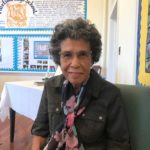
Interviewee: Queen Davis
Interviewee: Emily Fox
Date: October 26, 2017
Accession#: EDLP 007
Length of Recording (min/sec): 48:37
Sound Recording
Summary: Queen Ann Butler Roseborough Davis was born in Ridgeway, South Carolina in 1938. Her father was a sharecropper, and her mother was a homemaker. While in Massachusetts, her father worked for the railroad. When she was eleven, Queen’s family moved back to South Carolina. She attended Johnson C. Smith University to study education and took part in the Civil Rights Movement. She later became a school principal and administrator in Fairfield County.
This oral history interview with Queen Davis on October 26, 2017 includes discussion of growing up in Ridgeway, South Carolina, sharecropping, the first time she experienced racism, her father buying and selling land in Ridgeway, living in the rural and segregated south, dropping out of school, and returning to school with the help of Maude Ross (guidance counselor), integrating Fairfield County schools, race relations during integration and today.
Transcript
Emily Fox: So to start of the recording, I have to say who I am, so, I’m Emily Fox. We are conducting an interview as a part of my class at the University of South Carolina. We’ve got your photo taken, the forms signed, and so, again, we have this all set up for backup, just going through the check list. So, we can go ahead and dive on in. If you could start off by saying your full name and where you were born.
Queen Davis: My name is Queen Ann Bulter Roseborough Davis. I was born in Ridgeway, South Carolina about twenty miles from here.
EF: Ok.
QD: In 1938.
EF: Alright, thank you. And so, before the interview you mentioned going up to Massachusetts. Could you talk a little more about that timeline and growing up, telling me a little bit about that, your family?…
QD: I left Ridgeway when I was eighteen months old. My parents were sharecroppers here, and that was a very difficult life. My daddy was a shrewd person, and he had managed to start saving money without the white man knowing that he had been accumulating not wealth, but a little bit of money. And he was on his way to try and get his own land. And he had an aunt who lived in Springfield, Massachusetts, and the way that blacks moved, migrated, there was that somebody else was already there. And so he took the family up and kind of spirited us away so that the sharecrop owner of the property wouldn’t know he was gone. He kind of, he got us on the train and he got us on the back, you know, he almost had to slip away so that’s what he did to get us to Springfield, Massachusetts. So, I was just a toddler, and we stayed there and he worked on that railroad until I was in the fifth grade. I think I was eleven years old when we returned south. And I went to start to go to school here in Ridgeway. As a matter of fact, the school, the school district, black school district at the time bought the property from my dad to build the school so I had a lot of new experiences. In those early, early years everything was so new. Segregation was new, I didn’t know all that kind of stuff, and I had to learn it all.
EF: So that wasn’t the case in Massachusetts?
QD: Oh, in Massachusetts…racism was very veiled, you know. But my mother was also a wise lady, and she understood that if we were in the drug store, and it took much longer for us to be served an ice cream soda, and there would be magically not any place to sit down by the time we got ours, she understood that, and would let the people know right away that she did not appreciate being discriminated against. So, discrimination took place but it was under the cover, and as a little girl, I didn’t get to the feel, get the brunt of it, until somebody actually blurted something out when I was in the second grade. And I was coming down the street with a little girl, you know how little girls hold hands and skip? And so we were holding hands and skipping all the way home from school. We’d had a good day in school that day. I think we were in second grade. I think that’s what it was. And her mother leaned out the window and yelled, “Don’t you bring that black nigger up here.” That was my first experience. And she and I dropped our hands, both felt the same way, I think, because she just, we just dropped our hands and we never stopped skipping. I skipped all the way home, and I think she skipped, I could see her house. My house was around the corner, and I never stopped skipping, I just skipped all the way home and I never mentioned it until I was old enough to talk about it as an adult, or almost an adult. I didn’t talk about it as a little kid to other kids or anything like that. That’s how, that’s how searing it was to my little psyche…I didn’t realize how much–how to feel about that. I had no–I didn’t know how to, process that, whereas the kids who were living in South Carolina already knew what to do with that, you know, where to put it in their mind. But I didn’t, so that was a, kind of a, a rude awakening for me. To be where I thought that didn’t happen because I didn’t know about anything except what I experienced.
EF: Yeah, I couldn’t even imagine. Especially with you explaining, you know, that your mom was able to help keep…
QD: …Oh she knew. She knew how to, she knew how to keep people off of her. So I knew that much. I knew that there were places that we were not welcome because she made it clear that she understood what they were doing. And she was feisty. And she had…a clean mouth, but it was loud. So, so she told them off. So, I remember that part well, too.
EF: Yeah. That’s great. So thinking–I’m just taking notes thinking of different questions in case I have to deviate away from what’s written. So…
QD: I was in fifth grade. We came here, and we went to school there in Ridgeway until it was time to come here. I went to school here until–I was a student here and then I was a teacher here.
EF: Ok, so did your family then have to move, how far is Ridgeway from here? I’m totally blanking.
QD: About fifteen miles from here.
EF: Ok, so did you all have to move or anything, or you make that commute, or you said your dad owned the land in Ridgeway.
QD: He bought the land, he was able to buy the land that he was trying to buy. He was able to do that. And when we got here he built a house and the house is still there.
EF: Wow that’s amazing. That’s so nice.
QD: Yeah, my son owns it now. So that was the beginning of our being here. We’ve always been there, because I live in Winnsboro now. But I grew up there, finished growing up there.
EF: Great. And so you mentioned a little bit before the recording that, you know, you kind of had to learn a lot moving back to South Carolina. Yeah, do you mind diving into that a little bit?
QD: I did, I did. It was such a shock. And see my mother and father did not sit us down and say, ‘ok, this is how you have to behave now that you’re in the South’. They didn’t do that, a formal orientation was probably what we needed. Because my brother had a very bad experience–it was–we were just fortunate that the man who came down on him was a friendly kind of guy–you know, not all white people were all, you know, hateful…He was not hateful, but he under–he certainly did not want to be–as he felt like, disrespected, as a white man. He needed to get his, you know, you need to kiss his… somehow you need to do it, you need to be sure you do it. And let him know you’re doing it. So, he–my dad–would cut poke wood, and they could pin it up and sell it. So, and he–and this guy was named Mr. Kelly–he was always our buyer. And so when he got, when he had some poke wood all cut because it was time buy something–that was the way we lived.
When we didn’t have money from the farm, there was money from the woods. And so he had some poke wood all cut and he said, “OK, JD,”- my brother’s named JD, he had his driver’s license at–got it when he was thirteen I think then–and he said, “go down to tell Mr. Kelly that we’ve got these many cords of wood. That he can come and pick those up.” And daddy was busy doing something, so JD jumped in the truck and he drove down there and he went to the man’s front door, and knock on his door. And boy, but he said the man let him know that he was angry, he said you got to go around to the back. And he went around to the back. And he was like thirteen. See he knew nothing about how that go, how that went. And he did, he dealt with him he got the message and daddy–he would just show up when it was time to cut the wood–but he came right up behind my brother and took my daddy out into the yard. I don’t know what conspired—transpired–in that conversation, because my daddy never told us, but that was the first time he decided he needed to orient us a little bit. He said, “Ok, now you don’t go to the front door of white people’s homes. You don’t ever do that, you go to the back. No matter what your reason for being there is, you always go to their back doors. Always.” And that’s all he said about that. So they kept it short, they didn’t just wash us down in all the rhetoric they might have given us to let us know we’re now in a segregated South. And all these things are before you, and you’re going to run into places where they say “white only,” and place where they say this–you go to the back or you go upstairs. They didn’t–we had kind of ran into that as we went. You know, and there are kids around us all the time so there was other kids. My auntie, who was almost our age, she kept us well informed. She made sure we didn’t, we didn’t miss a trick if she was around. So that was the way we learned how to live in a segregated South.
But you know, at that tender age it almost an excitement, like an adventure. You know, it was just so different. Not only are we riding in wagons, we never had a wagon ride before until we got here. Now we’re riding in my granddaddy’s two-horse wagon! And that was just fun-fun-fun! But also we have all this stuff about: ‘you need to step off the curb’ and ‘all these places where you can’t go’, ‘how we’re always in the back’. It was just kind of, it was demoralizing in a way, but there was an aura of, ‘wow, this is so different’, for me to take in. And little kids take in things, and we grew up– we didn’t grow up here, so we didn’t already know, so we had to learn. And when we learned, I think we learned it well because we learned it with some understanding of why this is. Because we had come from a place where it wasn’t openly, in a way, a process or practiced. And we also, when we were even there, I remember, when we were in Springfield that this always hit me, and I wondered, ‘why is that true?’ There were–when children would come from the South–you know and people were migrating all the time–there would be a family that came in, a family that came in next door to us. And there were a lot of little kids, and kids my age. A little girl, “Oh boy! We are going to go to school together! Now we’re going to walk to school together, we’re going to-“– these were black kids. “We’re going to walk to school and I got a friend to walk to school with me!”… Oh, no… When they arrived from the South, they were shuttled right away downtown, to the specific school, no matter what–there were no tests given, there was no ‘how do you do’—how—‘why we going to do this’? ‘Are we going to do this for everybody who came from the South’… went to that special school downtown.
EF: Yeah do you know what kind of schooling it was? I guess what made it different than…
QD: It was a… Oh! Because all the black southern kids were there, because they were already too dumb to go, they didn’t know enough according to those persons who were in power to go to school with us. Now, if you came from Italy–I remember Theresa Scattalanni (sp), I’ll never forget when she came in from Italy and I was–she was given to me as her, her language mentor. She wasn’t sent downtown where all the foreign kids were – there was no such place. But she was blonde, and she was white. She, all she had to do was be oriented and she had to figure out how to do things, and there had to be someone there right at the school to help her along. And that’s all it took. Now that could have been done with my little friend. I could have done that for her. I could have oriented her, could have made sure she got caught on to everything. Theresa Scattalinni (sp) didn’t know the language. So tell me know now, why she is brighter and well-enough equipped to jump right in there with me, sit next to me, and catch on to the fourth grade stuff that we’re doing, just because I’m willing to help her…
EF: Yeah. That’s interesting.
QD: Very interesting. I thought that–I always remember that. I said, ‘those kids had to go downtown’. They gave, they gave them the transportation. They gave them the little bus tokens. They went to the bus stop, caught the bus every day and went downtown. I don’t know if she ever–I don’t know when she stopped that process, because my dad purchased his land the next year after that happened, when that happened to her, and we moved South. So I don’t know how long she stayed in that totally segregated school.
EF: Right.
QD: I mean, it was more than segregated, because they were relegated to that place because of where they came from. Not just because–there were a lot of black kids like me–who were from Springfield and started school in Springfield, and went to school with them all the time. But these kids couldn’t do it. I don’t know how long they kept them in those situations, but I think that didn’t help them at all for them to be totally segregated like that because they were all together, because they didn’t, weren’t supposed to know enough to be with us. And that, you know—nobody–that’s discrimination. That’s discrimination, it is. It really is. So I experienced it that way through her I felt, I felt bad about that because I knew it was because of her color so that was even before I came here, I knew that.
EF: Yeah, that’s – just, you know, because in our class we focus mostly on the South, so that’s really interesting that even when you leave the south it’s not necessarily anything better.
QD: Yeah, there was.. It’s just automatically decided that they had to have a special school for these kids.
EF: Yeah. Hm. I’ll just say that’s interesting. Ok, so let’s move a little bit later. You’re back in Ridgeway, and then you’ve come here to go to school.
QD: Right…ninth grade…
EF: Ninth grade, yeah, because this was the high school, correct?
QD: This was the high school.
EF: Right! Could you talk a little bit about your memories and being here in high school?
QD: Ah, it was… One thing, we did learn our history. The kids in ninth grade now aren’t learning it like… we learned the black history. We sang the songs, we learned the poems, we knew all the people who were involved, and all the historic blacks, and all the literary blacks. That was one thing that we had. And we had a–we had–there was a dignity to being here. One, case in point was, when there was graduation, the mothers dressed up. They put on their best hat, their best clothes. Everybody at that graduation was totally dressed up. Not like, not like a wedding, but like a, like we’re all in at a reception you know. They were more than dressed for church. And, and you could hear a pin fall. When the graduates came in, nothing but the music…nothing but the music. Throughout the – it was very ceremonious.
We lived, we understood how to be dignified, how to be dressed up and ready for things, and inspired by what you hear, and proud of what you do, and taught–we were taught to speak. You know we had elocution, we had oratorical contests. Who was going to speak the best, you know, who was going to win the prize? And even today the girl who won–I remember who won the prize when we were in eleventh grade–she still speaks beautifully. These things were taught to us. We were close. We were close–and there were cliques. Oh, there were cliques! Serious cliques. Serious. Especially, Ridgeway versus Winnsboro. You know other Ridgeway kids were all buddies, and the Winnsboro guys especially were all buddies. And they were, it was always a little…tension about who was going to get to date who, you know. Winnsboro guys were going to come to Ridgeway to try to date our girls, you know that kind of thing…. ‘Ah, we aren’t going to have that we aren’t going to have that, no’.
EF: Yeah. So there wasn’t a high school in Ridgeway…everyone…
QD: No, we had to come here. This was the only one. Except for the one—McCrory Liston….There was a high school over there–that school went K-12. But here, this was the only high school. Ridgeway kids left there when we were in ninth grade, when I left, and after, um, after population kind of grew, they started to come up here to the junior high. And then integration came in seventy. So, um, everything changed again…. By that time I was teaching
EF: Yeah. Right, yeah… right I was going to ask next what you did, what was your pathway after graduating?
QD: After graduating from here? Well, I had an interruption. When I was in the eleventh grade, I thought I knew everything already, and you know, and you really–actually, when you think about it, we weren’t given a sense of ‘there’s a future out there for you that involves your needing more education than you’re getting right now’. That was not…discussed in the home. You know, my dad was proud of all the–I made straight A’s. I mean, that was just, I think it was in the blood–something in the genes…my brother didn’t, but he had the genes, too, so it was all, there was also something in me I always wanted to be a teacher, even though I didn’t think that was, there was any way that was even possible, but I would just teach everybody when I was little. I’d teach all the dolls when there was no people around. So, I–that was kind of in me, but that didn’t come about. I threw that out of my mind and didn’t think about it and got married. To do that, during those years wasn’t unusual at all.
So I did that, left school for two years. Then my husband was killed a car accident, and by that time I had a little boy, and I came back. Maude Ross, who is one of the persons y’all–I think somebody might be going to interview? Because she was my mentor. She just sent me a note, and it said–by one of the little girls that lived in the community where I was – and the note said, all it said was, ‘Come to school tomorrow, Maude Ross.’ That was all it said, nothing else–it didn’t say, ‘I’d like to talk to you, maybe you want to think about this, I have an idea that maybe you might want to consider, talk it over with your mother and dad’, and so on. None of that, none of that. She just said, ‘Come to school tomorrow.’ I think that’s important. I put roller skates on–I was moving out of there so quickly. I was still living in the house where I had been married. I got out, I had to get out of there right then and there and go home to my mom and dad. My mother was thrilled to have the little grandboy to bring up, she thoroughly enjoyed it. And so what I did, I didn’t ask anybody, I didn’t call anybody, we didn’t have that much of a phone system at that time. I didn’t discuss it with anybody, except them, said I’m going to go to school. I’m going back to school.
And the next morning, I walked down to the bus stop just like I had been doing it all year, this was like October. And the bus driver, who was a preacher, he might–he ought to be one of these persons interviewed–he was the bus driver: James Addison. I stood there where I knew the bus would stop, if I were–when I used to go to school–and he just stopped for me like he knew he was, that was what I was supposed to do. When I got on nobody was surprised, “Hey, how ya all.” See right, and I sat right down, and the little girl who was two years younger than me because I had dropped out of school, she was in the senior class and she was in, taking, she said, “You taking shorthand and type?” And I said, “I’ll be taking short hand and type.” She said, “Oh, well this is what our shorthand lesson is today.” Oh, it was such a blessing because when I arrived at school, I went to Maude Ross’s office; she was the guidance counselor at that time. I think she might have still been teaching some classes, too. After I went through that and the principal and his wife–his wife Mrs. Charlton–greeted me and all, she sent me to class, they sent me to class. And I was taking shorthand. And the teacher in that class just opened up the class and said, “Oh and good morning to–we have a new student. We have a student who has come back today. And her name is Queen Roseborough. She used to be Queen Butler. She’s coming back today and she’s going to be a member of our class.” And then she said, ‘Ok, you know what your assignment was for today, to read today, so please open your books to such and such place, and I’m going to call on somebody to read’. And so she gave us some–she gave me a book, “Here’s your book; this is your book.” And when–and she said, “Ok, Queen Roseborough?” The little girl on the bus had shared the book with me, so I had read it. I was flat-out ready. I was so ready, I was so ready! That was a shining moment for me. Nobody else knew how much that meant to me, that I had been, had had an opportunity, because I had been two years rusty. When I read it, on the bus I picked it up right away, and I was ready. No glitch, not one. I don’t know how she felt about that, but I felt good. I felt good about it. I actually graduated valedictorian of the class, and there was some controversy about it. But I didn’t know it. Again, I’m a kid again, right? I really went back to being a kid again, I did… Until I got married again I was still a kid, because my mom just became my son’s mother. He called me ‘Mama T.’, and called her ‘Mama’. So the two of us were with him together, but she was really his mom. And I was glad to give her those years with him because she died when–in 1987–by that time he was a big boy, grown up. But I think that was a good thing for him to have that kind of life with them because I was away for four years at college.
So, I fit back in to schoolwork and all that because kids are friendly, kids are friendly. And they were glad to have me around, you know. It was alright with them. And I got a scholarship. But that was because I took a test, not because the school granted me a scholarship, because I was val[edictorian]. I took a test and got a scholarship, and went to Johnson C. Smith University, and graduated and became a teacher. Married again, and started my own family. Taught here until–well, I taught at Winnsboro High, taught in junior high, when we put in a junior high, and we moved to that grade, because I was teaching ninth grade. And then I left and went to Germany for two years–my husband was overseas–and had a wonderful time over there teaching and traveling and all, and came back here and started at Winnsboro High all the time and taught seniors primarily, and was senior sponsor for a lot of years there–enjoyed it… and then went to District Office. Became an administrator, went back to Fairfield Central as principal for three years, my last three years. That’s what I did. So, that’s how that went. And, as far as, you know–I did not feel any discomfort, and I don’t know if it was because I had that early background of mixing and mingling with white kids, and having white friends, and all that. Because that lady that yelled out at me was the only one who did something like that.
So I had white friends, I had a little white girlfriend who my mother could not stand because she was so bad–not because she was white–she was so bad! She just mess up everything. And when she–we would hide her under the bed because my mom didn’t want her in the house. So that’s how close we were to the little white kids that lived around us. We were the only blacks in right in that corner for a while, but after a while we moved to an area where there were a lot more. But, kids…we make it happen. You know, so as a teacher, I didn’t feel any discomfort because of my race. …Now, there may be others who had racist situations develop, but I didn’t have any. I remember one time we’d sent home an assignment when I was teaching at–and we did what we called ‘team teaching’–and I was teaching at the junior high, and I don’t remember what the assignment was but it had to do with discussing the differences in some kind of racial thing. It wasn’t an open discussion on racists or anything like that but, whatever the assignment was it involved a black and white situation. And they were like in ninth grade at the time that you would be reading things like that might have that happening. Some of Huckleberry Finn things, you know all that. I don’t remember what we were reading, a novel, and that was what we were doing and, oh! we got some nasty letters from parents: ‘I don’t want my child learning any of this’,’ my child is not coming to school to learn anything about what happened with the black kids, the black race’…’That is not supposed to be a part of my child’s life’, and that kind of stuff. So, that was the worst–I guess a comeuppance–we got by integration, because we didn’t have to put up with that when they were all black, you know. And they didn’t, the parents didn’t have to put up with, they didn’t hear anything. And that’s why they know nothing. They knew nothing, they know nothing because parents didn’t teach them anything at home. And they–the teachers–not dare teach them anything at school, so they know nothing. The white race knows nothing! You don’t know anything. Now, we were taught–like I said–we were taught. We learned it all. Right here. We learned it all. They didn’t hold back and say, ‘well, you know these white people really like you’, now they didn’t say that they hated us, but they say, ‘oh this is what’s happening and this is why’. Your books – this old, got somebody’s name in it from six years ago and that’s why. Because, this is a segregated situation. All our furniture came from the stuff they threw out. I mean they didn’t hold, they let us know that why your desk is already torn up when it gets in here, you sit down and you say “well I thought I was getting a new desk.” ‘Yeah, it’s new…It’s new’.
EF: New to you.
QD: Yeah, ‘new to you’! But it’s not a new desk, and that’s–you know, and they didn’t inflame us and try to make us get in the streets and march or anything…. They didn’t do that. That happened later in our lives, when the Civil Rights movement began, and it–when it hit, when the five boys sat down at Greensboro, I was at Johnson C. Smith University. So I was in the middle of that. That next morning, Charlotte streets were full. We filled the streets! Johnson C. Smith shut down. I mean, there were, there weren’t [sic] any class. We did not go to anybody’s class that next day. We went downtown, to the courts. Oh, it was amazing, it was thrilling, but it–and it we had debates with Queen College, we had debates with the white kids. So, kids are still kids, we–they were willing to meet with us and talk it out, you know. And all the stuff that they were ignorant about, we tried our best to help them learn. So we believed that was the beginning of those who finally understood how all this has come about because of where I am, since the way our ancestors were treated, and we’re treated, and did some treating.
Then, I think that was the beginning; when those people invited us to their school to talk it out, and we didn’t hold back. Nor did they, they didn’t hold back either. They said, they actually came right out with it. We don’t believe you all are equal to us, and that kind of stuff. They actually, we actually had those intellectual context with them which I know had to make a difference to some of them. And that’s why the Civil Rights Movement was able to–because by itself, with just black people alone, it was going to be tough going. But there were an awful lot of white people who came aboard who understood either because they learned it at home or they learned it straight from us. Those college kids were ready to learn. And they could learn. If you’re in college, you want to learn. That’s why you’re there. And that’s why they’re always the ones who make, who get the morals and get the values actually out there. We going to fight, or, and we’re going to win, and because it’s right. They have a righteousness that’s all in their head it’s like “Oh, my head is buzzing I feel like this is so right.” That’s the way we were. We were just like, high on it. It was an amazing time. Yeah, but when I got back here, all of that had died down pretty much and we still had to fight out, fight it out here locally because the doctor’s offices were still segregated. Even when my little girl was born, it was still that way. But you still kind of have a feeling of home, and I went the home route with her birth. And I had my own doctor and he, you know, he still had the segregated rooms. But the thing that woke me up from that was, she had a fever. And, she had an ear infection. She had–I could tell that something was wrong with her ears so I took her to the doctor, that same doctor. And he looked at her ears with a flashlight, and I said–he gave her some of that red medicine–I said, ‘I’m out of here, I’m gone’. I went to Fort Jackson and never looked back, and I said, ‘you know, you don’t have to, you don’t even have to consider that kind of stuff, and it’s wrong anyway. But, there’s excellent doctors here at Fort Jackson so from that point on, I didn’t have anything but, but even up until that time she was born in sixty-four, there was still lots and lots of stuff going on.
EF: Yeah, it’s not an overnight thing by any means. I mean, look outside today. Just looking through the questions, you’ve touched on a lot of them. So, I appreciate that makes our list of twenty not seem so bad.
QD: I talk a lot.
EF: No, I love it, it’s so good. So one of the other questions we have on here, we talked about the Civil Rights, but then thinking back to, I guess, with the Brown decision. Thinking back to that, what did you feel about that process?
QD: See, that happened back in the fifties and we were small children at that time. And so, that was happening among the adults. Are we done? Is it time?
EF: Oh no we’re getting a picture.
QD: I was thinking I know she’s short on time.
Oh no, we’re good, we’ve got probably another ten minutes or so.
QD: So that was happening and I wasn’t–that was happening when I was still, and I moved here. I was like in upper elementary, junior high. Fifty-four, gosh I was here. I was in ninth grade the year I came here. So we didn’t talk about that a lot. I think the adults talked about that a whole lot more about that.
EF: Do you remember –
QD: So no I don’t remember. I do remember this. There was a lawyer who lived in Irmo who was a part of that movement I might say–early on movement. And it was during the time when, when if you did, if you came out for that kind of thing, you would be threatened, be at a risk and I remember him being at risk and having to ride somewhere in the trunk of a car because they were looking for him because he was a lawyer who was trying to bring suit, for some of the people in Columbia. So, there were people here who were–because the adults would be at risk of jobs and their livelihood–so, that may be why we weren’t pushed to be vocal, you know, about it. And the parents, ‘shhh shhh shh’. They talk about it behind–you know whispered a lot about it. But, it mostly happened in the courts. We didn’t come out as young people until the Civil Rights Movement began.
EF: Right. Ok.
QD: And that just opened it up.
EF: Yeah. I have a couple more question. I’m curious, I don’t, now did your parents talk to you at all about what their education was like and their experiences?
QD: No, my dad did. My dad was very shrewd and he was very smart. He’d point out all the schools he went to. They were all there in Ridgeway and I used to know where all of them were. And he was one of the smartest kids in the class and all that. But he didn’t, those schools were just schools that kids could go to when they weren’t picking cotton or working in the fields they could go there and learn something. The– I don’t even know if they called them grades, you know, but they just kept going and older, you’re older, you got to go to I think they moved up. And when we first came here, oh I thought, again, I thought it was so interesting because I came from Massachusetts, Massachusetts now, they had one of the best school systems in the world already, and I came from that. They were top notch, top notch school system actually. And the school buildings were top notch, as well. I came here and we had to walk a long, long, long, long way to go to a one room school with one pot belly stove in it. And I could not believe it. I said, “Why we got to be in here together…” Everybody, the whole school, was in one room. And we split up somehow, because we had a teacher who taught the older kids and there was a teacher who taught the younger kids but we were in the same room. They had us over here and she had them over there. I thought that this is interesting. But I kind of felt like – it was hard for me to—because I was so young, I didn’t know how to, how to challenge–but I felt like I wasn’t getting as much maybe as I should. I was too young to actually make that assessment, I just kind of, you just kind of get into the flow of things and enjoy where you are. You know the answers to everything so just answer. You just answer! Some of that was because that genetically we were bright, bright folk but part of that was because of the background, the educational background that I had is with me, and it was excellent. It really was, it was excellent.
EF: A solid foundation
QD: I had all the advantages of Massachusetts and it still has an excellent school system. So, and I brought all of that with me and would share, hopefully share it when I was teaching. I think some of that came out. All of the stuff that I had, kind of, gathered up in my own mind.
EF: Yeah, wonderful.
QD: But I wanted to say this about after we integrated. How–was there any–there was some awkwardness, like in the lounge, maybe, you get in the lounge and you want to be open. You know how you be in the lounge, you want to rest, be restful and talk about your day and all that. And not, and not gossip about the kids, but they do anyway. Sometimes there’d be a little awkwardness there when certain teachers would come in, because you felt like that teacher was prejudiced, or if the students had said something about that teacher putting them at the back, or calling them last, or doing things that–the little, subtle things that teachers could do–and they did. They did that to our kids…Especially the ones who came over here for freedom of choice–you read about that? The freedom of choice time? Those were the ones…I don’t know that any of those people in this (unintelligible 38:40) or in this group, because I know a lot of them from the church I used to go to. Those were the kids who had some real experiences because they weren’t welcomed here. They came because the law said–they were trying to avoid total integration and said, ‘well, let’s do this, let’s do this little thing’. And that was one of the things they did. And they didn’t think the kids would take it up, but the kids took them up on it. And there were several that went to Winnsboro High before we integrated. And those kids caught it. Yeah, they caught it, they caught it. They really did. And we were safe and secure, still here. Right in this building, and they were over there. They did catch it… I said–because I think I said we all–we kind of didn’t feel…maligned or all that–that we might have felt, because we were black–but those kids’ parents understood how important it was to integrate. They understood that their kids could get a better education if they went there, where the books were new and–they actually had chemistry equipment and all that.
And they went… When we arrived into the integrated situation, it was less–abrasive I think, for the black kids because, because they got us, you know. And, they used us, too. They let us know if anything was going wrong. We had Maude Ross who was our guidance counselor, and Mr. McLennon was the principal and he was a hard-nosed guy…hard-nosed football, coach-type, you know?… So he was hard on everybody, he didn’t care what color you were. He was hard on everybody! (laughter) He used to have everybody crying. If he could, he could get you shedding some tears about how brusque he is, he would do it. But I don’t think he was a racist. I don’t think he treated the white better than the blacks none. Could be–you never know what’s going on behind your back–but he wasn’t, no one was, he wasn’t especially blatant about it, but we still had to run into that and we still do. We still do…And it’s sad that it seems to be going back in that direction instead of going forward.
EF: Yeah, that was. That was going to be my next questions. So just, how things are today.
QD: We’re going back, we’re going back. We almost yearn for the days when we could be comfortable. You know, because they’re taking us back. We thought we were coming out of the total discomfort of being segregated, into less uncomfortable, integrated situation where at least we got all of the advantages. We’re supposed to get all the advantages, because we kept seeing that–that wasn’t ever happening, wasn’t ever going to happen…And now, we’re able to be told to our face that it’s all because we still believe that you are inferior to us. And that’s why all this is going on now, is going on. Because we believe you’re inferior, you should, you should have never been allowed to vote. We’re going to try to stop you from voting if we can. That’s the way things are now. We feel like it’s back in our face like it was when it was totally segregated; when my dad said, ‘you can’t go to their front door. You’ve got to go to the back’. And they would like to get it to some kind of situation where it’s clear that we are superior, you are inferior. And I cannot stand that because if you look around you, my God, we’re all the same! If you just look around you–how many times do you see anybody out there–I mean everybody you look at– they’re all the same! They’re all–we’re all the same. We’re all together, we’re all one. Now y’all ought to just give it up! Just give it up!…Some of us have light skin and blonde hair– and some of us, you know–and we were, now, we were segregated against because of light skin, too. We had that going on. And see that, that’s all we got to have going on now. That’ll probably happen for a while…Now that, that’ll get, get better. We ought to just leave it alone and stop with this mess. Just stop the mess, stop the whole mess of worrying about who’s who, and what color they are. Stop that…Now we have the immigrants coming, and they’re creating another level of a problem…The white man has got, he’s got–he’s mad, and I understand. He’s mad, he say, ‘great day!… I can’t stay on top for trying’. So and we understand that kind of frustration, but we can’t become the brunt of it. Can’t become the brunt of it….And we have our kids. Our kids have got to have it better.
EF: What do you think are some things that would help with that change?
QD: I don’t know, I don’t know, I’m so sick of politics. I could just – if I could just throw it all out the window and we could do it another way but – we have to keep talking. Just like I said when, when integration came, hitting us in the face when we were in college, we talked. We talked. We went to them and talked. And we told them the truth and they told us the truth. I think that’s what helped the Civil Rights Movement to be as strong as it was. And not everybody in that room bought it, but they asked us to come over there and talk and we did. And I think, once we did, they were open. They had to be open. And I know that’s like a cliché: that ‘we need to talk to each other’, but it is true that we need to talk to each other. And I don’t know how to get to the ones who actually hate…How do we get them, how do we get them to tell us what it is they hate about us? What do you hate about people, these people? Why do you hate those people? Why?…I can’t understand that. They bring as much to the table as anyone else, probably more, depends on what it is. My God, when you go see a basketball game you don’t see nobody out there but them. That’s all– but you not going to pay money to go see somebody else that can’t play basketball. You’re not. You’re just not going to pay money for it. You might say, “Yeah, I’m so glad you’re my son,” but you’re not going to pay any money unless he’s getting ready to tear that basketball court up…So let’s go ahead and say there’s some things that we all bring to the table. Not all that–not all mental. Some of it’s mental prowess–some sharp people—and can out-think anybody white… So I don’t know…What is it you hate?…What?…What do you hate? Seems to be a sexual thing. Don’t want you mixing, don’t want to mix. But we did! (laughter)
…When I was a principal?…When I was a principal, we had a mother came over and she said she did not want –no, no, no it must not have been that lady. It must have been earlier on… This happened during the time that I was–must have been that person–because I was the one she was telling about that she did not want her daughter to go – The seniors would have a time of the year when they were free—‘senior freedom’–and they could leave the campus to go to lunch, which was big freedom for them. And we had it very regimented, you had to sign this, and all that so there was lots of stuff we had went through because this is dangerous, we think. These kids are out in the street. But her mother, this mother came and said, “I do not want my daughter to go to lunch.” She–this little black boy was liking her daughter. And she wanted us to declare that her daughter would never do this. Well, I’ll tell you all we could declare is that she won’t, we won’t take her, you know, we won’t take her. Will she, now, if she does anything that you think is wrong, or somebody reports her for doing something she think, then we take her privileges, that’s all we can do. We can’t stop her from eating, and she went to eat with that boy every day. Every day. And do you know, some years later, when I was in a grocery store–in a department store, she was one of the packers. And, she was bragging about her grand baby…That boy married that girl. Married her! So you know, you know she was so set on hating him, and she was so happy with that grand baby. I said, what irony. How ironic that, if I had spent some time, sent somebody to yank that boy out of there…
EF: Yeah, it’d be a different story.
QD: It’s something. I said you know, life is something.
EF: Yeah, my goodness. Well, I want to say thank you –
QD: You’re welcome
EF: -so much. I’ve just personally enjoyed hearing the stories you’ve had to share and I know that other people will to. Um, so thanks for letting us record this and come in this morning.
QD: Ah, let me think back to what I said, I hope I didn’t say anything I think –
EF: No, it’s all good.
QD: That’s what happened, that’s the way it was.
End of Interview