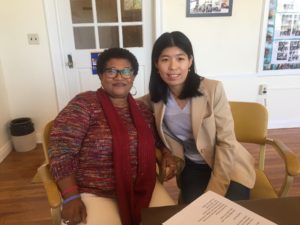
Interviewee: Ruth Chavis
Interviewee: Jingtong Dou
Date: October 26, 2017
Accession# EDLP 005
Length of Recording (min/sec): 42:07
Sound Recording
Summary: Ruth Chavis was born in Ridgeway, South Carolina, one of eight children. After her mother’s death during childbirth, she and her siblings were raised by their grandmother. She attended Fairfield High School, and college for administrative secretarial science. She worked for the V.A. hospital in Columbia, South Carolina, and later in the district office of the Fairfield County School system.
This oral history interview with Ruth Chavis on October 26, 2017 includes discussion of growing up in Ridgeway, South Carolina, being raised by her grandmother, who also put her through college, Fairfield High School, integration, the Civil Rights Movement, voting rights, race relations in Fairfield County past and present, instances of prejudice, involvement with the alumni association of Fairfield High School, Richard Winn Academy in Winnsboro, and the quality of teachers and teaching today.
Transcript
Jingtong Dou: Hello, my name is Jingtong. We are conducting this interview for a class project at the University of South Carolina.
Ms. Gore: You want to . . . we need to have that photo. We’re going to have a photo along with the interview if you don’t mind. So I will . . . go ahead, we’re recording anyway, that’s a good thing I checked. Alright, so . . . my kids are so much better at this than . . . okay, you ready? That’s beautiful. And we’ll get some of us together afterwards. Did you want one with your camera as well, or I can send it to you?
JD: Oh, you can send it to me, that’s fine, yeah, we’ll get it later. Okay, so could you tell us a little bit about yourself? What’s your name, your background and where were you born?
Ruth Chavis: Okay. My name is Ruth B. Chavis. I was born in Fairfield County in a city called Ridgeway, that’s about maybe ten miles away from here. And I went to, started school, elementary school at Geiger Elementary. That school still is up and running, that’s in Ridgeway. And I think we–at Geiger we went from first through, I believe, seventh grade. During that time at Geiger I had to walk to school, we didn’t have bus, we’d walk…cold. Some mornings I got to school, my hands were frozen. And we were a very poor family. My mother died when I was about in the third grade. I had about three siblings under me and she died having one so it was about four siblings underneath. And I had three older than me. And when she died my grandmother took us in, and we lived right there in Ridgeway in a small house. We did not have running water nor toiletry. So we used an outside toilet. And we bathed, like in foot tubs or– some people call them foot tubs–big tubs, and we’d heat it with wood. We used wood stoves…
JD: Stoves, I know the heating. The heat.
RC: Um-hum, um-hum.
JD: So where did you go to school?
RC: I went to school–I attended at Geiger Elementary–I believe at Geiger we went to the seventh grade. Once we left seventh grade we came to this school, which was Fairfield. And I think here we started here I believe it was the eighth grade if I’m not mistaken. And that’s when I started high school.
MG: So eighth grade was the beginning of high school or…?
RC: Um-hum.
JD: So could you tell more about your memories of that school? Was there facilities? Was the teacher . . .
RC: The facilities were good, the students was good. At that time they had integrated. I think, what year did we integrate?
MG: 1970? Was it ’70?
RC: Because I graduated in ’72, and I think they said, I remember when we integrated we did not . . . I always wanted to go to the prom, never went to high school prom, never went to the prom in my life. I remember getting my sisters ready for the prom. Looking forward to my day. The schools integrated; we did not have a prom. The white folks had their prom; we didn’t have a prom. I guess, you know, we were poor too so we couldn’t afford to get together and we didn’t get together and have a prom. So they had their own prom and, you know, of course we couldn’t attend their prom, ‘cause we’d just integrated. And back then people were coming to integrated schools with whites, a lot of them was leery about you; like they was scared of you. Thought you was gonna–if you touch them, it’s going to change their color or whatever. And then some of them were friendly. But it was different, quite different.
MG: How many whites were still in the school when you integrated the high school, do you remember, was it . . .
RC: We came to, okay that’s, when we got integrated that was not at this school, it was at Winnsboro High, which is down the road. And I don’t know how many children were at Winnsboro High, it was a good bit of us. I’m thinking, I don’t know–our high school…this is my class–I don’t know whether I have a high school book in here or not. I see a book over there, but I done forgot how many of us was in the class.
MG: But it was predominately white still.
RC: Predominant white. You know, was some black, you know, when we got there it was white, you know, after we integrated it was mixture of black and white.
MG: Was this school still in operation? Was this . . .
RC: No, this school was not in operation.
MG: So they closed the black school and you . . .
RC: Integrated.
MG: . . . the blacks had to all go to one.
RC: From Winnsboro High.
JD: So what were your ambitions while you’re going through school?
RC: Well, you know, you always wonder whether you’re gonna do good or not, and how they’re gonna accept you. Some teachers–teachers was prejudiced then–they were prejudiced toward us, but we made it.
MG: Yes, you did.
JD: Were you hoping to stay in Fairfield County or somewhere else?
RC: Well, when I graduated out of high school–I graduated in ’72–I still stayed home with my grandmother. And then, I think I stayed home about a year, and then I went to Columbia College. And I was there about two years.
JD: So what’s the overview of your life after you left the school?
RC: I’ve had a, I can say, a pretty good life. I was–my grandmother raised us, she worked in white folks’ houses in Ridgeway all of her life. That’s how she put us through school. She put us–it was eight of us–and I think five or six–six of us–she put through college; cleaning up in white folks’ houses in Fairfield County, in Ridgeway. And we had–predominately she worked for good, well-to-do people, rich people I would say, who would help us buy clothes and stuff for us. And during that time we were very poor, we wore a lot of hand-me-downs–well I ain’t gone say a lot–that’s all we wore. …Somebody else’ clothes ‘cause we couldn’t afford to buy any.
But she worked for good people who took care of us, and were good to her and good to us. And she learned us how to [sic]–the girls–how to go and clean up white folks’ houses. You know. I used to babysit and keep–I used to clean up the house, iron for them. She raised us how to work, and work hard. But she didn’t raise us to have hatred in our heart for white folks. I tell people I’m not prejudiced today, you know. I treat them just like a black American.
JD: So what did your family teach you about race relations while you were growing up, about race relations?
MG: What was going on, the race relations, how, with all the . . .
RC: She would tell me, you know, always tell us it was things that we couldn’t do, and places we couldn’t go, the white children was able to go. And she would always tell us things that we couldn’t afford, which we knew. Because–but she would always make us feel good and make us respect our self and let us know that we were just good as anybody else. Whether we were poor, whether we were middle class, rich or whatever–we was just good as anyone else.
MG: How did she feel about–did she express how she felt about the issues, you know, I know you didn’t–you knew it wasn’t right, but did she talk about, you know . . .
RC: She talked about her hard times, how she—‘cause she was raised up poor. She had to pick cotton which, I never picked cotton, during the time I was living in Ridgeway cotton was being raised, but she wouldn’t let us go pick. And she said that she didn’t want us to do that. But she told us the hard times, how she had to pick cotton and how much she picked and, you know, just got a little bit of money, but it kept her. But it was hard times for her.
JD: Did she–?
RC: She didn’t never go to college. But she did finish, you know, school, and she put her–she had–one of my aunts went to nursing school, and then one was a dental assistant, she put them, you know. And then when my mother, like I said, when my mother passed, she sent about five or six of us to college. And that was just working in houses, housekeeping.
MG: What did you do after college?
RC: After college I got a job at the, in Columbia at the VA. I went to school administrative secretary science. And then after I got a job in Columbia, matter of fact, came back and got a job here in Fairfield County working in the school district. The guy that I was sitting beside he was one of my teachers, and I end up being his secretary, too.
MG: …How about that!…
RC: Worked with him for about…I worked for Mr. Manning about five years, but worked at the district office right here in Winnsboro. Stayed up here for about twelve years, working in the school system.
MG: Okay. Are you back in Ridgeway now or . . .
RC: I live in Columbia now. Richland County.
MG: Mr. Manning’s name came up on some of my interviews. Yeah, I haven’t done all my interviews, that’s why I’m here today to try to meet some of the others…Okay.
JD: So I’m curious, during that time–besides the white school–where were some places that were blocked off for you?
RC: (pause)…I just can’t think right now, but it was . . .
MG: Yeah, well, and also, I know–so you’re younger than . . . but I know the federal government didn’t allow the signs anymore. Were there places that blacks just didn’t go, because you knew you weren’t welcome? What kind of places were those?
RC: I’m just trying to think…I was hoping my girlfriend–kinda more up on stuff than me, would be, or somebody else would be here to help me out. ‘Cause I was hesitant about coming, ‘cause I asked Betty, I said, “Betty, will I be able to?” She say, “Yeah, I’m sure it’s questions…”
MG: Whatever you can’t answer, we’ll figure it out.
RC: I’m just trying to think of places that we wasn’t allowed to go.
JD: …Or there’s no places that allowed?
MG: It wasn’t legal, but there . . . the community still might’ve had some places that, you know, you just weren’t welcome.
RC: Yeah.
MG: Because she was, you know, younger than 1965, technically that’s when it wasn’t allowed anymore. But communities didn’t all change right away.
JD: (unintelligible 13:12)
RC: If I think of it I’ll let you know.
MG: We’ll come back to that one.
JD: Right. What do you remember about the Civil Rights movement?
RC: I remember, you know, when they gave us the right to vote, that was one of my main things. I wanted to live to vote.
JD: Before that?
MG: And you remember that–that was an exciting time.
RC: That was an exciting time.
MG: Were you old enough to vote at that time?
RC: I don’t remember, but I know my grandmother always stressed to us to vote. She said people think it’s not helping but it does help. She always stressed to us to register to vote.
MG: I was going to ask one: Tell me about the white and black relations in the community. More than just your home, just the people you were around and the churches and the community.
RC: Back then people was kind of–even though in the school, they act like you was gon’ hurt–you know, they was skeptical of you…
MG: …skeptical of you…
RC: A lot of them didn’t want you beside them, near them, you know?… And prejudice back then, it’s just like it’s today, it’s visible today. You wouldn’t think it is but it’s–it isn’t, but it is. We have prejudice right today.
MG: So would you say it has changed much?
RC: I think it has changed some.
MG: Is it more of an acceptance, you think, that this is not going to go away but . . .
RC: I don’t think it’s gonna ever go away. Do you?
MG: No… I don’t know.
RC: I don’t know. I wish it would. But I don’t–I think it’s gonna always be here. To certain people. You know, ‘cause you look at it–my daughter even told me this week, we were in the grocery store, and there was just a little baby–a little toddler–and her mother was telling her to say ‘hi’, and she act like she was scared to death. She said, “Momma, that baby act like she never seen black people before.” I said, “Well you know, believe it or not Keisha, some people teach their children not to be friendly to black folks.” We have to face it, you know. Yes, some people teach their children. And I have a girlfriend who—sister–who take care of foster children and she was saying to me, she gon’ put her sister’s child on the bus in the morning, and she said she said something to her–don’t fly or something–and she said, “Whatchu talking about?” And she said, “Ruthie, she was calling me, ‘don’t eat that banana now’.” She was telling her that she was a monkey! And this a retarded child! So she was telling her she was a monkey. Don’t you think she got it from somebody? Somebody taught her that…
MG: Yeah, okay that’s a very derogatory way of speaking of an African American.
RC: Yeah. African Americans.
MG: When they call them a monkey–the animal–like a monkey.
JD: So it’s still invisible but it still exists, right?
RC: Yeah. It exists.
MG: It still exists, yeah.
RC: It still exists. And I–when Maryann told me I said, she say, “You don’t know what she was telling me.” I said, “No.” She said, “She was telling me I was a monkey.” I said, “Well Maryann, where did she get that?” She said, “Whoever her parents were, or whoever home she been in they taught her that.” Had to teach that.
MG: Um-hum, that was taught.
JD: So what did the Civil Rights–the Civil Rights struggles like in the Fairfield County at the time?
RC: Well, one thing about Fairfield County–even though I went to school here, raised here–but I moved out of Fairfield County to Richland County.
JD: In Columbia.
RC: Yeah. I still attend church in Fairfield County, in Ridgeway.
MG: Did you see–during like the ‘70s, when the schools were integrated, during that time–you kind of touched on it some already, but: how did the community–maybe in your church–what was the talk, what was the conversation during that time?
RC: You heard a lot of people talking about how– (cell phone interruption 18:08) You had a lot of people, you know, would always say how the, you know, the children in the class or school treated them, you know.
MG: And they . . . not positive.
RC: And they’d pick on them and, you know, smart remarks and say stuff, but our parents taught us not to bother them, you know, just turn, walk away.
MG: So is that pretty much, was that pretty much the . . . were there many fights between black and white?
RC: I don’t, I didn’t see, I don’t think it was a whole lot of fights.
MG: Okay. But you knew, but just tension.
RC: It was the tension.
JD: Just the tension.
RC: It was a lot of tension.
MG: Yeah, not verbal.
JD: So you can’t view that, but it’s invisible?
RC: Um-hum.
MG: Um-hum, yeah–not hitting-fighting, but just, you know…
RC: And you seen [sic] a lot of shoving and, you know…knocking shoulders and stuff like that.
JD: I know, like they treat the foreigners sometimes. Very conservative people.
RC: Um-hum, yes.
JD: Can I ask about the Brown decision?
MG: The Brown v. Board of Education. Do you remember that? That was 1954, so…
RC: No, that was the year I was born.
MG: Yeah, I was going to say, she’s closer to my age. (laughter) I don’t remember it either. Did you hear your grandmother talk about it though? Do you remember that, did she say anything about?
JD: While you were in school, the teachers–the history teachers?
MG: The history, did they speak about that? Especially in the black school, as turning point of any–in any way?
RC: Look like I remember some of my teachers speaking of it. They would always talk about it.
JD: How did they feel about that? What did they expectation or…?
MG: Do they think it made an impact at all?
RC: Some of them thought it did. That it was a little turning point there once it came about.
JD: So could you tell us your memory about the integration process?
MG: The year that they actually made the change, the year . . . because you said you were eighth grade–were you the first class to come to Winnsboro? Or no, you did . . .
RC: I think our class was the last class to leave this school. Yeah.
MG: So you were younger when it actually started.
RC: …When it actually started.
MG: But you were the last class here before they closed this school.
RC: I remember, it was blacks at that time, too, you could decide what school you wanted to go to, and a lot of blacks decided to go to school with the white folks. So. But I didn’t like it when they integrated. Yeah.
JD: They didn’t like it?
RC: I didn’t.
MG: She didn’t like it.
RC: I didn’t like it.
MG: Because of the tension that they felt.
RC: Yeah. And then I think about the things that we couldn’t have–like the prom, we didn’t have a prom.
MG: Oh, yeah…
JD: Okay, so looking back about . . .
RC: They had their own proms…
MG: So they still segregated it.
RC: Uh-huh.
MG: It was just you were in school together but they had . . .
RC: They had their prom.
MG: . . . the whites had a prom and the blacks didn’t get to have a prom.
JD: Did you separate in the classroom; like we did in China…?
MG: Were they separated in the classroom? No.
RC: No, we wasn’t. Excuse me, we wasn’t separated in the classroom.
(unintelligible 22:01)
JD: You were in the same classroom, but the white students, they had their prom. The African American kids, they didn’t have their prom.
MG: Um-hum, they weren’t allowed to have a prom.
RC: Because we didn’t get it together.
JD: Even though in the integration process.
RC: Even though they had their prom we wasn’t allowed to their prom. We couldn’t attend their prom. And we never did get together to have a prom.
MG: Was that only one class or was that several years?
RC: Now my sister who was two years older than me, she went to the prom. Um-hum, but I know our class, we did not have, class of ’72.
MG: So you had to raise your own money.
RC: Yeah, you had to get it together. We didn’t have a prom. Yeah.
JD: So where did you go after finishing the high school?
RC: I went to, I worked in a factory in Ridgeway for about a year, Charm Factory who made lingerie housecoats and stuff. I did that for about a year, and then I went off to college. Yeah.
MG: And you said it was an administrative secretary type of . . .
RC: Uh-huh, secretarial science, secretary. Then when I graduated I came, got a job here in the school system.
MG: Um-hum, are you still there or are you retired?
RC: No, I’m retired. I did about twelve years in education, worked in this district office, and worked with adult education, too. At night, two nights a week.
MG: Nice. Yeah, I visited Mr. Seibels over there, Moses Seibels?
RC: Moses Seibels?
MG: Yeah, I was able to interview him.
RC: Oh, okay.
MG: At the district office one day. It was a few months back.
JD: I’m curious about your decision making for choosing the school that you will go to college. So what was your decision making?
RC: Well, when I first graduated I said I was gonna go to school to do fashion merchandising cause I love to sew. But realized it was gonna be a little bit more money than we could afford, so I got, went for secretary.
MG: Columbia College was all women, it still is.
RC: It was Columbia Commercial. It was a business school. Uh-huh.
MG: Oh, okay. Is that in Columbia?
RC: It was in Columbia. But they closed it down and then they changed the name of it and all. Was a business school.
JD: So do you stay involved with the school system?
RC: Yes. I . . .
JD: How do you stay involved with the school system after graduation?
RC: Okay, with this school system we have an alumni and our class always helps support it, the alumni parades and we put on, like fundraisings outside, cookouts and we attend.
MG: The alumni association is, it’s expansive, that’s this whole group that we were able to get these interviews like this.
RC: They did the school over. And I have a girlfriend who works very hard in here. She does, she put all of this together. ‘Cause half of this class over here is my sister’s class, class of ’74. And then I’m class of ’72.
JD: So do you think the things has changed greatly in the Fairfield County?
RC: I think they’ve changed a lot.
JD: How did they change?
RC: People more accepting of you. They’re not as, I think they get along, they work together and became friends, you know? And now it’s, I know in my–I live in Richland County but I can imagine Fairfield County, back when I was coming you didn’t have no white friends, but now we have white friends. Black and whites get along better, children-wise in school, you know. But back then say something about my friend look at you funny, you know.
MG: Can I ask a question?
JD: Of course.
MG: With the schools make up now–we went to Geiger, and it’s still a school.
RC: Yeah.
MG: Is it predominately black still or are the whites still putting their kids into the . . .
RC: That’s–Geiger was an elementary school and from my understanding it’s predominately black. They have some whites there but not many.
MG: And where are the white kids going?
RC: I guess they must be going to school up here, Richard Winn Academy. That’s . . .
MG: Okay, what are the grades for Richard Winn?
RC: I don’t know whether it’s first through twelfth or not.
MG: Is it? Okay, ‘cause I know a lot of–that’s the white flight we mentioned earlier. So if you could tell us a little bit about that white flight that would be helpful for her.
RC: I don’t know too much about it. I know it still exists. It still is open.
JD: Is it open, still, today?
MG: Well, white flight is . . . the academy, yes, it’s open…What happened is, when they integrated the schools a lot of the whites did not want their children to be at the integrated school. So they opened to the private school.
RC: Yeah, they went to the private school.
MG: And actually they opened the private school when that happened.
RC: And like I said that school still exists today.
MG: And it is still predominately white.
RC: Um-hum.
MG: There’re a few blacks there.
RC: I think some blacks attend there now. But used to be they couldn’t attend. But I think it’s, cause I was talking with someone or looking in a book and I saw they do accept blacks there now. But back then they didn’t.
MG: They just didn’t accept them. It was just . . .
JD: Is it a private academy?
MG: It is a private school.
RC: It was a private academy.
MG: Um-hum, so private schools, you can do that because they were . . .
JD: They cost money, they cost tuition.
RC: Um-hum.
MG: Yeah, but the government did stop them from making it not where they can’t accept black children. Yeah.
JD: So what did your school experience that influenced you in the Fairfield County or Columbia?
RC: Back then we had very good, I mean, we had very good teachers who taught us how to, you know, once we, it was like they were teaching you a way of living. Once you left that school you could move on and progress on.
JD: To move forward.
RC: Move forward.
JD: So is there any particular memories that you would like to share with us? Or stories that you think is interesting.
RC: I think now things have moved on and have progressed. And I think in a society we get along better now than we did back then, you know. ‘Cause you have all type of friends now and races and you work with people, you get close to people, you send your children to school, you teach them how to be able to associate with anybody, no matter what color their skin are. You teach them how to be kind and respect people. I have two children; I have a twenty-three year old and a twenty-nine year old–both of them are in college–and I’ve never taught them not respect white folks.
My daughter had–and my son–had a lot of white friends. And I teach–I think if people would raise their children up to correspond with any type of race, to let them know you’re not–or they’re not–no better than you. You all are perfect in God’s sight, He’s not gonna look at the color of our skin. And I think sometime we forget that. We think there’s gonna be–I mean, this is me–gonna be a white Heaven, a black Heaven; a white hell, a black hell, I don’t think so. And that’s what I tell people, you might as well get along here good because when we get there we gon’ all be together.
JD: But sometimes for me, when I moved here, I always want to stay in my conference room, like finding more Asian, people from China, but I didn’t find a lot in Columbia.
RC: Um-hum, you didn’t?
JD: I didn’t. But when I was in Madison, the school is huge, and it has 6,000 Chinese students there, international students there, so I can speak my own hometown language and took–hung around with them during the weekend. But here I cannot, so I understand that feeling.
RC: Yeah. And I see examples, ‘cause my daughter, she’s very social, and she had a birthday party–she said it wasn’t a party, it was cake and ice cream–Saturday night, and Keisha always been able to get along with folks, she has a lot of white friends. And it was a young lady there at the house, white girl, she act just like one of us, you know, I treat her that way ‘cause I’ve never treated—asked–you know, my children to treat people different because of the color of their skin.
JD: So what do you think about the state of the race relations today?
RC: I think there is still prejudice, you know, and for some (unintelligible 33:52) reason, I believe it’s gonna always be to a certain extent. To a certain extent. And I believe as society and people try to advance in the job field I think sometime they are held back because of the color of their skin. You know?
JD: I know.
RC: Which, on a different scale, you know. On a different scale.
MG: Like what you were saying you’ve got to work harder to get to that point.
RC: And with us, we have to work twenty or ten times harder than them to advance. Yeah.
JD: But we are making, progressing.
RC: I think we making progress. We, you know, you have a lot of black folks in big high positions. But you know, once you, you got to prove your point, it takes a lot to get there. And I hope I’ve said something to help you all.
MG: You have, this has been wonderful.
JD: Yes, just fascinating to me. Yeah. So do you see possibilities for positive change in the future, or what would you like to see to change? Especially for the schools.
MG: Um-hum, what kind of changes would you like to see happen?
RC: I think by my children being out of school now it’s hard for me to say, ‘cause they’re in college. And only thing I hear about the schools is, I hear it from other people, my friends or whatever, associates, or my sisters or siblings that has children in school. And I think, now I think that society need to screen their teachers more.
JD: Screen their teachers more.
MG: Check out the background.
RC: Check out the background.
MG: Their philosophy, the teachers.
RC: The teachers. I think we need to screen our teachers and once, you know, ‘cause everybody that teach is not there trying to help a child go up. Everybody there, every teacher is not a person that love children, you see what I’m saying?
MG: Is it black and white, are you seeing that?
RC: I think it is, I think it’s black and white.
MG: That the teachers aren’t teaching for the right reasons, they’re not all wanting to help children to move up. I get what you’re saying, ‘cause I went back into the classroom. I taught for sixteen years, and I returned two years ago, to the classroom.
RC: Did you see that?
MG: Because I needed to, I felt God was leading me back.
RC: Back to help.
MG: To brings those kids up, and I understand what you’re saying.
RC: Do you understand what I’m saying?
MG: Um-hum. That everybody’s reason for going into the classroom is not necessarily to make every child feel good about, and grow and become better. Everybody’s, some, most I’d say even still do.
JD: Do some of the teachers treat the children differently?
MG: Differently. Differently, yes. That’s what she was saying.
RC: And I just think they’re not taking their . . .
MG: Do you think there’re biases?
RC: Probably.
MG: And like you said because it’s both sides, it’s not just black or white.
RC: It’s not just black it’s both.
MG: Their personal biases.
RC: I think they let their personal bias get in the way.
MG: In how they teach their classes.
RC: How they teach the children and how they…you know….
JD: I know. Teachers are supposed to give great instructions to the children, to let them to grow, to . . . excel…But sometimes they just treat people differently.
MG: Yes.
RC: True.
JD: (unintelligible 38:16, sounds like, ‘as some issues’)
MG: Just a number.
RC: Yeah. Just a number.
MG: Yeah, that’s interesting that you brought that up because that’s . . .
RC: Huh?
MG: That’s interesting that you brought that up, that it’s, maybe that is influencing the progress at schools.
RC: They need to screen these teachers and, you know, check them out good. To see whether they have, you know, everybody doesn’t have the love in their heart for children. They’re just out there to make their paycheck.
MG: Um-hum, I think it’s an easy major. Easy thing to major in.
JD: It’s a universal issue to train the teachers, letting teachers know that everyone has a different potentials to grow.
RC: That’s right.
JD: As teacher you need to realize the recognition the difference for each children. But sometimes they don’t. So it’s harder for children to survive.
RC: Yeah.
JD: We still have ten minutes.
MG: We got ten minutes? Wow, you did good this time. Ms. Martin was talking–you know Ms. Martin?
RC: Uh-huh.
MG: We interviewed her first, so she just keeps on talking.
RC: This is it? You finished?
MG: Yeah, we’re done. Do you have any more questions? We talked about the white flight.
RC: This was very interesting, I hope I said something to help you all.
MG: You did. You did.
RC: I hope I did. Now I didn’t hear the end, now I know you pictured me, you taped me. What will you all do with this? ‘Cause see, I got you a little few, you know, they was explaining it so I didn’t get to . . .
MG: You can explain your part and I’ll explain mine.
JD: I can explain my project. I am working with Dr. Doyle Stevic at, for the history class– the desegregation of African American in South Carolina. And we are doing this project, so this is my first time interview the citizens in the Fairfield County, so I hope I can learn the post and the pre- desegregation time, because during class I don’t have any background for the Civil Rights Movement. So this is very unique and very wonderful experience for me.
RC: So you’re trying to find out about it. She’s trying to find out.
MG: Yes, and I am a doctoral student, Dr. Stevic is my advisor. And I finished my coursework for my doctorate, I’m writing my dissertation. And I grew up in Massachusetts during desegregation, so my experiences are very different from people who are my age that are in the South, that were in the South at that time.
RC: Right.
MG: We had issues, too. We had the busing was our big thing. So my dissertation is to understand the mindset and the, and just interview as many people as I can to understand how their experiences were. I’m not really actually doing a comparison but to understand their experiences during desegregation. And Fairfield is the county that I chose to do my research on. So I’m here with her so we can understand, help each other and she’s the interviewer doing an excellent job. And I’m seeing what I can learn as well.
RC: Okay.
JD: Thank you so much for Margo to work with me, because Dr. Stevic wants to make sure that I’m on the right track.
MG: She’s doing it on her own.
End of Interview